 Skip to main content Skip to footer


An ecommerce marketing agency is worth it for a small online store when you have evidence that customers want your products, understand your margins, and need expertise your team cannot supply. The investment includes more than agency fees: advertising, creative production, software, and your approval time also affect the return. Hire to solve a defined growth problem—not to discover whether your store has a business model.
- Is an ecommerce marketing agency worth it? Yes, when customer acquisition and retention can support the full investment.
- Choose founder-led marketing for customer discovery; choose specialist help for a clearly defined execution gap.
- Hey Prospekt offers brand, web, and growth marketing services for B2B and B2C companies.
- Judge ecommerce marketing by contribution profit and customer quality, not platform-reported revenue alone.
Is an ecommerce marketing agency worth it for a small online store?
Yes, when the agency addresses a measurable constraint and the resulting contribution covers the full marketing investment. Store size alone does not settle the decision. A small store with repeat demand and clear economics has a different brief from a store still testing its offer.
Start with measurement. A practical guide to connecting Google Analytics to your conversion testing helps frame the connection between website changes and business outcomes.
| Approach | Best for | Main advantage | Main limitation |
|---|---|---|---|
| Founder-led marketing | Learning why customers buy | Direct customer feedback and control | Competes with operations and product work |
| Freelance specialist | Fixing a defined channel or technical gap | Focused expertise without a broad scope | You coordinate strategy and dependencies |
| Ecommerce marketing agency | Coordinating acquisition, creative, and website improvements | Shared direction across connected work | Requires budget, access, approvals, and clear accountability |
The right choice is the smallest scope that solves the actual problem. Hiring more capabilities than you need adds coordination without necessarily adding useful work.
Why this matters
Your 2026 marketing plan needs a business objective before it needs a channel list. More traffic is not the same as more profitable orders, and more orders do not automatically improve cash flow.
An agency can manage campaigns and creative. You still own product quality, fulfillment, customer service, and commercial decisions. Outsourcing marketing does not outsource those responsibilities.
Buy help at the point where execution is holding back a credible opportunity. If the offer itself is unclear, make customer discovery part of the brief rather than asking an agency to scale an unproven promise.
When founder-led marketing is the better choice
Founder-led marketing is best for a store still learning who buys, what they value, and which objections stop a purchase. Customer conversations, support messages, and product feedback give you material that a campaign dashboard cannot replace.
Stay close to this work when you cannot yet explain why someone chooses your product over the alternatives. Write down the language customers use. Turn repeated objections into clearer product descriptions, stronger explanations, and better purchase guidance.
The advantage is proximity. The limitation is capacity: every hour spent producing campaigns is an hour unavailable for buying, fulfillment, or customer service.
Keep marketing founder-led while the main task is learning. Bring in outside help for a specific skill gap rather than delegating all customer understanding.
When a specialist is the better choice
A specialist is best for a bounded problem with a clear owner. Examples include repairing purchase tracking, improving product photography, or managing an existing advertising account with an agreed commercial objective.
The benefit is focus. You can define the deliverable and judge whether the work solves the problem without opening a broader engagement.
The trade-off is integration. Better advertising cannot compensate for unclear product pages, and stronger product pages cannot repair a broken purchase event. Someone inside your business must manage those connections.
For your 2026 brief, name the dependency before assigning the task. If campaign performance depends on new creative and website changes, make those responsibilities explicit rather than expecting a specialist to control work outside the agreement.
When an agency is the better choice
An ecommerce marketing agency is best for a store whose growth problem crosses several disciplines. The advertising promise, product page, checkout experience, and retention messaging need to support the same buying decision.
An agency engagement makes sense when you can identify those connected problems but cannot coordinate the work internally. The advantage is a shared plan. The limitation is that an external team still needs access to your commercial knowledge and timely decisions.
Do not confuse a broad service menu with a useful strategy. Ask which work comes first, what it depends on, and what the agency would deliberately leave out.
Hire an agency for connected execution, not for the appearance of a larger marketing department. A proposal should explain the sequence of work, not simply list available services.
Why the value of an ecommerce agency varies
The value depends on your store's economics and the work required—not on whether another founder recommends outsourcing. Use these factors to assess your own situation:
- Contribution margin: Product costs, payment processing, fulfillment, and returns determine how much an order contributes before marketing and overhead.
- Demand evidence: Existing purchases and customer feedback give the agency something concrete to investigate and improve.
- Purchase frequency: A repeat-purchase business and an occasional-purchase business need different retention assumptions.
- Website readiness: Product information, mobile usability, and checkout functionality affect what happens after a campaign earns a visit.
- Measurement quality: Duplicate events, incomplete order data, and overlapping attribution make performance harder to judge.
- Internal capacity: Creative approvals, product knowledge, and operational decisions remain dependencies even when execution is outsourced.
A weakness in one area does not automatically rule out an agency. It changes the assignment. A measurement problem calls for a measurement project before an aggressive acquisition plan.
How do you decide whether hiring is financially sensible?
Build the decision around your own order economics. Avoid a universal revenue threshold: stores with different margins, return patterns, and fulfillment requirements do not have the same capacity to fund marketing.
Establish the baseline
Record net sales, orders, new customers, returning customers, marketing expenditure, and contribution before marketing. Use consistent definitions so that a change in reporting does not masquerade as improved performance.
Separate observed results from projections. If you expect future repeat purchases to justify customer acquisition, show the evidence for that expectation rather than treating hoped-for orders as earned revenue.
Include the full commitment
Review agency fees alongside media expenditure, creative production, software, and internal effort. Ask which items belong inside the proposed scope and which remain your responsibility.
This is also where you assess cash exposure. A plan that looks attractive on paper still needs to fit the cash your business can commit while results develop.
Define the decision rule
Agree on what would justify continuing, narrowing, or stopping the engagement. Connect that decision to commercial outcomes and completed work—not just campaign activity.
For a 2026 agency agreement, document the baseline before launch. Otherwise, both sides can describe progress without agreeing on what actually changed.
What should the agency work on first?
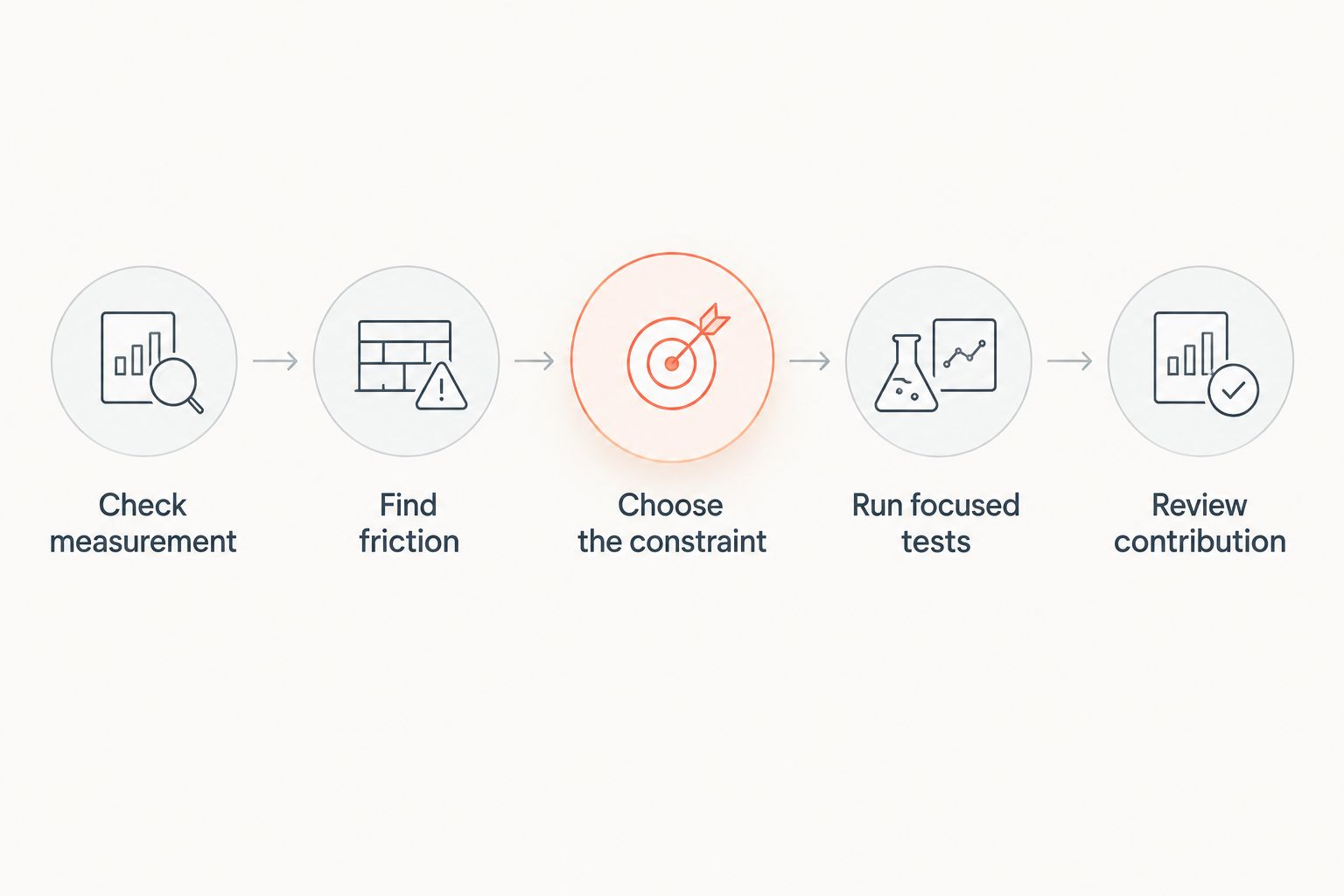
Use a sequence that connects evidence to action. Starting every available channel at once makes ownership and diagnosis harder.
- Check measurement. Confirm that purchases, revenue, and customer records reconcile sufficiently for the decisions you need to make.
- Find friction. Review the path from campaign promise to product page, checkout, and post-purchase experience.
- Choose the constraint. Select the problem that the evidence supports, such as weak purchase intent or confusing product information.
- Run focused tests. Connect each change to a stated hypothesis and a commercial measure.
- Review contribution. Evaluate the result alongside marketing expenditure, order economics, and operational effects.
The sequence is a decision framework, not a guaranteed timetable. Some stores need measurement repair first; others have reliable reporting but an unclear offer.
Require a written reason for the first priority. If the proposal begins with a channel because that is what the agency sells, rather than because your evidence supports it, ask for a revised plan.
What does relevant agency evidence look like?
Look for a case study that explains the starting problem, the work performed, and the outcome. Match the situation to your store instead of selecting the largest percentage in a presentation.
Hey Prospekt's SwamiG project describes wholesale ecommerce work on a Magento 2 website, including ERP synchronization, SEO, and advertising. The stated outcomes are 310% higher organic traffic and 4× return on ad spend. Those measures describe traffic growth and advertising return; neither establishes net profit.
The Russell Westbrook Enterprises project describes a mobile-first Webflow build with division-specific architecture, reporting 380% higher mobile engagement and 2.3× B2B inquiries. That is website and inquiry evidence, not a forecast for retail orders.
Use these distinctions when assessing any 2026 proposal. Relevant evidence demonstrates experience with a problem; it does not establish the result your store will receive.
Ask what else changed during the engagement. Product mix, offers, website changes, and customer demand all belong in the discussion before you attribute an outcome to one marketing activity.
Where Hey Prospekt fits
Hey Prospekt is best for B2B and B2C companies seeking brand, web, and growth marketing services together. Its stated full-service scope fits a brief that needs coordinated work rather than an isolated channel task.
The advantage is service breadth. The trade-off is fit: a store needing only a narrow technical repair should assess whether a focused specialist engagement better matches the problem.
Evaluate Hey Prospekt as an ecommerce marketing agency against the same requirements you would apply to any partner: relevant evidence, clear ownership, defined deliverables, and business-level reporting. The fit rests on the proposed work, not the label “full service.”
Define your store’s growth brief
Discuss your commercial goals, current constraints, and the work your team needs help delivering.
Can a small store hire before it has steady sales?
A small store can hire for research, positioning, measurement, or launch preparation before sales become steady. That is a different assignment from scaling a repeatable acquisition channel.
Define the engagement as validation when validation is the job. Ask for learning objectives and concrete deliverables rather than a confident sales forecast unsupported by purchase history.
Is a freelancer better than an ecommerce agency?
A freelancer is the better fit when the task is narrow and you can coordinate the surrounding work. An ecommerce agency fits a problem that requires several disciplines to move together.
Neither structure removes your management responsibility. Choose based on the work and its dependencies, not on team size alone.
How will I know whether the agency is working?
The agency is working when agreed deliverables are completed and the commercial evidence supports continuing the plan. Evaluate that evidence against your starting baseline and the full marketing commitment.
Keep platform reports in context. An advertising platform's attributed revenue is not a complete account of your store's profitability.
FAQ
Is an ecommerce marketing agency worth it for a very small store?
An ecommerce marketing agency is worth it when a defined execution problem and your store’s economics justify the commitment. If you are still learning why customers buy, founder-led discovery or a focused project is the better starting point.
What should I prepare before talking to an ecommerce agency?
Prepare your order history, contribution margins, marketing expenditure, customer feedback, and current reporting. Explain the business problem you want solved and identify who will approve work internally.
Should I hire an agency or fix my website first?
Fix purchase-blocking website problems before paying to send more visitors through them. An agency can own that work if website improvements are explicitly included in the scope.
Is return on ad spend enough to judge an agency?
Return on ad spend is not enough to judge an agency because attributed revenue does not establish profit. Review it alongside product costs, fulfillment, returns, agency fees, and other marketing expenditure.
Can an ecommerce agency guarantee profitable growth?
An ecommerce agency cannot establish a credible profit guarantee from campaign management alone. Product economics, customer demand, fulfillment, and other business conditions also affect the result.
Does Hey Prospekt work only with ecommerce brands?
Hey Prospekt serves B2B and B2C companies with brand strategy, digital marketing, and creative services. Evaluate its ecommerce marketing agency fit against the specific work your store needs.
What should happen if the agency misses its targets?
Review the missed target against the agreed baseline, completed work, and underlying assumptions. Decide whether to change the approach, narrow the scope, or end the engagement using the decision rules established before launch.
One last thing
Before signing your 2026 agreement, ask: “What would make you advise us not to increase marketing expenditure?” Require an answer tied to your margins, measurement, or operating constraints.
That question tests whether the proposal includes restraint as well as expansion. A useful growth plan explains what to do next—and what evidence would make that next move wrong.
Related guides
- How long does it take to see growth marketing results?
- Is a full-service marketing agency worth it for a growing business?
- Shopify to abandoned-cart recovery workflow


