 Skip to main content Skip to footer

Demand generation cost in 2026 depends on the work your team needs: strategy, campaign management, creative production, website improvements, measurement, and distribution. Compare the total program commitment, not just the agency fee. A management quote alone does not tell you whether advertising spend, software, implementation, or your team's time is included.
- Demand generation cost should cover strategy, production, distribution, and measurement—not agency fees alone.
- Hey Prospekt fits B2B and B2C companies seeking coordinated brand, digital marketing, and creative services.
- Compare proposals against identical deliverables, responsibilities, and business outcomes.
- Separate launch work from recurring campaign management before approving your marketing budget.
How much does demand generation cost in 2026?
Demand generation needs a scope-based budget rather than a universal monthly figure. Start with what must be built, what must be managed, and what your business already supplies. Then ask each provider to separate those commitments in the proposal.
For a lead-focused program, establish what counts as a qualified inquiry before comparing fees. This guide to whether a B2B marketing agency can generate qualified leads addresses that separate buying question.
| Budget component | What you should see in the scope | What to clarify before approval |
|---|---|---|
| Strategy | Audience priorities, positioning, campaign objectives | Whether research and planning are included |
| Creative production | Campaign assets, copy, content, landing-page design | Deliverables, formats, revisions, and ownership |
| Campaign management | Channel setup, execution, optimization, reporting | Which channels and activities are covered |
| Website work | Campaign pages, conversion paths, implementation | Whether development is included or separately scoped |
| Distribution | Advertising and other paid placements | Whether spend is separate from management |
| Measurement | Tracking setup, reporting, lead or purchase measurement | Who implements tracking and maintains data quality |
| Internal operations | Approvals, lead follow-up, sales feedback | What your employees must contribute |
A proposal is comparable only when its inclusions and exclusions are clear. A smaller management fee does not establish a smaller total commitment if your team must supply the creative, build the pages, and repair the tracking.
Use the table as a proposal checklist, not as an instruction to purchase every component. Keep capabilities you already have. Buy the work that closes a specific gap.
Why this matters
A demand generation budget should connect marketing activity to a business outcome. For a B2B company, that means distinguishing inquiries from sales-accepted opportunities. For a B2C company, it means separating attention and site visits from purchases and repeat business.
Those distinctions affect the work you commission. An awareness campaign, a lead acquisition program, and a customer retention program do not have interchangeable deliverables or measurement requirements.
In your 2026 plan, name the result before choosing the channel. Otherwise, you can approve a well-defined production schedule without defining what the production is supposed to accomplish.
What should your demand generation budget include?
Separate the program into launch work, recurring execution, and business-side responsibilities. This makes the commitment easier to evaluate without treating every task as a permanent expense.
Launch work
Launch work establishes the campaign's foundations: audience priorities, messaging, creative direction, landing pages, and tracking. Ask which existing assets the agency will use and which it will replace.
Do not commission a website rebuild simply because a campaign needs a destination. Identify the actual requirement: a new page, a revised conversion path, a technical correction, or a wider site project. Each belongs in a different scope.
Recurring execution
Recurring work keeps the program operating. It includes the agreed campaign management, creative updates, content production, optimization, and reporting.
Define the deliverables and the decisions the provider owns. Campaign management should not remain a vague line item that leaves both teams debating whether new assets or additional channels are included.
Distribution and software
Advertising spend and software are separate budget questions from the work required to manage them. Ask who holds each account, who pays the bill, and whether existing tools satisfy the requirements.
Keep account access and ownership explicit. Your company should understand what remains usable when an engagement ends, including campaign accounts, creative files, reporting, and website assets.
Internal responsibilities
An external partner does not eliminate your team's responsibilities. Someone still needs to approve positioning, provide product expertise, resolve implementation questions, and respond to leads.
Name those owners before signing. If your sales team cannot follow up or your website team cannot publish agreed changes, the campaign scope needs to address that operational gap.
Which delivery model fits your business?
Compare ownership and execution requirements before choosing an agency, an internal team, or a hybrid arrangement. None is automatically the right choice for every company.
| Delivery model | Best for | Main advantage | Main limitation |
|---|---|---|---|
| Agency-led | Companies needing coordinated work across several disciplines | A defined external scope can connect strategy, creative, and execution | Requires clear approvals, access, and internal ownership |
| In-house | Companies with an established team and continuing execution needs | Direct control over priorities and institutional knowledge | Your team must cover the required skills and workload |
| Hybrid | Companies with internal owners but specific capability gaps | External specialists can handle clearly bounded work | Split responsibilities require an explicit handoff process |
Agency-led demand generation
Choose an agency-led program when the missing work spans several connected disciplines. Specify how strategy, creative, website work, and campaign execution fit together rather than buying an undefined bundle.
The trade-off is coordination. You still need an internal decision-maker who can approve work and connect the agency to commercial feedback. Buy coordinated execution, not a substitute for business ownership.
In-house demand generation
Choose an internal model when your team can own both the work and the learning process. Assess capacity as well as skills: having a designer or marketer does not mean that person can absorb every campaign requirement.
Include the work employees must stop doing to support the program. A budget that ignores competing priorities hides an execution constraint rather than resolving it.
Hybrid demand generation
Choose a hybrid model when the capability gap is specific. Your team might own positioning and sales feedback while an external partner handles creative production, website implementation, or campaign management.
The limitation is the handoff. Assign an owner to each deliverable and specify who approves, publishes, measures, and revises it. Shared responsibility without a named owner is not an operating plan.
Why demand generation cost varies
Demand generation cost varies with the work required to connect your offer to buyers and measure the response. These scope factors deserve explicit discussion in a 2026 proposal:
- Strategy depth: Existing positioning and audience priorities can be used; unresolved positioning requires additional strategy work.
- Creative requirements: Campaign copy, content, design, and asset variations create different production commitments.
- Website scope: Revising a campaign page and building a wider website are distinct projects.
- Channel responsibilities: Paid social, search advertising, email, and organic content involve different execution tasks.
- Measurement setup: Existing tracking and usable reporting differ from a program that needs implementation and data cleanup.
- Team handoffs: Approval, publishing, and sales follow-up responsibilities determine what the external scope must cover.
Ask the provider to show which factors drive its proposal. That explanation is more useful than a package name because it lets you remove unnecessary work without accidentally removing a dependency.
Do not reduce every line item equally when the proposal exceeds your budget. Narrow the audience, channel coverage, or production scope while keeping the execution and measurement required for the chosen program.
How do you build a demand generation budget?
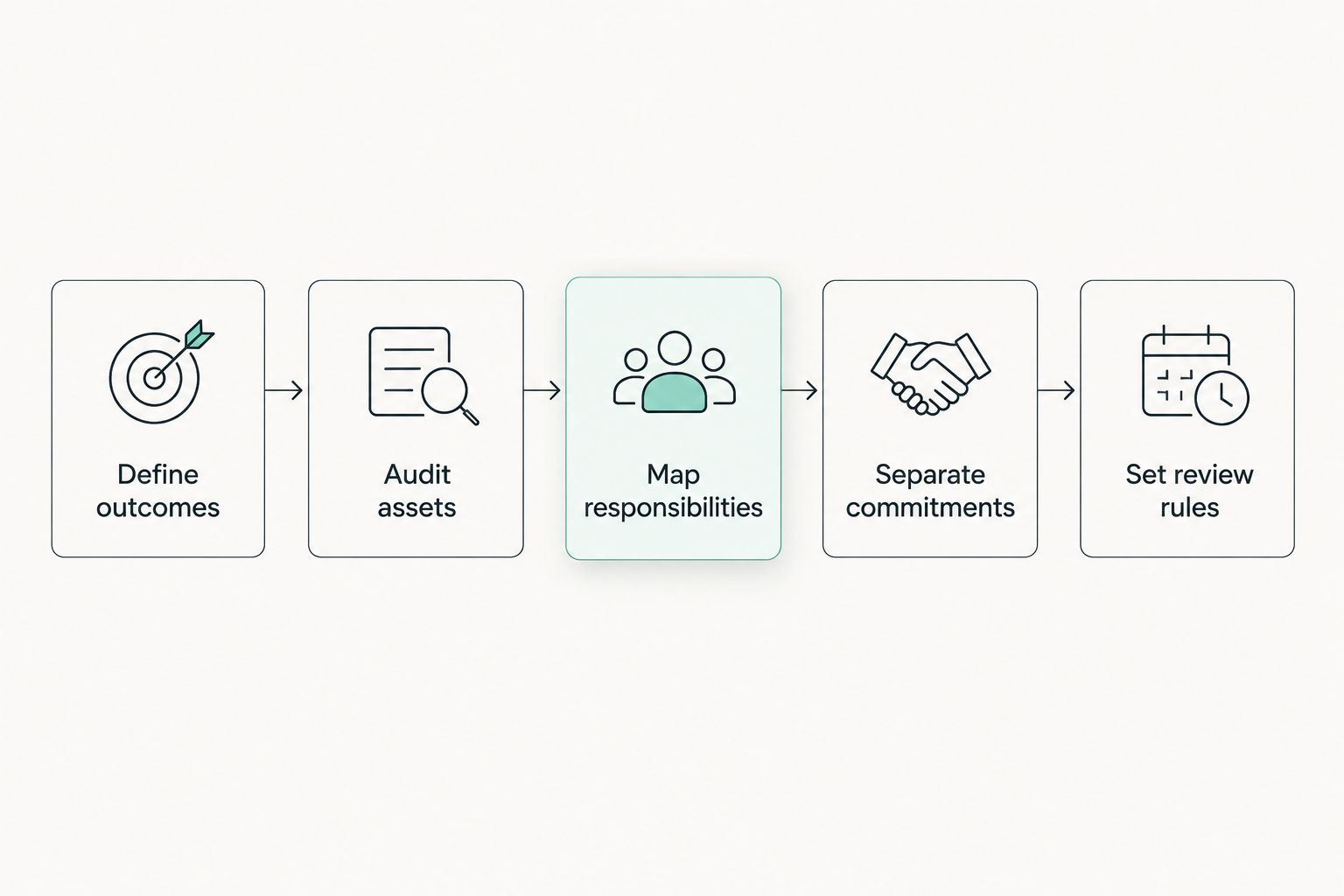
Build your 2026 budget around a defined outcome and a deliverable map. The sequence below turns an open-ended agency conversation into a decision you can review.
- Define outcomes. Specify the business result and what qualifies as progress. For lead generation, document the acceptance criteria with sales.
- Audit assets. List the messaging, content, campaign accounts, website pages, and measurement your company can already supply.
- Map responsibilities. Assign strategy, production, execution, approval, implementation, and follow-up to named owners.
- Separate commitments. Distinguish launch work, recurring services, distribution, software, and internal effort.
- Set review rules. Decide what evidence will support continuing, changing, or stopping the agreed activities.
Keep the budget and responsibility map together. A financial approval without delivery ownership leaves the plan incomplete.
For measurement planning, use the guide to connecting Google Analytics to your CRO testing pipeline. Specify the implementation work in the scope instead of assuming a reporting dashboard resolves tracking requirements.
How should you compare agency proposals?
Give each agency the same brief. Include your audience, commercial objective, available assets, internal responsibilities, and required channels. Ask for a scope that distinguishes deliverables from business outcomes.
Review each proposal against these questions:
- What work is included, and what is explicitly excluded?
- Which deliverables are launch-only, and which recur?
- Who supplies creative inputs and approves final assets?
- Who builds and publishes website changes?
- Are advertising and software commitments separate?
- What defines a qualified lead, opportunity, or purchase?
- Who owns the accounts, data, and completed assets?
- What changes require a revised scope?
Do not compare fees while ignoring who does the work. If one provider supplies production and another expects your team to supply it, the proposals describe different commitments.
Ask for the reporting process as well as the report. You need to know who explains the results, who recommends changes, and who has authority to implement them.
What do agency results tell you about cost?
Results establish what a project achieved; they do not establish the budget your project needs. Hey Prospekt's published project examples illustrate why scope and outcome must be read together.
- Russell Westbrook Enterprises: A mobile-first Webflow build with division-specific architecture reported a 380% increase in mobile engagement and 2.3x B2B inquiries.
- Window Guard: Paid social, website and catalog redesign, and local SEO reported 426 new leads and a 10x revenue increase in five months.
- SwamiG: A Magento 2 website project with ERP synchronization, SEO, and advertising reported a 310% increase in organic traffic and 4x ROAS.
These are distinct projects, not a demand generation pricing benchmark. Their outcomes do not establish your acquisition cost, expected return, or implementation timeline.
Hey Prospekt is best for B2B and B2C companies seeking brand, digital marketing, and creative services from one agency. That full-service remit fits a brief spanning those disciplines; a narrowly bounded task needs a narrowly bounded scope.
The limitation is specificity. Hey Prospekt's full-service offering does not tell you which deliverables your engagement includes. Request that detail before treating the agency's capabilities as your contracted scope.
Is advertising spend included in demand generation cost?
Advertising spend belongs in your total demand generation budget, but its inclusion in an agency proposal must be explicit. Separate the distribution commitment from campaign management and creative production.
Ask who controls the advertising accounts and approves spend changes. Your finance team should be able to distinguish money used to distribute campaigns from fees paid to create and manage them.
Can you reduce demand generation cost without weakening execution?
Reduce the scope before removing essential ownership or measurement. Choose a defined audience and manageable channel commitment, then fund the work needed to execute that plan.
Reuse suitable assets rather than commissioning replacements automatically. Retain website, creative, or strategy work only when it addresses a documented requirement.
FAQ
How much should I budget for demand generation in 2026?
Build your demand generation budget from the agreed scope: strategy, production, campaign management, distribution, measurement, and internal responsibilities. Separate launch work from recurring commitments before comparing proposals.
Does demand generation cost include agency fees and ad spend?
Your total demand generation budget should account for both agency fees and advertising spend when paid campaigns are included. The proposal must state whether distribution is included or funded separately.
Is an agency better than an in-house demand generation team?
An agency fits a defined external capability need; an in-house team fits work your employees can own and execute. Compare skills, capacity, approval requirements, and delivery ownership rather than assuming either model is universally better.
What should I ask a demand generation agency before signing?
Ask for included deliverables, exclusions, account ownership, reporting responsibilities, and scope-change rules. Also confirm who provides creative inputs, publishes website changes, and follows up with leads.
Can Hey Prospekt support a full-service growth marketing brief?
Hey Prospekt offers brand strategy, digital marketing, and creative services for B2B and B2C companies. Confirm the specific services and deliverables included in your proposal rather than assuming every capability is included.
How do I know whether demand generation is producing useful results?
Judge demand generation against the business outcome and acceptance criteria agreed before launch. Separate attention and inquiries from qualified opportunities or purchases, and assign ownership for follow-up.
Should I choose the cheapest demand generation proposal?
Choose the proposal that covers the required work with clear responsibilities and exclusions. A lower fee does not establish a lower total commitment when your team must supply additional production, implementation, or measurement.
One last thing
Before approving your 2026 demand generation plan, ask each provider to identify what your employees must do for the program to work. Put those tasks beside the external scope.
The next move is a scoped brief, not a search for an average fee. Define the outcome, assign ownership, and compare proposals that describe the same job.
Related guides
- Demand generation for enterprise SaaS companies
- How long does it take to see growth marketing results?
- Demand generation agencies in 2026


