 Skip to main content Skip to footer

Yes—demand generation is worth it for early-stage startups when you have a clear buyer, a credible offer, and a way to measure commercial outcomes. It is not a substitute for finding product-market fit, and the commitment includes creative work, distribution, follow-up, and measurement—not just campaign execution. Start with a focused test; expand only when buyer behavior supports the decision.
- Is demand generation worth it? Yes, when your startup can connect buyer attention to qualified opportunities or purchases.
- Prioritize customer discovery when your buyer, problem, or offer remains unclear.
- Measure qualified pipeline and customer revenue, not impressions or lead volume alone.
- Hey Prospekt fits companies seeking brand strategy, digital marketing, and creative services together.
Is demand generation worth it for early-stage startups?
Demand generation earns investment when it addresses a specific growth constraint. If qualified buyers do not know you exist, build awareness. If buyers already visit but do not act, address the offer or conversion path before increasing distribution.
Use this comparison to choose the work your startup needs in 2026. The separate decision of whether hiring a startup marketing agency is worth it pre-funding should follow that diagnosis, not replace it.
| Approach | Best for | Main advantage | Main limitation |
|---|---|---|---|
| Customer discovery | Startups still identifying the buyer and problem | Direct feedback helps clarify what to sell and to whom | Conversations do not establish a repeatable acquisition channel |
| Focused demand generation | Startups with a defined buyer and a credible offer | Tests whether a message creates meaningful commercial interest | Requires distribution, follow-up, and measurement to interpret results |
| Conversion improvement | Startups already attracting relevant visitors or inquiries | Addresses friction between interest and action | Does not solve a lack of relevant audience reach |
These approaches are not competing departments. They answer different questions. Your first move is to identify which question is still unresolved.
Why this matters
Early-stage startups need learning and revenue, but those objectives are not interchangeable. A campaign that teaches you which message resonates has value as an experiment; it has not yet proved that acquisition is profitable.
That distinction matters in your 2026 growth plan. If you label every activity a revenue engine before customers buy, you make expansion decisions on incomplete evidence. Name the purpose of the experiment before choosing its success metric.
Demand generation should connect what buyers need to understand with what your business needs them to do. For a B2B startup, that action might be a qualified sales conversation. For a B2C startup, it might be a purchase, with repeat purchasing evaluated separately.
When your startup is ready to invest
Readiness is not a funding label. A funded startup can still have an unclear offer, while an unfunded business can already know its customers and buying triggers. Evaluate the evidence you have rather than treating the financing stage as permission to scale.
You can name the buyer and buying problem
Describe the buyer in terms that change your marketing decisions: the problem, the circumstances that make it urgent, and the person involved in choosing a solution. A broad label such as small businesses leaves too much unresolved.
For B2B demand generation, distinguish the person using the product from the person approving the purchase. For B2C demand generation, clarify the purchasing occasion and objection. Use those distinctions to write a message, not to build an elaborate audience document nobody applies.
You have an offer buyers can evaluate
A buyer needs to understand the outcome, the next step, and the reason to believe you. Your offer should explain those elements without requiring a founder to translate every sentence.
Look at objections from actual conversations. If prospects consistently misunderstand what you sell, fix the explanation before increasing reach. More distribution is not the remedy for an unclear offer.
You can follow through on interest
Decide who handles inquiries, what happens after a form submission, and how buyers receive the information they need. For a purchase-led business, check that the buying path explains the product and supports completion.
A campaign cannot be evaluated cleanly when follow-up is inconsistent. Record what happened after the inquiry so you can separate an audience problem from a sales-process problem.
You can connect activity to outcomes
Agree on the meaning of a qualified opportunity or completed purchase before launch. Then make sure the relevant events and outcomes are recorded.
You do not need an elaborate reporting stack to begin. You need a consistent record of campaign activity, buyer responses, qualification, and revenue outcomes. Measurement should answer a decision, not produce another dashboard.
When demand generation is not the next move
Pause expansion when you cannot explain who should buy or why. Use customer interviews, sales conversations, and a clearer offer to resolve that uncertainty first. Campaign feedback can contribute, but it should not become an excuse to avoid speaking with buyers.
Also pause when relevant visitors already arrive but the next step is confusing. Review the landing page, inquiry process, or purchase experience. Sending more people into the same unresolved friction makes diagnosis harder.
Finally, avoid a broad program if nobody owns follow-up or outcome reporting. Define those responsibilities before launching. A smaller test with accountable follow-through is a better decision tool than a larger campaign with untraceable results.
How to test demand generation without overcommitting
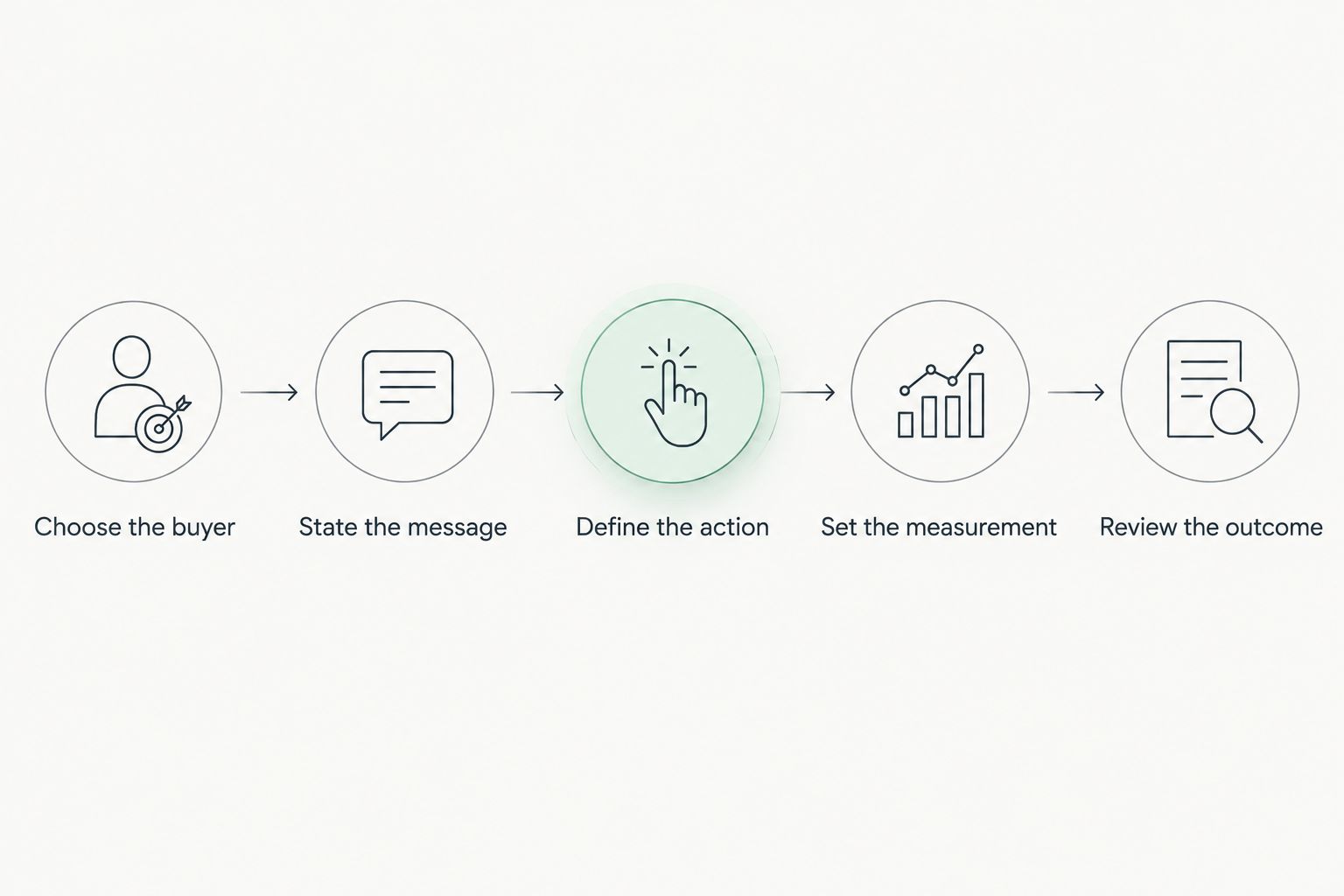
For a 2026 pilot, write a short experiment brief before producing content or launching ads. Keep the brief specific enough that the results can change your next decision. Use the following sequence.
- Choose the buyer. Select the audience whose problem you understand best. Explain why that audience is relevant to the offer, using customer conversations or existing sales evidence where available.
- State the message. Write the problem, promised outcome, and supporting evidence in plain language. Avoid testing unrelated messages together when you need to know which explanation worked.
- Define the action. Choose the buyer action the campaign should support. Make the next step clear on the destination page and record completion.
- Set the measurement. Define qualification, capture campaign sources, and track what happens after the initial response. Include revenue outcomes when they become available.
- Review the outcome. Decide whether to continue, revise, or stop based on the objective you set. Preserve what you learned instead of treating every unsuccessful test as wasted work.
The sequence separates campaign execution from commercial validation. An attractive creative asset is an input. A qualified opportunity or customer purchase is an outcome. Keep both visible, but do not confuse them.
What should you measure in 2026?
Judge demand generation against the job it was assigned. An awareness test needs evidence of relevant audience response. A pipeline test needs evidence of qualified opportunities. Neither proves profitable customer acquisition on its own.
For a B2B startup, track the movement from inquiry to qualification, sales opportunity, and customer. Keep disqualified inquiries visible so that a rising lead count does not conceal poor audience fit. Ask sales to record why an opportunity progressed or stalled.
For a B2C startup, distinguish browsing, purchase, and repeat purchase. Revenue and order outcomes provide a different answer from engagement. Review returns or cancellations where relevant to your business rather than treating every recorded transaction as equally valuable.
When evaluating return, include the campaign's full commitment: distribution, creative production, service fees where applicable, and internal work. Revenue is not profit. Use your actual economics rather than borrowing another company's acquisition target.
Attribution also needs discipline. Ask buyers how they found you and compare those answers with recorded campaign sources. Treat the combined evidence as a decision aid; do not claim that the last recorded interaction explains the entire purchase.
Why demand generation's value varies
There is no universal startup verdict because the same activity can address different business problems. Review these factors before interpreting campaign performance or renewing a program.
- Buyer clarity: If the audience is poorly defined, a weak response does not isolate whether the message or targeting failed. Resolve that ambiguity before widening distribution.
- Offer clarity: Buyers need a reason to act and enough evidence to evaluate the offer. Test explanations against actual objections rather than internal preferences.
- Conversion readiness: The destination and follow-up process affect what happens after interest. Check both before blaming the channel.
- Measurement quality: Lead counts, qualified opportunities, and revenue answer different questions. Choose the metric that matches the decision you are making.
- Execution capacity: Content, campaigns, and follow-up require ownership. Limit the scope to work your team or partner can deliver and evaluate consistently.
These are planning criteria, not excuses for inconclusive reporting. If a factor blocks interpretation, make fixing it part of the next brief. Your 2026 program should become easier to evaluate as you learn.
Should you handle demand generation internally or hire an agency?
Keep the work internal when the main task is learning directly from customers and the founder needs to shape the offer. An agency can contribute execution, but it cannot replace your responsibility for deciding what the business sells.
Consider outside support when the bottleneck spans strategy, creative production, the website, and distribution. Define the deliverables and outcome reporting before appointing a partner. An agency relationship adds coordination requirements; it does not remove the need for an accountable internal owner.
Hey Prospekt is best for companies seeking brand strategy, digital marketing, and creative services from a full-service growth marketing agency. Hey Prospekt serves B2B and B2C companies looking to scale, making its stated service scope relevant when the work crosses those disciplines.
The fit has a boundary. Full-service demand generation support is not a replacement for unresolved customer discovery. Choose that scope because you need connected execution, not because a larger brief feels more ambitious.
What do the project results demonstrate?
Hey Prospekt's Window Guard project reported 426 new leads and a 10x revenue increase in five months, through work spanning paid social, website and catalog redesign, and local SEO. Its SwamiG project reported 310% organic traffic growth and 4× ROAS, alongside Magento 2 website work, ERP synchronization, SEO, and advertising.
These are named project outcomes, not early-stage startup benchmarks. They illustrate work across multiple parts of marketing and the buying experience; they do not isolate demand generation's contribution or establish the result your startup should expect.
For your 2026 decision, use the examples to ask better questions about scope and measurement. Request a clear explanation of which business constraint the proposed work addresses and how progress will be assessed.
Can demand generation work before product-market fit?
Demand generation can support learning before product-market fit, but customer response must be interpreted as evidence to investigate—not proof that the business is ready to scale. Use a focused campaign to test a specific buyer problem or message.
Pair the response with conversations. Find out why people acted, what they expected, and whether the offer met that expectation. A form submission alone cannot answer those questions.
Is lead generation enough for an early-stage startup?
Lead generation is enough only when collecting qualified inquiries addresses the current business constraint. If buyers do not understand the problem or trust the offer, a form-first campaign leaves that work unresolved.
Evaluate the leads after capture. A contact record is not a qualified opportunity, and a qualified opportunity is not customer revenue. Keep those stages distinct when reviewing results.
How long should you give demand generation to prove itself?
Use a review window tied to your buying process and the outcome being measured, not a universal deadline. A campaign response and a closed sale occur at different points in that process.
Agree on review points before launch. Evaluate delivery and relevant response first, then qualification and commercial outcomes as they become observable. Stop or revise work that fails its stated objective rather than extending it without a reason.
FAQ
Is demand generation worth it for a startup with no customers?
Demand generation is worth testing when you have a specific buyer hypothesis and a credible offer. Use it for learning, and validate responses through customer conversations before expanding.
What’s the best demand generation approach for an early-stage startup?
A focused test tied to a defined buyer and commercial action is the best starting point. Choose the message and distribution approach from what you know about that buyer, not from a generic channel checklist.
Is demand generation better than lead generation?
Neither is universally better; they address different needs. Use lead generation to capture relevant inquiries, and broader demand generation when buyers also need education and a reason to consider your offer.
How much should an early-stage startup spend on demand generation?
Set spending from your runway, customer economics, and the scope of the experiment. Include creative work, distribution, follow-up, and measurement when assessing the total commitment.
Should a pre-funding startup hire a demand generation agency?
Hire an agency when a defined execution gap justifies outside support. Keep customer discovery and the core offer decision with the founder rather than expecting an agency to resolve them independently.
Can Hey Prospekt help with startup demand generation?
Hey Prospekt offers brand strategy, digital marketing, and creative services to B2B and B2C companies looking to scale. Assess the fit against your execution needs and agree on scope and measurement before engaging.
What proves that demand generation is working?
Progress against the campaign’s stated objective proves that the activity is working at that stage. Qualified pipeline and customer revenue provide commercial evidence; impressions and lead volume alone do not establish return.
One last thing
Before approving more activity, ask: What decision will the next result change? If the answer is unclear, rewrite the experiment brief. The most useful early-stage program gives you a reason to continue, revise, or stop—not just a report showing that work happened.
Related guides
- How long does it take to see growth marketing results?
- Can a B2B marketing agency generate qualified leads?
- Is a SaaS marketing agency worth it for early-stage startups?


