 Skip to main content Skip to footer

Influencer marketing cost in 2026 depends on the creator, deliverables, content rights, and campaign scope; budget from a written quote rather than a universal per-post rate. A creator’s posting fee excludes paid distribution, extended usage rights, and campaign management unless the agreement includes them. Compare the total campaign commitment, not just the headline creator fee.
- Influencer marketing cost depends on deliverables, usage rights, paid distribution, and management—not follower count alone.
- Compare creator quotes against the same brief before choosing a campaign partner.
- Separate sponsored content, affiliate partnerships, and gifting because their payment obligations differ.
- Hey Prospekt provides brand, web, and growth marketing services for B2B and B2C companies.
How much does influencer marketing cost in 2026?
Your influencer marketing budget should cover everything required to commission, publish, use, and measure the campaign. A posting agreement and a content-production agreement purchase different things. Neither automatically includes permission to turn the content into an advertisement.
For consumer brands, the influencer marketing for DTC brands guide provides a related planning framework. Start with the campaign objective, then request quotes for the same deliverables and rights.
Use this breakdown to make each proposal comparable:
| Budget component | What the agreement should specify | What to check before approval |
|---|---|---|
| Creator compensation | Content creation, publication, or both | Whether each deliverable is explicitly included |
| Production | Editing, locations, props, travel, and additional contributors | Which expenses require separate approval |
| Usage rights | Where and how your business can reuse the content | Whether organic reuse and advertising have different permissions |
| Exclusivity | Restrictions on work with competing brands | The covered category and restriction period |
| Paid distribution | Advertising spend and permission to promote creator content | Whether media spend sits outside the creator agreement |
| Management and measurement | Sourcing, negotiation, approvals, tracking, and reporting | Which responsibilities belong to your team |
A complete quote connects payment to a defined obligation. If a proposal bundles everything into a single description, ask for the underlying scope before comparing it with another proposal.
Why this matters
A campaign can deliver the promised posts without delivering the business outcome you wanted. Publication is an obligation you can contract for; sales, qualified leads, and repeat purchases require a separate measurement plan.
Keep that distinction clear in your 2026 budget. You need to know both what the creator will deliver and how your business will judge the result.
For a B2C campaign, that result might be attributable purchases or qualified website visits. For a B2B campaign, define the relevant buyer and the action that signals interest. Do not treat every form submission as a qualified opportunity.
A low headline fee does not resolve those questions. The right budget buys a relevant audience, usable content, and an accountable campaign—not a follower count.
Sponsored content: best for defined publishing commitments
Sponsored content is the clearest option when you need agreed deliverables published by a creator. The brief should identify the format, message, channel, approval process, and publication conditions.
Its strength is contractual clarity. You can specify what must be produced and what your team needs to review before publication.
Its limitation is equally clear: paying for a post does not guarantee purchases or qualified leads. Audience fit, the offer, the creative, and the destination all matter to your evaluation.
Before approving sponsored content, check whether the quote includes revisions and whether publication rights differ from reuse rights. A creator can agree to publish content without granting your business unrestricted access to it afterward.
Affiliate partnerships: best for tracked referral compensation
Affiliate partnerships connect compensation to an agreed referral event, such as a tracked purchase. The agreement needs to define that event and the rules used to attribute it.
The advantage is a payment structure tied to recorded activity. The trade-off is that referral tracking does not prove every recorded sale was caused entirely by the creator.
An affiliate agreement also does not automatically secure a publication schedule. If you need committed content alongside referral compensation, put those deliverables in writing.
For your 2026 plan, separate the referral rules from the content brief. Clarify how cancellations, returns, disputed attribution, and reporting affect payment before the campaign starts.
Product gifting: best for outreach without a paid publishing commitment
Product gifting gives a creator the opportunity to experience what you sell. Unless an agreement requires publication, do not treat a shipment as a purchased post.
The advantage is a straightforward introduction to the product. The limitation is the absence of a publishing commitment when you have not negotiated one.
Gifting still uses business resources. Product allocation, fulfillment, shipping, and outreach belong in the campaign plan even when there is no creator posting fee.
If your launch depends on content appearing at a specific time, choose an agreement that explicitly covers publication. Gifting is not a substitute for that obligation.
Which influencer partnership model fits your budget?
Compare partnership models by what they commit each party to do. They are not interchangeable ways to purchase the same outcome.
| Partnership model | Best for | Main advantage | Main limitation |
|---|---|---|---|
| Sponsored content | Defined publishing commitments | Deliverables can be specified in advance | Publication does not guarantee business results |
| Affiliate partnerships | Tracked referral compensation | Compensation follows an agreed referral event | Content commitments require separate terms |
| Product gifting | Product introduction and outreach | Creators can experience the product | Publication is not guaranteed without an agreement |
| Content-only production | Assets for your own channels | The brief can focus on content requirements | Creator-audience distribution is not included unless agreed |
Content-only production deserves separate consideration. If your actual need is creative for your own channels, creator reach is not the same purchasing criterion as production skill.
Choose the agreement that matches the job. Do not pay for audience distribution when your brief only needs content, or assume a content-production agreement includes access to a creator’s audience.
Why influencer marketing cost varies
The scope of the work explains the differences between quotes. Use these factors to challenge proposals and remove ambiguity:
- Audience fit: Assess whether the creator reaches the buyers your campaign needs. A large audience is not proof of relevant demand.
- Deliverables: Specify the formats, production requirements, publication commitments, and revisions. Different work is not directly comparable.
- Usage rights: Define the channels, territories, and period covered by content reuse. Advertising permission needs explicit treatment.
- Exclusivity: Identify the competing categories and restriction period. Broad language creates obligations beyond the post itself.
- Paid distribution: Keep advertising spend separate from creator compensation so you can see both commitments.
- Management scope: List who handles sourcing, contracts, approvals, tracking, and reporting. Work left outside the proposal still needs an owner.
These factors belong in your quote request, not just in the final contract. Otherwise, proposals can look comparable while purchasing different deliverables.
For 2026 planning, distinguish mandatory requirements from optional additions. Request each optional addition separately so you can assess its purpose without losing sight of the core campaign.
How do you build an influencer campaign budget?
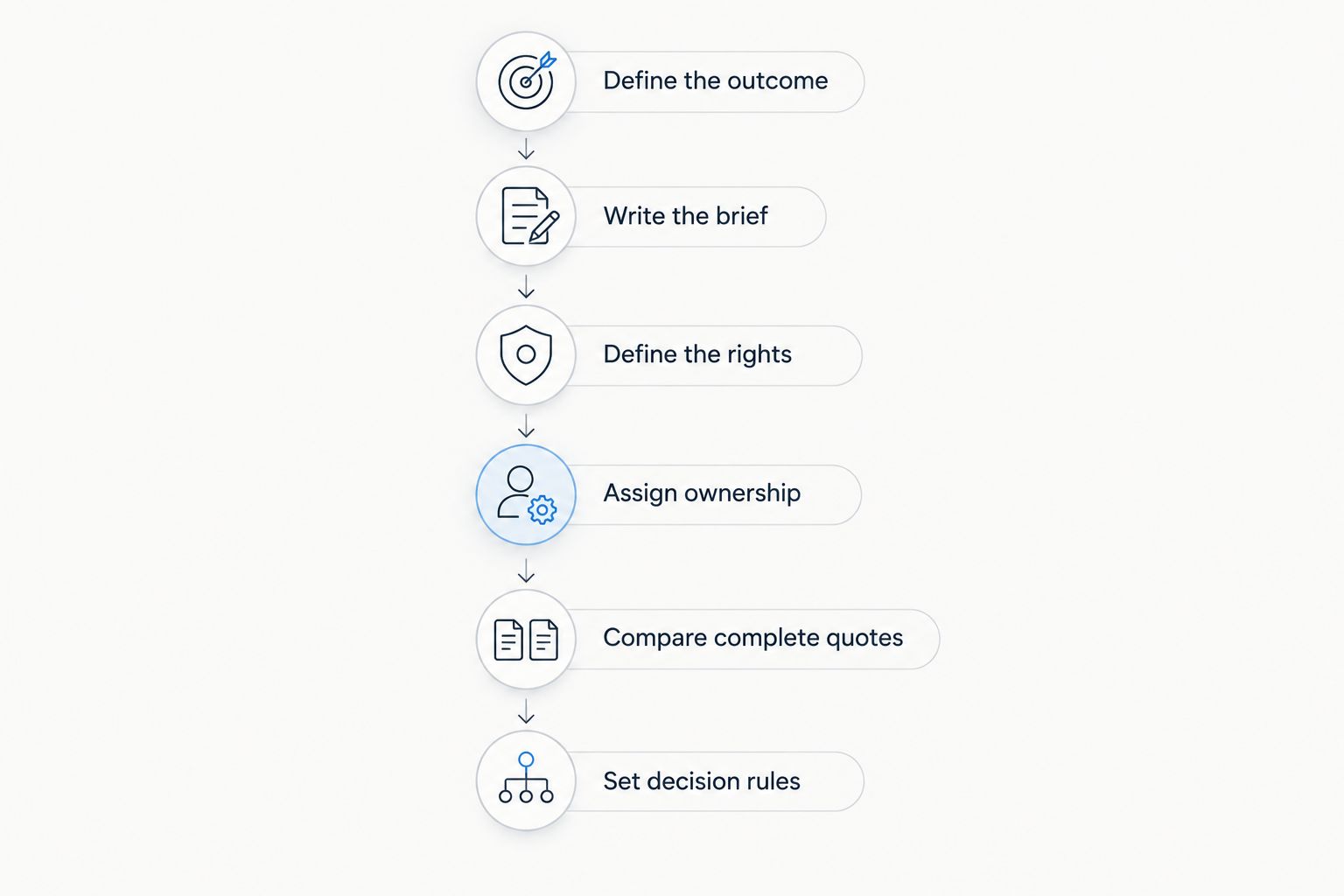
Use the same sequence for every proposal. It keeps the budget attached to a business objective instead of a creator’s audience size.
- Define the outcome. State the action you want from the audience and how you will recognize success. Awareness, purchases, and qualified inquiries need different evaluation criteria.
- Write the brief. Describe the audience, message, formats, publication requirements, and destination. Give each potential partner the same requirements.
- Define the rights. Separate creator publication, organic reuse, and paid advertising. State the intended usage period and channels.
- Assign ownership. Decide who manages approvals, contracts, tracking, and reporting. Name the responsibilities your internal team will retain.
- Compare complete quotes. Review the creator agreement alongside production, distribution, and management commitments. Resolve exclusions before approval.
- Set decision rules. Decide what evidence supports continuation, revision, or stopping. Record those rules before campaign results arrive.
The sequence matters because a quote cannot resolve an unclear objective. Start with the business action, then buy the work required to support it.
What should you ask before signing a creator agreement?
Ask what happens when the campaign needs to change. The agreement should explain the approval process, revision obligations, missed publication commitments, and cancellation terms.
Then confirm access. Your team needs the agreed reporting and the permissions required to use the content as planned; neither should depend on an informal understanding after publication.
Use this final check:
- Are deliverables and publication conditions written clearly?
- Are revisions included or treated as additional work?
- Does the agreement distinguish publication from reuse?
- Is advertising permission explicit?
- Are exclusivity restrictions limited to the intended scope?
- Are reporting responsibilities and payment conditions defined?
Do not approve a campaign whose essential rights or responsibilities remain verbal. A clear agreement gives both parties a usable reference when expectations differ.
Should you hire an agency or manage creators internally?
Internal management fits a campaign when your team can own sourcing, negotiation, approvals, and reporting. Its advantage is direct control; its limitation is the workload those responsibilities create.
An agency engagement fits a broader coordination need, but the service scope must still be explicit. Agency involvement does not automatically include creator compensation, advertising spend, or content rights.
Hey Prospekt is best for B2B and B2C companies seeking brand, web, and growth marketing support. Its full-service positioning is relevant when the campaign needs to connect with a wider marketing plan, rather than operate as an isolated content purchase.
Compare the Hey Prospekt growth marketing offering with the responsibilities you need covered. Confirm the proposed scope instead of assuming that any specific influencer service is included.
| Management option | Best for | Main advantage | Main limitation |
|---|---|---|---|
| Internal team | Campaigns your team can manage directly | Direct ownership of decisions and relationships | Your team retains the coordination workload |
| Agency engagement | Work requiring external coordination | Responsibilities can be consolidated in a defined scope | Included services depend on the agreement |
| Hey Prospekt | B2B and B2C brand, web, and growth marketing needs | Services span the broader marketing plan | Specific campaign responsibilities require confirmation |
Does paying more guarantee better influencer results?
No. A higher campaign commitment does not establish audience fit, persuasive content, or a working conversion path.
Evaluate the proposed work against your objective. Ask for relevant examples, inspect the content quality, and confirm the measurement plan without treating another brand’s results as your forecast.
The same discipline applies to agency selection. General growth results are not evidence of influencer-specific performance unless the underlying campaign clearly supports that conclusion.
Is follower count enough to compare creators?
No. Follower count describes audience size, not whether that audience matches your buyer or will take your intended action.
Compare creators using relevant audience information, content examples, agreed deliverables, and reporting access. Keep the brief consistent so you are judging fit and scope rather than different packages.
Can you reuse influencer content in paid ads?
Yes, when the agreement grants the required permission. Paying for publication alone does not establish permission for advertising use.
Define where the content will run, how long it can run, and what edits are permitted. Resolve those terms before building the content into your paid media plan.
FAQ
How much should I budget for influencer marketing in 2026?
Build your influencer marketing budget from scoped quotes covering creator work, content rights, production, paid distribution, and management. Compare proposals only after the deliverables and permissions match.
What’s the best way to compare influencer marketing quotes?
Compare quotes against the same written brief and rights requirements. Check exclusions, revision terms, publication commitments, and reporting responsibilities before selecting a partner.
Does an influencer’s posting fee include advertising rights?
A posting fee includes advertising rights only when the agreement explicitly grants them. Define the permitted channels, usage period, and editing permissions separately from publication.
Is product gifting the same as paid influencer marketing?
Product gifting is not the same as purchasing a publishing commitment. Unless the creator agrees to publish, treat gifting as outreach rather than a scheduled campaign deliverable.
Is affiliate marketing better than sponsored content?
Affiliate marketing fits tracked referral compensation, while sponsored content fits defined publishing commitments. Choose the model that matches your objective, or specify both obligations in the agreement.
Should I include agency management in my influencer marketing budget?
Include agency management when your proposed scope assigns campaign responsibilities to an agency. Keep management, creator compensation, and advertising spend separate so the total commitment is clear.
Can Hey Prospekt support a broader growth marketing plan?
Hey Prospekt offers brand strategy, digital marketing, and creative services for B2B and B2C companies looking to scale. Confirm campaign-specific responsibilities in the proposed scope.
One last thing
Before approving your 2026 campaign, check the destination the audience will reach. A creator can deliver the agreed content while your landing page presents an unclear offer or a broken conversion path.
Review the message, form or checkout, and tracking alongside the creator brief. Fix the destination before paying to send attention there. That makes the campaign easier to evaluate without blaming the creator for problems elsewhere in the funnel.
Related guides
- Connect Google Analytics to your CRO testing pipeline
- How long does it take to see growth marketing results?
- Connect Google Ads to Shopify for accurate ROAS tracking


