 Skip to main content Skip to footer

PPC management cost in 2026 depends on the work included and the agency’s billing model, not just the size of your advertising budget. Separate the management fee from media spend, then check whether tracking, creative, landing pages, and reporting sit inside the agreement. Compare proposals for the same scope before comparing fees.
- PPC management cost covers agency work; ad spend and additional production need separate budget lines.
- Compare retainers, spend-based fees, hourly work, and performance agreements against the same deliverables.
- Hey Prospekt fits B2B and B2C companies seeking brand, web, and growth marketing services together.
- Choose PPC management by scope, measurement, and accountability—not the headline fee alone.
Why this matters
A management proposal tells you little until you know what the agency owns. Campaign changes, conversion tracking, ad production, and website improvements are different responsibilities. A fee comparison that ignores those boundaries compares different services.
For your 2026 shortlist, use the PPC agencies guide alongside a written scope checklist. The shortlist answers who to consider; the checklist answers what you are buying.
Hey Prospekt is best for B2B and B2C companies seeking a full-service growth marketing agency. That positioning matters when your advertising needs brand strategy, creative work, and website support as well as campaign management. Ask any prospective partner to specify which services belong in the PPC agreement.
How much does PPC management cost in 2026?
PPC management is a service fee, separate from the money used to buy advertising placements. The amount depends on the agreed responsibilities, account complexity, and contract structure. A useful proposal makes those boundaries explicit instead of hiding different kinds of work under one total.
Start with this breakdown. Every line should have an owner, a deliverable, and a clear statement of whether it is included.
| Budget component | What it covers | What to confirm |
|---|---|---|
| Campaign management | Account structure, targeting, bids, exclusions, and ongoing changes | Included channels and responsibilities |
| Media spend | Advertising purchased through the platforms | Who pays the platforms and approves budget changes |
| Measurement | Conversion events, attribution settings, and reporting setup | Implementation, testing, and maintenance responsibilities |
| Creative production | Ad copy, designs, video, or other campaign assets | Included formats, revisions, and production boundaries |
| Landing-page work | Campaign destinations, forms, and conversion-focused changes | Whether design, development, and testing are included |
| Additional services | Work outside the campaign-management agreement | Approval process before extra work begins |
The distinction is practical: a campaign manager can identify a broken form without being responsible for rebuilding it. Likewise, an agency can manage advertising without supplying every asset the account needs.
Your total PPC commitment is broader than the management fee. Read the proposal as a set of responsibilities, not a single billing line. If a necessary task is excluded, assign it internally or add it to the agreed scope before launch.
Flat-retainer PPC management: best for defined ongoing work
A flat retainer attaches a recurring fee to an agreed service scope. It is a sensible structure when you want ongoing account management with defined responsibilities and a predictable agency commitment.
The advantage is clarity. You can connect the agreement to named channels, reporting expectations, and ongoing campaign work. The limitation is the scope boundary: adding a new market, asset format, or website project does not automatically make that work part of the retainer.
Ask what triggers a scope review. Your proposal should explain how the agency handles expansion, urgent requests, and work that was not included at the start. Choose a retainer when the recurring work is clear—not simply because the invoice looks simple.
Spend-based PPC management: best for an explicit budget relationship
A spend-based agreement connects the management fee to advertising spend. Its defining feature is the billing relationship, not a guarantee that every increase in spend creates an equivalent increase in agency work.
The advantage is an explicit connection between the media budget and the fee calculation. The limitation is that spend alone does not describe account complexity. A campaign using existing assets and established tracking has different requirements from an account needing new creative and measurement repairs.
Confirm the calculation method, any minimum commitment, and what happens when you change the media budget. Require approval rules for budget increases. A spend-based fee still needs a deliverables-based scope.
Hourly or project PPC work: best for a bounded assignment
Hourly or project agreements suit work with a defined endpoint, such as an account audit, a tracking repair, or a campaign build. They separate a specific assignment from an open-ended management relationship.
The advantage is focus. You can buy a named deliverable without assuming that ongoing campaign management is part of the engagement. The limitation is continuity: completing the assignment does not establish who will monitor performance or make subsequent changes.
Define the handoff before approving the work. Specify the documentation, access, and acceptance criteria you need. Choose bounded work for a bounded problem; assign ongoing ownership separately.
Performance-linked PPC management: best for measurable outcomes
A performance-linked agreement ties some compensation to an agreed result. The contract must define the result precisely, including which records determine whether it happened.
The advantage is an explicit outcome requirement. The limitation is attribution and quality: a submitted form is not necessarily a qualified lead, and recorded revenue is not necessarily profit. An agreement that rewards the wrong event can conflict with your commercial goal.
Specify qualification rules, attribution treatment, exclusions, and dispute handling. Confirm who controls the website, sales follow-up, and other dependencies. Do not accept an outcome-based agreement until both parties can verify the same outcome.
Compare the billing models against your actual needs
No billing model resolves a weak scope. Use this comparison to identify the contract structure that matches the work—not to rank agencies by billing preference.
| Model | Best for | Advantage | Limitation |
|---|---|---|---|
| Flat retainer | Defined ongoing management | Clear recurring commitment | Additional work needs scope control |
| Spend-based fee | An explicit relationship between media spend and fees | Transparent calculation when terms are clear | Spend does not fully describe workload |
| Hourly or project | A specific audit, repair, or build | Bounded assignment | Ongoing ownership needs a separate agreement |
| Performance-linked | Outcomes both parties can verify | Explicit result requirement | Attribution and qualification require detailed terms |
Why PPC management cost varies
Your account’s requirements matter more than the label on the proposal. These factors change the work you need to define:
- Channel scope: Specify which advertising platforms the agency will manage. Do not assume that a PPC agreement includes every paid channel.
- Account complexity: Products, services, locations, languages, and distinct buyer groups create different campaign requirements. Describe yours before requesting a proposal.
- Measurement work: Distinguish maintaining working tracking from implementing or repairing it. Name the conversion events your business actually values.
- Creative responsibility: Clarify who supplies copy, design, video, and revisions. Campaign management and asset production are separate tasks unless the agreement joins them.
- Website responsibility: Identify who owns landing pages, forms, checkout issues, and testing. Advertising cannot resolve every problem after the click.
- Reporting and coordination: Define the decisions reporting must support, who attends reviews, and how the agency works with sales or internal marketing.
These are scope questions, not reasons to accept an unexplained fee. Ask the agency to connect each responsibility to a deliverable. If the proposal lists an activity without an owner or output, tighten the agreement.
How do you compare PPC management proposals fairly?
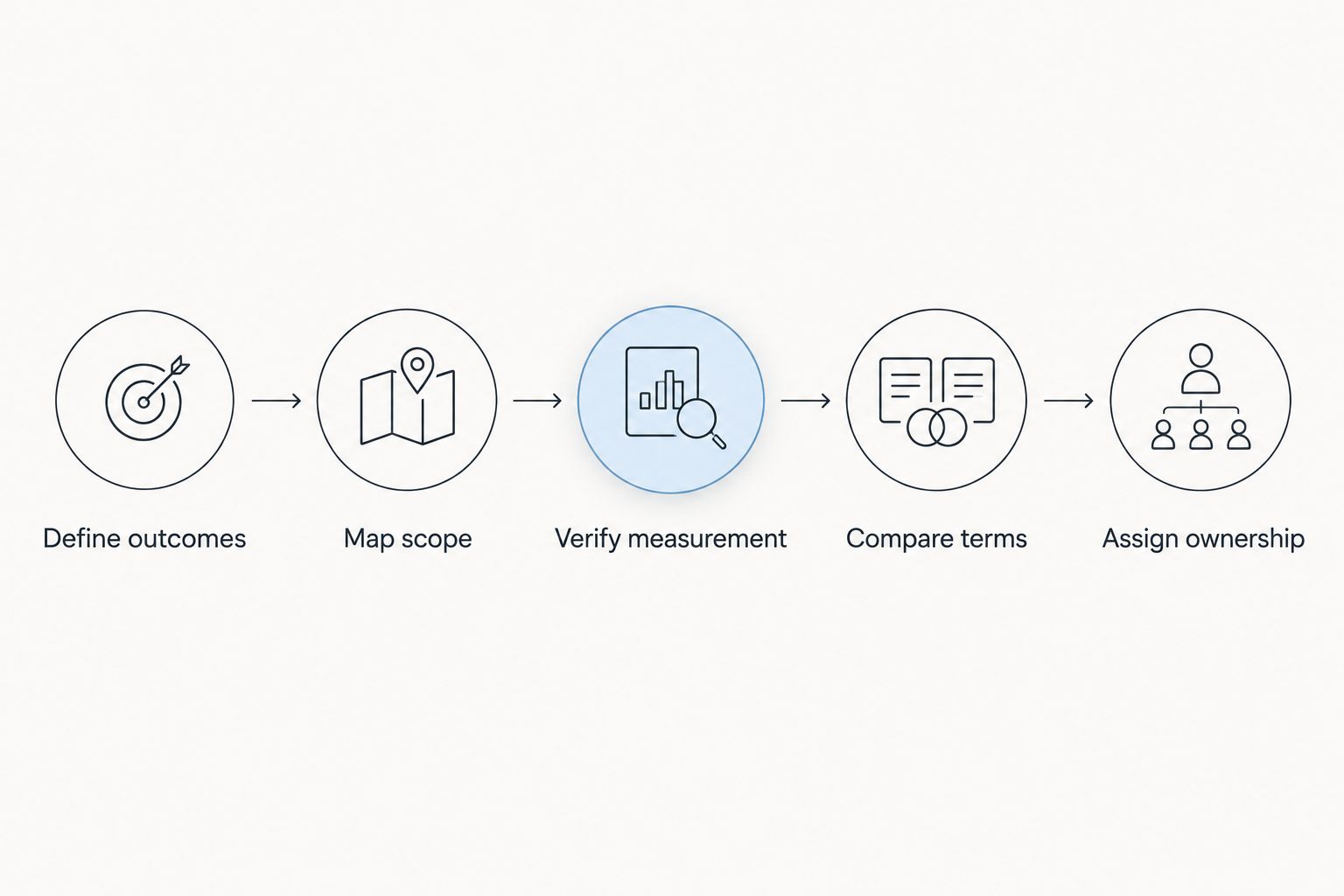
Use the same brief for every agency in your 2026 evaluation. A consistent brief prevents a campaign-only proposal from being compared with an agreement that also includes creative production or website work.
- Define outcomes. State the business result you want: qualified opportunities, completed purchases, or another clearly defined conversion. Avoid treating every recorded action as equally valuable.
- Map scope. List channels, markets, campaign destinations, and production responsibilities. Identify what your internal team will continue to own.
- Verify measurement. Explain how conversions reach your analytics or customer records. Ask who will validate the setup before using those records to judge performance.
- Compare terms. Review the fee calculation, excluded work, budget approvals, termination provisions, and account access together. Do not isolate the headline management fee.
- Assign ownership. Name the person responsible for approvals, website changes, assets, and sales feedback. Unassigned dependencies remain unassigned after the contract is signed.
Keep your brief usable. Agencies need your actual account requirements, not a long wish list that treats every possible service as mandatory. The strongest comparison shows which proposal addresses your needs and which leaves work with your team.
What does full-service campaign evidence tell you?
Full-service results help you understand the breadth of an engagement, but they do not establish a PPC management fee. Separate the reported result from the services used to achieve it.
Hey Prospekt reports 426 new leads and a 10x revenue increase in five months for Window Guard through paid social, website and catalog redesign, and local SEO. Those results describe a combined engagement. They do not isolate the contribution of campaign management or establish what another account should expect.
Hey Prospekt also reports a 310% organic traffic increase and 4× ROAS for SwamiG following Magento 2 website work, ERP synchronization, SEO, and Ads. Again, the scope extends beyond advertising alone. Use the example to ask how a prospective agency coordinates campaign, website, and operational work—not as a transferable performance promise.
The benefit of a full-service growth marketing agency is the ability to discuss connected brand, web, and marketing needs within one relationship. The boundary still matters: a broad service offering does not make every service part of your PPC agreement.
For Hey Prospekt or any other agency, request a scope that distinguishes campaign ownership from supporting work. A relevant case study supports your evaluation; it does not replace a written proposal.
Explore a broader growth partnership
Review brand, web, and growth marketing services against the responsibilities your team needs covered.
Is ad spend included in PPC management?
Ad spend and PPC management are different budget components. Your agreement should state how each is billed, who pays the advertising platforms, and who can authorize changes.
Do not interpret an agency’s management fee as the entire campaign commitment. Also identify production, measurement, and website responsibilities before deciding that a proposal covers everything you need.
Is a lower PPC management fee always better?
A lower fee is not a better agreement when it excludes work your business needs. Compare responsibilities, evidence, measurement, and contract terms before making that judgment.
You can also reject unnecessary scope. If your team already owns creative and tracking, define that boundary instead of buying overlapping work without a clear reason.
Should you hire a PPC specialist or a full-service agency?
Choose the service scope that matches the problem. A PPC-focused engagement fits campaign work when supporting responsibilities already have owners; a full-service engagement fits a brief that also needs brand, creative, or website services.
Neither structure removes the need for accountability. Require named deliverables and clear ownership regardless of the agency’s positioning.
FAQ
What should a PPC management proposal include?
A PPC management proposal should define channels, deliverables, billing terms, reporting, access, and exclusions. It should also assign responsibility for tracking, creative, and landing pages.
How much should I budget for PPC management in 2026?
Build your 2026 PPC management budget from a written scope and an agency proposal, with media spend accounted for separately. Include any required production, measurement, or website work outside the management agreement.
Is percentage-of-spend billing better than a retainer?
Neither billing model is automatically better. A spend-based agreement needs a clear calculation and approval rules; a retainer needs a clear recurring scope and change process.
Does PPC management include landing pages?
PPC management includes landing-page work only when the agreement specifies it. Confirm whether the agency owns design, development, copy, testing, or campaign recommendations alone.
Can I pay a PPC agency based on results?
A performance-linked agreement requires a result both parties can define and verify. Establish qualification, attribution, exclusions, and responsibility for dependencies before agreeing to that structure.
Is Hey Prospekt a PPC-only agency?
Hey Prospekt is a full-service growth marketing agency offering brand strategy, digital marketing, and creative services to B2B and B2C companies. Confirm which services belong in your proposed engagement rather than assuming they are all included.
One last thing
Before signing your 2026 agreement, ask a question that exposes gaps fast: Who owns the problem when the campaign generates traffic but the website or sales process fails? The answer should identify responsibilities and escalation steps, not promise that advertising will fix everything.
Make that answer part of the scope. A clearly assigned dependency is more useful than another broad promise about growth.
Related guides
- Connect Google Ads to Shopify for accurate ROAS tracking
- Connect Google Analytics to your CRO testing pipeline
- How long does it take to see growth marketing results?


