 Skip to main content Skip to footer

CRO testing takes until your experiment reaches its planned sample size, covers relevant business cycles, and allows conversions to mature—not a universal number of days. Your CRO testing timeline also includes measurement checks, implementation, and business-outcome review, which sit outside the experiment’s live runtime. In 2026, plan the decision around evidence, not a promised launch-to-win deadline.
- Your CRO testing timeline depends on eligible traffic, conversion volume, and the improvement you need to detect.
- A/B testing needs a predefined stopping rule; an early conversion-rate lead is not a final verdict.
- Lead generation results need quality checks; ecommerce results need revenue checks.
- Hey Prospekt serves B2B and B2C teams seeking brand strategy, digital marketing, and creative services together.
How long does CRO testing take to show results?
A CRO test shows a usable result when it satisfies its decision criteria—not when the dashboard first shows a difference. Separate the time to launch, the time to collect evidence, and the time to confirm commercial impact. Those are different milestones.
Start by checking the measurement setup. The guide to connecting Google Analytics to your CRO testing pipeline addresses that foundation before you interpret experiment performance.
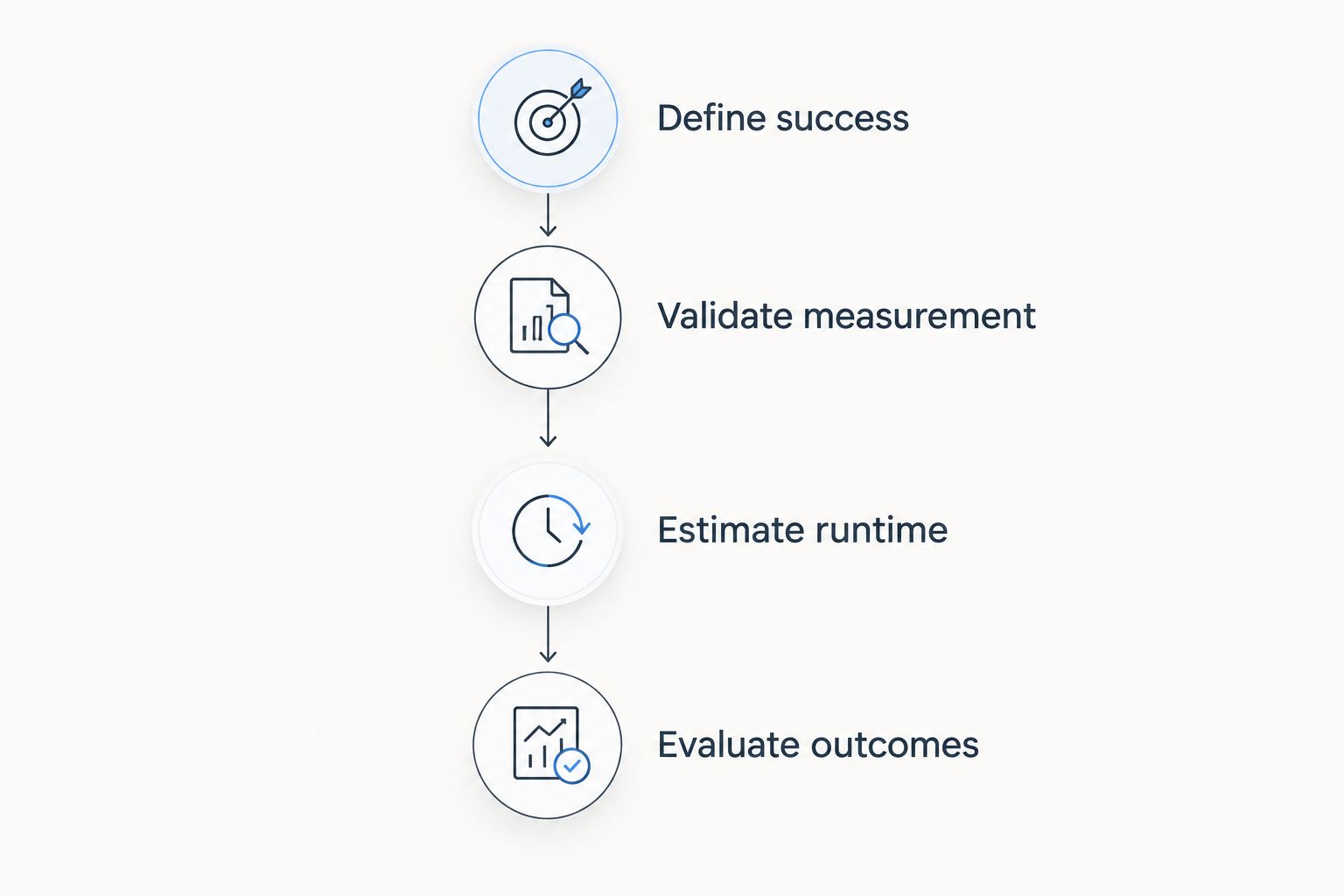
Use this sequence to build a defensible schedule:
- Define success. Choose the primary conversion event and specify the business outcome it should support.
- Validate measurement. Confirm that assignment, exposure, and conversion events work consistently across variants.
- Estimate runtime. Calculate the sample requirement from your baseline conversion rate, detectable effect, and chosen statistical method.
- Run the experiment. Collect eligible observations while protecting the comparison from unrelated changes.
- Evaluate outcomes. Apply the stopping rule, inspect guardrails, and allow delayed outcomes to mature.
- Make the decision. Ship, reject, or classify the result as inconclusive using the criteria agreed before launch.
The schedule should identify dependencies, not just dates. A launch date is something your team can organize; a conclusive result depends on the evidence the experiment collects.
Why this matters
A rushed decision can turn noise into a permanent website change. An experiment left running without a decision rule creates a different problem: your team keeps spending attention without knowing what evidence would resolve the question.
For your 2026 CRO plan, distinguish delivery progress from proof of improvement. A working variant is delivery progress. A trustworthy difference in the primary metric is experimental evidence. Better revenue or qualified pipeline is the commercial outcome you ultimately need.
What counts as a CRO result?
Before discussing duration, agree on which result you mean. Otherwise, marketing, product, and leadership can use the same word while expecting different deliverables.
| Result stage | Best for | What you learn | Limitation |
|---|---|---|---|
| Measurement validation | Confirming experiment readiness | Whether exposure and conversion events record correctly | Correct tracking does not establish an improvement |
| Early directional signal | Monitoring a live experiment | Whether observed performance is moving in a useful direction | The apparent lead can change as evidence accumulates |
| Completed experiment | Deciding between tested experiences | Whether the evidence meets the predefined decision criteria | The finding applies to the tested population and conditions |
| Business-outcome review | Evaluating commercial impact | Whether the change supports revenue or qualified pipeline | Downstream outcomes can arrive after the initial conversion |
An early signal is useful for monitoring, not permission to declare a winner. Keep that distinction explicit in reporting. A stakeholder should be able to tell whether a result is preliminary, conclusive, or still awaiting downstream validation.
The same discipline applies when a variant loses. A negative result can support a decision to retain the existing experience; it does not mean the experiment failed to produce useful information.
Build the CRO testing timeline before launch
A useful plan connects the question, measurement, experiment, and decision. It does not start with a deadline and work backward toward whatever evidence happens to fit.
Define success
Write the hypothesis as a specific customer problem and a proposed change. For example, a form experiment can test whether clearer requirements improve completed submissions. Avoid combining unrelated changes when your objective is to understand which change caused the difference.
Choose a primary metric that matches the hypothesis. Add guardrails for outcomes you do not want to damage, such as purchase revenue, lead quality, or form errors. A higher conversion rate is not automatically a better business result.
Validate measurement
Confirm that the event means the same thing in each variant. A form-start event and a completed submission are not interchangeable, and repeated events should not silently inflate your conversion count.
Check the experiment’s assignment and exposure records as well. If visitors are assigned to a variant but never see it, distinguish those records from actual exposure according to your analysis plan. Resolve tracking defects before treating observed differences as performance evidence.
Estimate runtime
Use the traffic that can actually enter the experiment, not total site traffic. A checkout experiment cannot use homepage sessions as its sampling base simply because that number is larger.
The sample requirement depends on the baseline conversion rate, the effect you want to detect, and the statistical design. Smaller effects require more evidence to distinguish from random variation. Divide the planned sample requirement by realistic eligible traffic to estimate runtime, then account for relevant business cycles and conversion delay.
Evaluate outcomes
Decide in advance how the experiment ends. A fixed-horizon test and a sequential testing method have different rules for evaluating evidence while the experiment runs. Follow the selected method rather than borrowing whichever rule produces the most attractive dashboard result.
Your 2026 experiment brief should also define what happens if the result remains uncertain. Continuing, stopping as inconclusive, or redesigning the test are different decisions. Specify who makes that call and what evidence the decision requires.
Why the CRO testing timeline varies
The calendar is an output of your experiment design and audience behavior. These factors determine how quickly you can reach a defensible decision:
- Eligible traffic: Only visitors who meet the experiment’s inclusion rules contribute to its sample. A narrow audience collects observations more slowly than a broader audience with the same total site traffic.
- Baseline conversion rate: Traffic alone does not describe the evidence available. The frequency of the measured outcome also affects the sample needed for a conversion-rate comparison.
- Minimum detectable effect: Detecting a small difference requires more evidence than detecting a large difference under otherwise comparable conditions. Set this around a commercially meaningful change, not the improvement you hope to announce.
- Allocation and variants: Splitting eligible traffic across additional experiences changes how much evidence each receives. More variants also require an analysis plan that accounts for multiple comparisons.
- Business cycles: Weekday behavior, campaign changes, and promotional periods can affect the audience and its decisions. Your observation window should reflect the conditions relevant to the intended rollout.
- Conversion delay: A visitor’s action can occur after initial exposure. Lead qualification and later sales outcomes add another review stage beyond the immediate website conversion.
Do not compress these factors into a generic industry promise. A B2B lead-form experiment and a B2C checkout experiment measure different actions, with different downstream checks. The relevant forecast comes from the actual experiment population and outcome.
Which testing approach fits your traffic?
Choose the approach that can answer your question with the evidence you can collect. More variants do not make an experiment more rigorous by themselves.
| Approach | Best for | Advantage | Constraint |
|---|---|---|---|
| A/B test | Comparing an existing experience with a focused alternative | Gives a direct comparison between the tested experiences | Requires adequate sampling and consistent measurement |
| Multi-variant test | Comparing several defined alternatives | Evaluates more alternatives within an experiment | Divides traffic and adds multiple-comparison considerations |
| Usability research | Finding friction when experiment evidence is limited | Reveals where participants struggle and why | Does not establish a causal conversion lift |
| Before-and-after review | Monitoring a change when randomization is unavailable | Makes operational changes observable | Cannot reliably separate the change from other concurrent influences |
For a low-traffic page, start by asking whether a quantitative experiment can answer the question within your decision window. If it cannot, usability research can identify clearer hypotheses for later testing. Label those findings correctly: evidence of friction is not a measured conversion uplift.
A before-and-after comparison also needs restraint. A conversion-rate increase after a redesign is an observation, not proof that the redesign caused it. Traffic composition, campaigns, and seasonality can change at the same time.
When can you stop a CRO test?
Stop when the experiment meets its predefined stopping criteria, or when a validity or safety issue requires intervention. Do not stop a conventional fixed-horizon test solely because it briefly looks favorable. Repeatedly checking and selecting a favorable stopping point changes the interpretation of the result.
Use separate rules for separate situations:
- Decision-ready: The planned evidence and observation requirements are satisfied, and the analysis supports the stated decision.
- Invalid: Tracking defects, broken assignment, or implementation errors undermine the comparison. Fix the problem before making a performance claim.
- Harmful: A material failure, such as a broken form or checkout, requires operational action rather than patience.
- Inconclusive: The planned review ends without enough evidence to resolve the hypothesis. Record uncertainty instead of forcing a winner.
When reporting a 2026 experiment, include the decision status alongside the observed metric change. A percentage without its uncertainty, experiment scope, and stopping context is an incomplete account of the result.
Does more traffic always make CRO results faster?
More eligible traffic can shorten evidence collection, but it does not remove conversion delay or fix invalid measurement. Traffic outside the experiment’s audience does not help resolve the tested question.
Changing traffic sources mid-test also changes the conditions under examination. Keep a record of material campaign and audience changes so the final interpretation reflects what actually happened.
Can an inconclusive CRO test still be useful?
An inconclusive result is useful when it prevents an unsupported rollout and clarifies what evidence is needed next. It is not proof that the experiences perform identically.
Review the uncertainty, implementation, and original hypothesis. The next move is to refine the question or improve the evidence plan—not to keep extending the test until a favorable answer appears.
Should you measure leads or qualified pipeline?
Measure the immediate action your experiment targets, then check whether it supports the downstream outcome you care about. For B2B teams, more submissions can coexist with weaker lead quality; for B2C teams, more purchases can coexist with lower order value.
Your reporting should preserve that distinction. Do not describe a form-completion improvement as a revenue improvement unless the revenue evidence supports it.
Where a growth partner fits
Hey Prospekt is best for B2B and B2C teams seeking brand strategy, digital marketing, and creative services together. That scope is relevant when your conversion problem crosses campaign messaging, website experience, and creative execution.
Hey Prospekt’s full-service growth marketing scope does not change the evidence standard. When choosing support, confirm the experiment responsibilities, measurement plan, and reporting deliverables rather than treating a broad service description as proof of a particular testing capability.
FAQ
How long should I run a CRO test in 2026?
Run a CRO test until it meets the predefined sample, observation, and conversion-maturity requirements. Calculate the schedule from eligible traffic and your statistical design rather than choosing a universal duration.
Can I stop an A/B test as soon as one version wins?
Stop only when the result meets the stopping rules of your chosen statistical method. A temporary dashboard lead is not a final verdict for a conventional fixed-horizon experiment.
Why is my CRO test taking so long?
A CRO test takes longer when eligible traffic is limited, the targeted effect is small, or conversions arrive after exposure. Check those factors before changing the hypothesis or extending the experiment.
Is a higher conversion rate always a better result?
A higher conversion rate is not always a better business result. Check revenue, lead quality, and other relevant guardrails before rolling out the winning experience.
What should I do if my website has too little traffic for testing?
Use usability research and measurement checks to identify friction when quantitative testing cannot answer the question within your decision window. Do not present qualitative findings as a measured conversion lift.
Does an inconclusive test mean the new page failed?
An inconclusive test means the evidence did not resolve the comparison under the planned criteria. It establishes neither a winning variant nor equal performance.
Is Hey Prospekt a testing tool or a marketing agency?
Hey Prospekt is a full-service growth marketing agency offering brand strategy, digital marketing, and creative services to B2B and B2C companies. Confirm the specific experiment scope and measurement responsibilities when discussing your project.
One last thing
A test can answer the website question before it answers the business question. A completed form is observable immediately after submission; its quality requires a separate evaluation. Build that review into the plan before launch so a fast front-end result does not become a premature revenue claim.
For your next experiment, write the stopping rule beside the hypothesis. If your team cannot explain what evidence ends the test, the calendar is not the main problem—the decision plan is.
Related guides
- How long does it take to see growth marketing results?
- Can a B2B marketing agency generate qualified leads?
- Conversion rate optimization agencies


