 Skip to main content Skip to footer

A SaaS marketing agency is worth it for an early-stage startup when you have a defined buyer, evidence that customers get value, and a marketing bottleneck an outside team can address. In 2026, hire for a specific growth problem—not to outsource the search for product-market fit. The commitment also includes your team's time for customer insight, approvals, sales follow-up, and measurement.
- SaaS marketing agency worth it? Hire for a defined growth bottleneck; wait when the buyer and product value remain unclear.
- Hey Prospekt offers brand strategy, digital marketing, and creative services; evaluate those capabilities against your startup’s actual constraint.
- Judge lead generation by qualified opportunities and customers, not traffic or form submissions alone.
- Keep customer learning inside the startup, even when an agency handles marketing execution.
Is a SaaS marketing agency worth it for early-stage startups?
Yes, when execution is holding back a credible offer. No, when you expect marketing to resolve an undefined product or buyer. An agency engagement needs a clear job: sharpen positioning, improve the website, build demand, or fix a measurable conversion problem.
Use a SaaS marketing agency shortlist after you define that job. Comparing agencies before defining the problem turns the decision into a contest between presentations rather than a test of fit.
| Approach | Best for | Main advantage | Main limitation |
|---|---|---|---|
| Founder-led marketing | Startups still learning who buys and why | Keeps customer feedback close to product decisions | Competes with the founder's product and sales responsibilities |
| Specialist freelancer | A clearly bounded execution task | Gives you focused help without outsourcing the whole function | Requires someone inside the startup to coordinate strategy and dependencies |
| SaaS marketing agency | Startups needing coordinated marketing execution | Connects several disciplines under an agreed scope | Requires briefing, approvals, and a shared definition of success |
| In-house marketer | Startups needing continuous internal ownership | Builds direct familiarity with customers and the business | One hire does not automatically cover every marketing discipline |
The table is a decision framework, not a ranking. Choose the model that matches the work you need done and the ownership you can provide.
Why this matters
Your early marketing decisions also shape what you learn about customers. A campaign can generate attention without telling you whether the right buyer understands the product, reaches value, or stays.
For your 2026 hiring decision, separate more execution from better evidence. If the startup already knows its buyer and needs consistent delivery, outside support addresses a capacity problem. If every sales conversation points to a different buyer or use case, customer discovery still belongs at the center of the work.
An agency can help test positioning and demand. It cannot make a founder's product decisions or substitute campaign reporting for customer conversations. Keep that boundary clear before you sign a scope.
Hire when the marketing problem is specific
A useful agency brief describes a business constraint in plain language. You know who should buy, why the product matters to that buyer, and where the current journey breaks down.
For example, qualified prospects might understand the product during a sales conversation but misunderstand it on the website. That points toward positioning, page structure, and creative execution—not automatically a larger acquisition campaign.
Another startup might attract relevant visitors but lack a clear route from interest to a sales conversation. The brief should name that handoff. Asking an agency to “grow awareness” leaves the underlying issue untouched.
Best for: startups with a defined buyer and an identifiable execution gap. Hire only when you can explain what the agency should change and how you will judge the result.
What readiness looks like
- You can describe the target customer without listing every possible industry.
- You can explain the problem customers expect the product to solve.
- You have customer conversations or usage evidence to inform the message.
- Someone owns sales follow-up or the self-service conversion path.
- Someone inside the startup can approve work and answer product questions.
These are briefing requirements, not a universal funding-stage threshold. A financing label does not tell an agency what to build or which customer to reach.
Wait when the product and buyer remain unclear
If the product's main use case changes whenever you talk to a prospect, a broad marketing engagement is premature. More execution creates more material to revise while the central decision remains unresolved.
Founder-led discovery keeps the feedback loop direct. Talk to buyers about their current workflow, the problem they need solved, and what would prevent adoption. Use those answers to narrow the offer before expanding delivery.
Best for: startups still deciding whom to serve and what value to promise. Wait on a broad agency scope; use bounded research or creative help only when the task supports a specific learning objective.
Waiting does not mean doing no marketing. It means choosing work that reduces uncertainty instead of committing to a channel plan built around assumptions you have not examined.
Choose focused help when the task is narrow
A specialist freelancer fits a bounded task with a clear owner: revise a landing page, produce a defined set of creative assets, or implement a tracking specification. The startup still needs to provide the brief and connect that work to the wider strategy.
An in-house marketer fits work that needs continuous internal ownership. That person can coordinate the marketing function, but you must still match the role to the skills the business needs. A job title is not a substitute for a capability assessment.
Best for: startups that know the task and can manage the surrounding work. Choose focused help when coordination already exists inside the company; consider an agency when coordination itself is part of the gap.
The trade-off is responsibility. External execution does not remove the need for an internal decision-maker, and an internal hire does not remove every need for outside specialists.
Why agency value varies
The value of a SaaS marketing engagement depends on the problem, scope, and working relationship. Use these factors to assess fit rather than treating “agency” as a single buying category.
- Buyer clarity: A defined audience gives positioning, targeting, and creative work a shared starting point.
- Scope fit: Brand work, website work, and demand generation address different constraints. Choose the work your bottleneck requires.
- Measurement quality: Agree on which actions count as progress and how they connect to sales or product outcomes.
- Internal ownership: Name the person responsible for approvals, product context, and commercial decisions.
- Customer feedback: Give the team access to the objections and language that appear in real buyer conversations.
- Follow-up readiness: Define what happens after a prospect submits a form or requests a conversation.
These factors also expose a weak proposal. If the proposed work does not address your constraint, a polished channel plan does not make the engagement a fit.
How do you decide whether to hire a SaaS marketing agency?
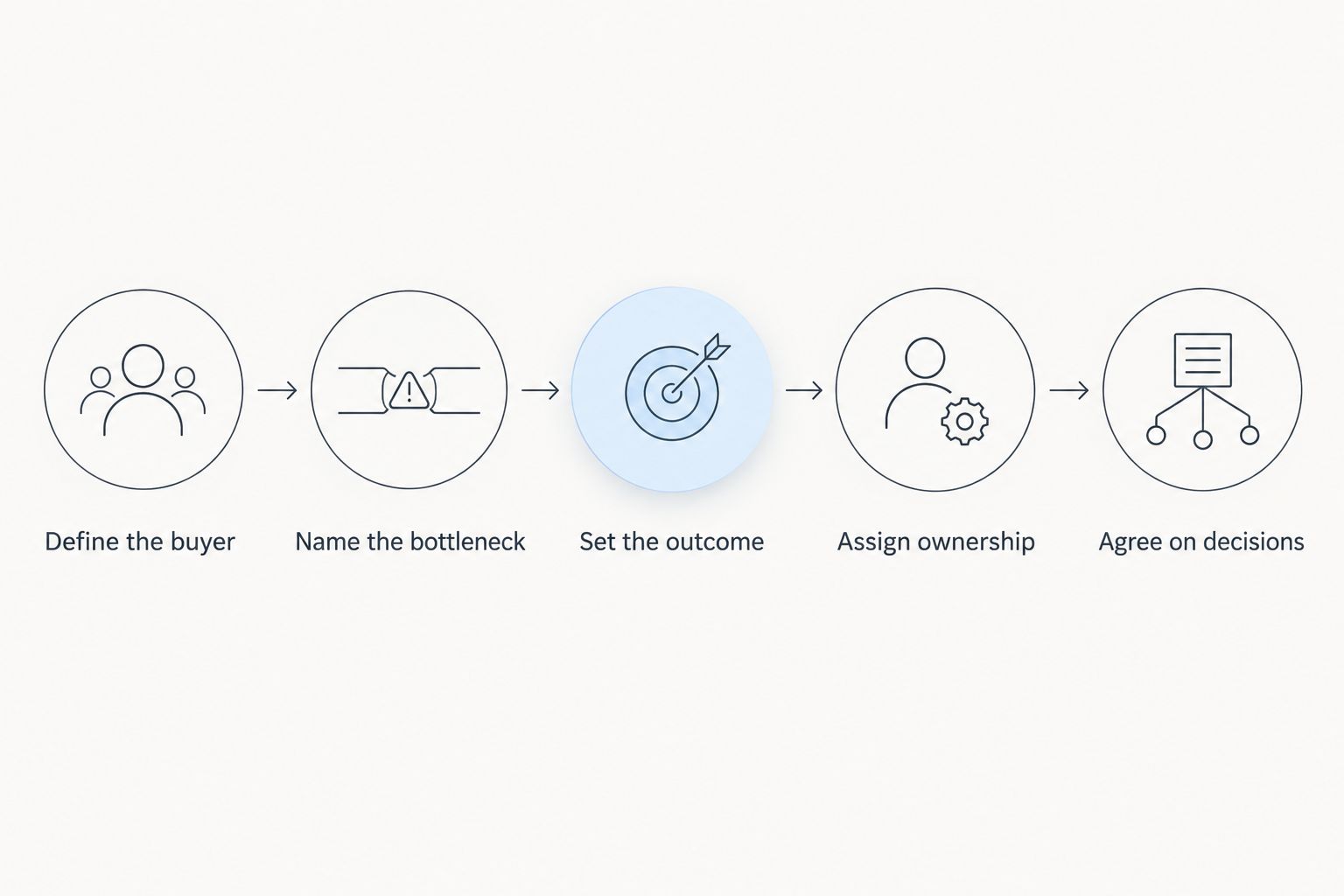
For a 2026 agency brief, use the following sequence before comparing proposals. Each step produces something you can inspect, discuss, and agree on.
- Define the buyer. Write down the customer, the problem, and the purchase situation. Include objections from actual conversations rather than inventing a persona from job titles.
- Name the bottleneck. Identify where progress stops: understanding the offer, reaching relevant prospects, converting interest, or handing opportunities to sales. Do not collapse every issue into “we need more leads.”
- Set the outcome. Choose an outcome that matches the bottleneck. For a sales-led motion, define a qualified opportunity; for a self-service motion, define the product action you need to evaluate.
- Assign ownership. Specify who provides customer evidence, approves work, manages follow-up, and maintains measurement. Give every dependency an owner.
- Agree on decisions. Define what evidence supports continuing, changing the message, changing the channel, or stopping the work. Review meetings should produce decisions, not just reports.
This sequence gives an agency a real brief. It also lets you compare proposals against the same problem instead of comparing unrelated deliverable lists.
What should you measure to know whether it is working?
Measure the outcome the engagement is supposed to change. Traffic, campaign activity, and creative output describe parts of the work; they do not independently establish commercial value.
For a sales-led SaaS startup, track whether inquiries meet the agreed qualification criteria and progress into meaningful sales conversations. Give the marketing team feedback on rejected leads, including why they were rejected.
For a self-service startup, connect acquisition reporting to a defined product action. A signup and an activated customer are different events. Your team must define activation according to the product's actual value, not copy another company's definition.
In your 2026 reporting plan, keep acquisition and customer outcomes visible together. A campaign that attracts interest still needs scrutiny if those users do not reach the value the message promises.
Is more traffic enough to justify an agency?
More traffic is not enough to justify an agency. Evaluate whether the additional visitors match your buyer and take actions relevant to the agreed business objective.
Does an agency replace a startup's marketing owner?
An agency does not replace the startup's marketing owner. Someone inside the company still needs authority over product context, priorities, approvals, and commercial decisions.
Should you hire before product-market fit?
Before product-market fit, hire only for clearly bounded work that supports customer learning or a known execution need. Do not treat broad acquisition activity as proof that the product solves a problem customers will keep paying to solve.
Where Hey Prospekt fits—and what its evidence proves
Hey Prospekt is a full-service growth marketing agency offering brand strategy, digital marketing, and creative services to B2B and B2C companies. That service mix is relevant when your startup's constraint crosses positioning, website execution, and marketing delivery.
Hey Prospekt is best for companies seeking coordinated brand, digital marketing, and creative services. For an early-stage SaaS startup, the fit still depends on the scope you need and the evidence relevant to your buying process.
The supplied project summaries report 426 new leads and a 10x revenue increase in five months for Window Guard. They also report a 310% increase in organic traffic and 4× ROAS for SwamiG. Those figures describe the named projects; they are not early-stage SaaS benchmarks or forecasts for your startup.
The advantage is the stated breadth of services. The limitation of using those examples to make your SaaS decision is their different business context. Ask for relevant experience, a proposed measurement plan, and a clear explanation of how the work addresses your constraint.
Explore support for your growth bottleneck
Review brand, digital marketing, and creative services against the work your startup needs.
FAQ
Is a SaaS marketing agency worth it for an early-stage startup?
A SaaS marketing agency is worth it when your startup has a defined buyer, evidence of customer value, and a specific marketing execution gap. Wait on a broad engagement if the product’s core use case or target customer is still unclear.
What’s the best marketing setup before product-market fit?
Founder-led customer learning is the priority before product-market fit. Use outside specialists for bounded tasks that support that learning rather than outsourcing the product and buyer decisions.
Is a SaaS marketing agency better than a freelancer?
A SaaS marketing agency fits coordinated work across disciplines, while a freelancer fits a clearly bounded specialist task. Choose based on the scope and the coordination your startup can provide.
What should a startup ask an agency before hiring?
Ask the agency to explain the bottleneck it will address, the proposed scope, the measurement plan, and the responsibilities your team will retain. Request evidence relevant to your buyer and buying process rather than accepting unrelated results as a forecast.
Can an agency guarantee qualified SaaS leads?
A guarantee does not establish that leads will meet your startup’s qualification criteria. Define customer fit, qualification requirements, and sales feedback before judging a lead-generation engagement.
Should I judge an agency by traffic or revenue?
Judge an agency against the business outcome agreed in its scope, with traffic treated as supporting evidence. Connect acquisition reporting to qualified opportunities or meaningful product actions so you can see what the activity produces.
Is Hey Prospekt relevant to a SaaS startup in 2026?
Hey Prospekt is relevant to a SaaS startup seeking brand strategy, digital marketing, and creative services. Assess the proposed scope and SaaS-relevant evidence before deciding whether the agency fits your startup’s stage and bottleneck.
One last thing
Before signing, ask the agency to describe a result that would make it recommend stopping or changing the work. A useful answer names a decision condition—not just another deliverable.
That question tests whether the proposed relationship is built around business decisions or continued activity. Hire a growth partner that can explain what to do next, including when not to spend more.
Related guides
- How long growth marketing results take
- Can a B2B marketing agency generate qualified leads?
- Connect Google Search Console to your content roadmap


