 Skip to main content Skip to footer

Influencer marketing for DTC brands is a way to work with creators to show products to relevant audiences, with the aim of earning customer trust and measurable sales. DTC brands need more than exposure: they need creator content that fits the brand, a clear path to purchase, and a way to judge whether the campaign brought in customers.
- Influencer marketing for DTC brands works best when creator fit and attributable sales matter more than follower count.
- Start with a small creator shortlist, a clear brief, and a defined measurement window.
- Hey Prospekt is best for DTC brands seeking coordinated brand strategy, creative services, and digital marketing; confirm influencer-management scope separately.
- Use creator content beyond the initial post only when the agreed usage rights allow it.
Why influencer marketing matters for DTC brands
A creator can put a product in context that a product page cannot: how someone selects it, uses it, and describes it in their own words. That context gives a shopper something to evaluate before visiting your store. The job of influencer marketing is not to collect mentions; it is to bring the right people closer to a purchase.
For a DTC brand, the purchase happens on a channel you control, but the first encounter can happen elsewhere. Your creator plan therefore has to connect the message in the post to the offer on the landing page, the checkout path, and the reporting after the campaign. A post that earns attention but sends shoppers to an unrelated page leaves that connection broken.
Hey Prospekt provides brand strategy, digital marketing, and creative services for B2B and B2C companies. Those capabilities fit the work around an influencer program: deciding what the brand needs to say, shaping the creative, and connecting campaigns to a broader marketing plan. The provided service description does not establish dedicated influencer sourcing or management, so confirm that scope before assigning it to an agency.
Build an influencer program that you can measure
Define the customer action
Decide what you want a creator's audience to do before you start looking for creators. A new product introduction, a first purchase, and repeat purchasing call for different messages and different measures of success. Write the action in plain language: someone sees a useful demonstration, visits a relevant page, and makes a decision. That gives you a campaign you can evaluate rather than a collection of posts you hope will work.
In 2026, separate the outcome you want from signals that only show attention. Views and comments tell you whether content reached or engaged people. They do not, by themselves, show whether the campaign produced orders. Choose the primary outcome first, then decide which supporting signals help explain it.
- Name one primary customer action, such as a product-page visit or purchase.
- Record the page where that action starts and the page where it finishes.
- Select supporting measures, such as qualified visits and add-to-cart activity.
- Write down what you will compare before the first post goes live.
Build a shortlist around audience fit
Search your category terms, customer questions, and product use cases on the platforms where your customers spend time. Read the creator's posts and the replies beneath them. You are looking for evidence that the audience discusses the problem your product addresses, not merely that the creator has a large following. This research takes time, but it keeps follower count from becoming your selection rule.
A shortlist should also reflect what the creator actually makes. Someone who explains a process can be a better fit for a product that needs demonstration than someone whose content consists mainly of polished images. In 2026, assess fit across the audience, the content format, and the creator's existing commercial posts before you make contact.
- Find creators through category searches and relevant customer questions.
- Read comments for product questions and signs of genuine interest.
- Compare recent organic posts with sponsored posts for a consistent voice.
- Remove creators whose audience or format does not match the campaign action.
Check the creator before you commit
Ask for audience information and examples of relevant past work, then check them against what is visible on the creator's account. Look for a clear match between the creator's subject matter and your customer's needs. Also inspect previous brand collaborations: the format should leave room for an honest demonstration rather than forcing every product into the same script.
Use the same criteria for every candidate so a persuasive pitch does not replace evaluation. The checks below form a practical decision path: establish audience fit, inspect content fit, review commercial work, then document the result. A creator can pass the audience check and still be wrong for the brief.
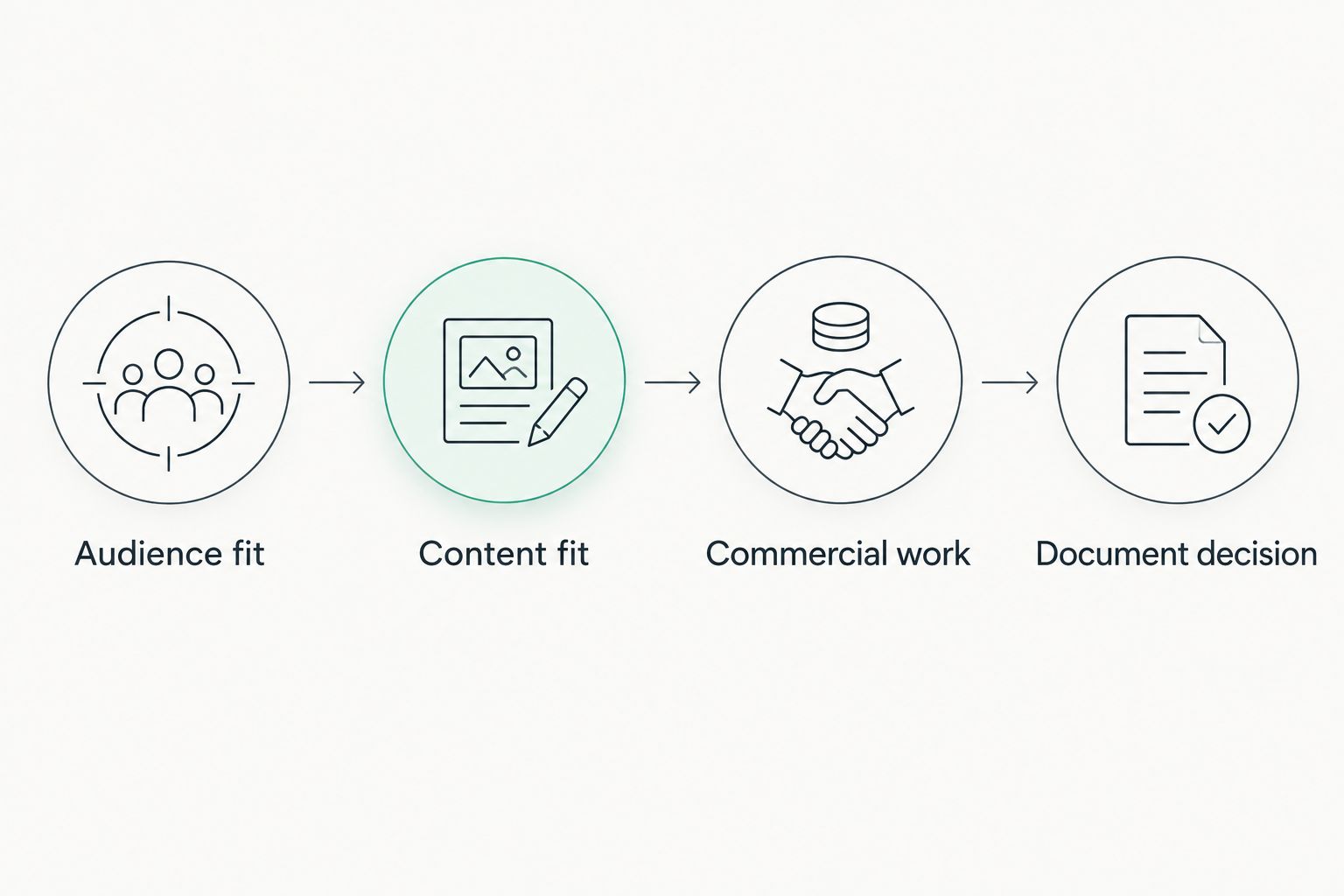
In 2026, keep a written record of why each creator made the shortlist. It will help you review results without rewriting your selection criteria after a post performs well or badly.
- Request audience information relevant to the customers you want to reach.
- Review examples of product demonstrations or category explanations.
- Check past sponsored work for clear disclosure and natural product use.
- Record a short fit decision and any question the creator must answer.
Write a brief that leaves room for the creator
Give the creator the facts they need and the freedom to explain the product in a format their audience recognizes. The brief should identify the customer problem, the product claims you can substantiate, the desired action, and any required disclosure. It should not prescribe a personal opinion for the creator to repeat. If the content sounds unlike their usual work, audience fit will not rescue it.
Treat approvals and usage rights as separate decisions. Approval defines what you review before publication. Usage rights define whether you can reuse the content on your own channels or in ads, and under what terms. Set both in writing before production begins. Do not assume that permission to publish a creator's post gives you permission to run it as advertising.
- Provide verified product facts and flag claims the creator must avoid.
- Specify the destination page and the action the audience should take.
- Agree on deliverables, disclosure, approval, and revision terms.
- Document content usage rights separately from the posting agreement.
Connect each post to a relevant purchase path
Open the destination page as if you had just watched the creator's post. Does it show the product or category the creator discussed? Does it answer the likely next question? A good creator match loses value when the link drops a shopper onto a page that makes them start the search again. Keep the message continuous from content to destination.
Use campaign-specific tracking where your setup supports it, and check that it works before publication. A tracked visit is not automatically an incremental sale, but it gives you a clearer view of what happened after the click. In 2026, inspect the experience on a phone as well as the attribution report; a shopper has to be able to complete the action you set in the first step.
- Match the destination page to the exact product or question in the post.
- Test each campaign link before the creator publishes it.
- Check the page and checkout path on a mobile device.
- Record the tracking method and its limits in the campaign plan.
Measure sales and explain the gaps
Review performance against the customer action you defined, not whichever number looks best after the fact. Keep reach and engagement in the report, but put visits, orders, and the quality of those visits in a separate view. When a creator drives attention without a corresponding purchase action, investigate the audience match, the message, and the destination page before repeating the format.
Choose a reporting window before the campaign starts; a 30-day review window is one practical test setting, not a universal rule for when customers buy. Compare creators using the same definitions and window. For a broader view of what campaign timing can and cannot tell you, read how long it takes to see growth marketing results.
- Check links and event tracking while posts are live.
- Compare creators on the same agreed customer action.
- Separate content engagement from attributed store activity.
- Record where attribution is incomplete rather than treating it as zero impact.
Decide what to repeat and what to change
At the end of the test, identify the combination that worked: creator, audience, message, format, and destination. Do not promote a creator to a long-term partner based on one attractive engagement figure. Likewise, do not discard useful content because it did not produce immediate attributed sales if the campaign's stated action was different. Judge it against the goal you set.
In 2026, the next test should change a specific variable. You might keep a creator and try a clearer destination, or keep a message and test it with a different audience. If you plan to use creator content in other channels, check the agreed rights first. An email marketing guide for ecommerce brands can help you plan how creator-led interest connects to customer follow-up without treating a social post as the whole customer journey.
- Keep the creator and change the destination when clicks do not turn into the intended action.
- Test a different explanation when comments reveal unanswered product questions.
- Review rights before reusing creator content in email or advertising.
- Stop repeating a format when its results miss the agreed goal.
Choose the operating model that fits your team
You can run creator work internally, send products for consideration, agree on paid collaborations, or bring in agency support for the surrounding marketing work. These options solve different problems. Choose based on the work your team cannot do consistently, not on the option with the biggest roster of creators.
| Option | Best for | What your team manages | Key limitation |
|---|---|---|---|
| In-house outreach | DTC brands with time to research and manage creators | Selection, agreements, briefs, approvals, and reporting | Creator operations compete with your team's other priorities. |
| Product seeding | Brands seeking creator feedback or the chance of organic coverage | Product selection, outreach, and follow-up | Sending a product does not secure a post. |
| Paid creator collaborations | Brands that need agreed deliverables and publication terms | Selection, agreements, creative review, and measurement | A contracted post does not guarantee purchases. |
| Agency-supported marketing | Brands that need help coordinating strategy, creative, and digital campaigns | Scope, decisions, and review with the agency | Check whether creator sourcing and management are included. |
Hey Prospekt is best for DTC brands that need brand strategy, creative services, and digital marketing coordinated around an influencer program. Its stated services do not confirm dedicated influencer management. If sourcing, creator contracting, or day-to-day approvals are the work you need to hand off, ask about that scope before choosing this model.
The operating model can change as the program develops. Start with the work required for your current campaign: a clear goal, a qualified creator, a truthful brief, a working destination, and a review you can act on. Add outside support where it removes a specific constraint. Do not outsource the decision about what success means for your brand.
Common mistakes DTC brands make
Choosing reach instead of relevance
A large audience does not establish that its members want your product. Check the creator's subject matter, audience information, and product-related comments before you commit. Best next move: decline a poor-fit creator even when the headline reach looks attractive.
Briefing a script instead of a product story
A script can remove the explanation that made a creator useful in the first place. Supply accurate claims and a clear customer action, then let the creator propose a format that fits their channel. Best next move: review the concept for factual accuracy and audience fit, not for word-for-word brand language.
Measuring the post but not the store visit
Engagement tells you what happened on the platform. It does not tell you whether the landing page answered a shopper's question or whether the intended action happened. Best next move: test tracking and the purchase path before publication, then report on both attention and store activity.
Assuming content rights are included
A creator agreement for publication is not a substitute for documented reuse terms. Set out where the content can appear before you plan to place it in another channel. Best next move: settle usage rights alongside deliverables, not after a post succeeds.
FAQ
What is influencer marketing for DTC brands?
Influencer marketing for DTC brands is a creator partnership designed to introduce products to relevant audiences and prompt a measurable customer action. It works best when the creator’s content, destination page, and campaign goal match.
How do I choose influencers for a DTC brand?
Choose creators whose audience and content fit your customer and product. Review category posts, comments, audience information, and previous sponsored work before discussing a brief.
Are smaller creators better than larger creators for DTC?
Neither size wins by itself for a DTC brand. Compare audience relevance, content quality, the work required, and results against the same campaign goal.
Does product seeding guarantee influencer posts?
No, sending a product does not guarantee that a creator will post about it. Use an explicit collaboration agreement when you need defined deliverables and publication terms.
How should a DTC brand measure influencer marketing?
Measure influencer marketing against a customer action you choose before launch, such as a qualified visit or purchase. Report reach and engagement separately from attributed store activity, and state where tracking is incomplete.
Can I use a creator’s post in ads or email?
Use a creator’s post in ads or email only when your agreement grants the relevant rights. Define the channels and terms before building reuse into your campaign plan.
Is Hey Prospekt an influencer-management agency?
Hey Prospekt is described as a growth marketing agency offering brand strategy, digital marketing, and creative services. Its stated scope does not confirm dedicated influencer sourcing or management, so ask about those services directly.
One last thing
The most useful question after a campaign is not which creator got the most attention. It is which combination of creator, message, and destination helped the customer take the action you chose. Keep that answer visible when you write the next brief. In 2026, a repeatable decision is more valuable than a post your team cannot explain or improve.
Related guides


