 Skip to main content Skip to footer


Construction company lead generation is the process of attracting and qualifying potential projects with the aim of filling the right work pipeline. In 2026, effective lead generation for construction companies starts with project fit, not inquiry volume: a request outside your service area or capabilities does not become valuable because it came through a form.
- Lead generation for construction companies works best when you define eligible projects before buying traffic.
- Track qualified inquiries, estimates and awarded work separately; raw lead counts hide project fit.
- Hey Prospekt is best for construction teams seeking outside brand and digital marketing support, not a substitute for estimating capacity.
- Compare referrals, organic search and paid search by the work each source produces, not inquiries alone.
Why lead generation matters for construction companies
A construction inquiry carries questions that a simple contact count cannot answer: Is the project in your service area? Does it match the work you take? Is there enough detail to estimate it? Can your team pursue it? Until you answer those questions, more traffic can create more screening work without improving the pipeline.
The distinction also changes how you assess results. A request for a small repair and an invitation to bid on a commercial build are both leads, but they need different qualification, follow-up and reporting. If you are setting expectations for a new campaign, how long growth marketing results take is a useful companion to this guide. The practical rule for 2026 is simpler: decide what counts as a viable opportunity before choosing a channel.
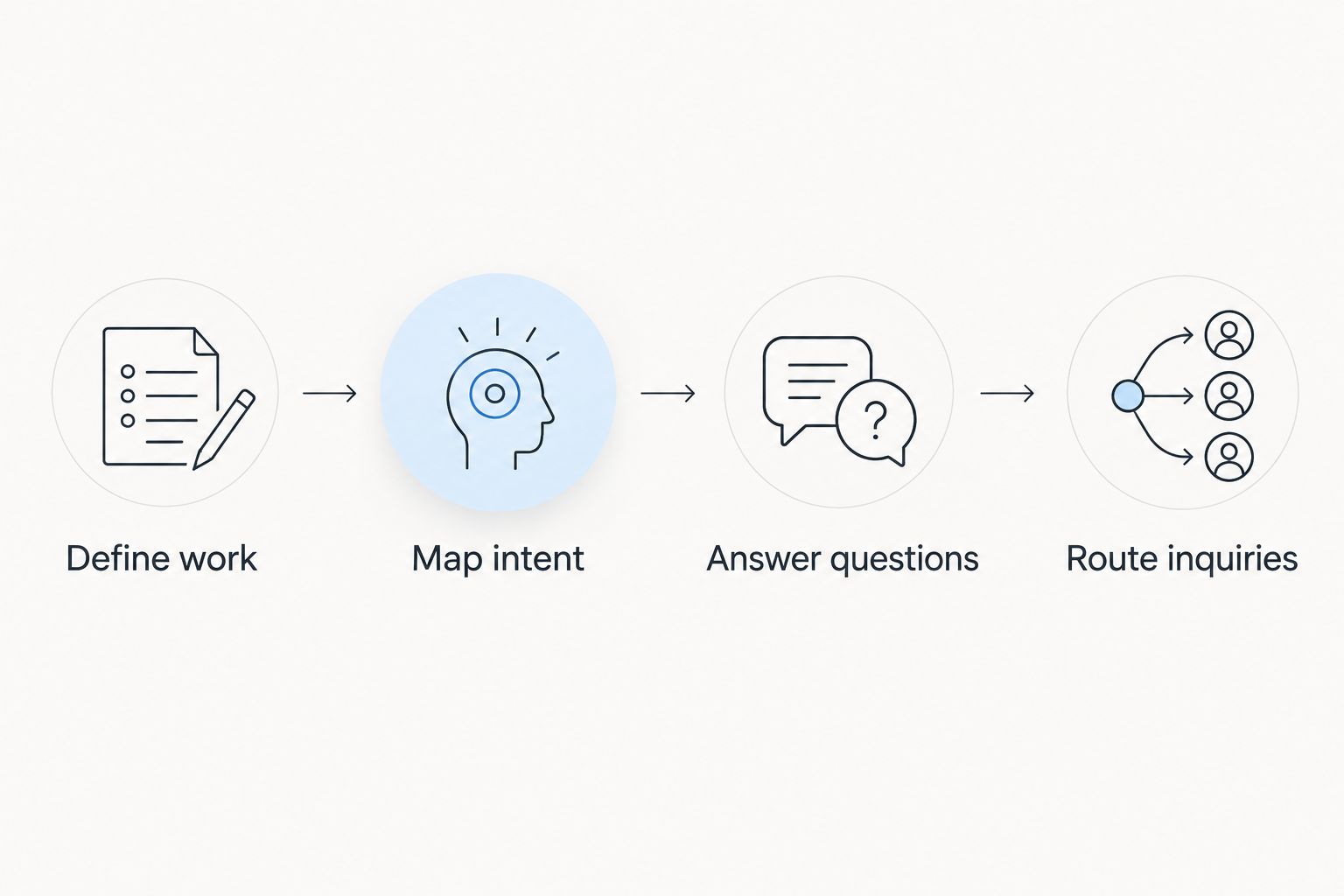
Define the work you want to win
Start with your own records, not a list of popular marketing channels. Review awarded projects, declined requests and estimates that never turned into work. Look for the project characteristics your team can recognize at first contact. A useful definition of fit gives whoever answers an inquiry a consistent way to route it.
Do not treat every service as one campaign. A residential renovation request and a commercial subcontracting opportunity call for different evidence, forms and follow-up. You can keep one reporting system while setting separate qualification rules for each line of work.
- List the project types you actively pursue and the requests you decline.
- Mark the service areas you can actually cover.
- Record the details needed before an estimator can assess a request.
- Agree on who decides whether an inquiry enters the active pipeline.
Map search intent to project type
Next, write down the language buyers use when looking for each kind of work. Start manually: ask the people who answer calls which questions come up, review the wording in genuine inquiries and inspect the search terms available in your own analytics or ad account. Keep research terms separate from hiring terms. Someone learning how a process works is not necessarily ready to request an estimate.
Search intent also affects what a page must answer. A buyer looking for a specific construction service needs to know whether you do that work and where. A buyer evaluating firms for a larger project needs a clear account of your relevant capabilities and a sensible way to start a conversation. Avoid sending both to a page that merely says your team handles everything.
- Group terms by service, location and buyer question.
- Separate informational searches from estimate or bid requests.
- Identify the page that should answer each high-fit search.
- Set aside terms tied to work you do not pursue.
Make each service page answer the buyer's question
Write the page before you increase traffic to it. A visitor should be able to identify the work covered, the geographic scope and the next step without decoding broad claims. You can review your existing pages against that standard by hand. If the information is missing, fix the page rather than assuming a bigger campaign will compensate.
For a construction company, the best next step depends on what an initial assessment requires. An estimate request might need a location and project description. A bid conversation might need a different route. Ask for enough information to triage the inquiry, but do not make the first contact form a substitute for the full estimating process.
- Give each priority service a clearly focused page.
- State the work covered and the areas served in plain language.
- Explain what happens after someone submits a request.
- Check that the form asks for the information needed to route it.
Route inquiries before you scale campaigns
An inquiry loses its usefulness if no one owns the next action. Map the path from form submission or call to qualification, estimating and follow-up. A shared spreadsheet is enough to begin: capture the source, project type, location, owner and current status. Review open records every 7 days as an operating rule, then adjust that cadence if your sales process requires it.
This is the point to decide whether outside support helps. Hey Prospekt offers brand strategy, digital marketing and creative services; those services can support how a construction firm presents and promotes its work. Your team still needs to confirm project fit, assign follow-up and make estimating decisions. Marketing support cannot turn an unqualified request into an eligible project.
- Assign an owner to every form and call source.
- Use consistent statuses for new, qualified, estimating and closed requests.
- Record why a request was declined or lost.
- Review unanswered and stalled inquiries every 7 days.
Test channels against qualified demand
Choose a channel for the kind of buyer you want to reach, not because it can generate a high contact count. Referrals start with people who already know your work. Organic search depends on pages that answer relevant queries. Paid search can direct traffic toward a defined service and location, but you need to inspect the searches and inquiries it produces. None of these channels removes the need to qualify projects.
Begin with what you can inspect for free: your existing referral sources, site inquiries and search performance. If you use paid campaigns or agency support, keep the same definition of a qualified project. Otherwise, each source gets judged by a different standard and the comparison stops being useful.
- Tag each inquiry with its actual source.
- Compare sources by qualified requests, not form submissions alone.
- Check whether each source brings the project types you accept.
- Stop promoting services or locations your team cannot serve.
Measure progress through the project pipeline
Use a 30-day reporting window to inspect inquiry quality, then keep a longer view of estimates and awarded work. The 30-day window is a review cadence, not a promise that a construction contract will close in that period. An inquiry that has not reached an estimate stage should not be reported as a won project or treated as proof of revenue.
Keep the source attached as an opportunity moves through the pipeline. That lets you ask a useful question: which marketing activity produced work the team chose to pursue? If project decisions take longer than your reporting window, retain the record and update its outcome later rather than resetting the count each month.
- Count total inquiries and qualified inquiries separately.
- Track which qualified requests reach an estimate or bid.
- Record awarded and declined outcomes against the original source.
- Review a 90-day project cohort to catch later decisions.
Adjust the message when leads miss the mark
If inquiries arrive but fail qualification, inspect the promise that brought them in. An ad, search result or page can attract the wrong work when its language is too broad. A form can also hide a mismatch until someone calls back. Diagnose the point where intent and eligibility diverge before raising spend or rewriting every page.
Compare actual requests with the service and location stated on the page that generated them. Then change one part of the message and watch whether the mix of qualified requests changes. A clearer description of who you serve can reduce irrelevant inquiries; that is useful even if the total lead count falls.
- Read declined requests for repeated service or location mismatches.
- Align page headings with the work your team wants.
- Clarify exclusions where buyers repeatedly misunderstand the offer.
- Compare the next 30-day inquiry window with the prior one.
Compare lead generation options
Best for: Select the option that addresses your current bottleneck. Referrals, organic search, paid search and an agency partnership serve different purposes, and none should be judged solely by how many contacts it produces. Review current costs directly with any provider; the relevant comparison here is fit and operational burden.
| Option | Best for | Strength | Key limitation |
|---|---|---|---|
| Referrals | Teams with relationships that already produce relevant introductions | An introduction can carry useful project context | Volume depends on introductions you do not control |
| Organic search | Firms able to explain specific services and areas on their site | A relevant page can answer buyer questions before contact | Pages need upkeep and a way to assess inquiry quality |
| Paid search | Teams with defined services, locations and a process for reviewing inquiries | Campaign targeting and search terms can be inspected and changed | Poor targeting can generate requests outside your scope |
| Hey Prospekt agency support | Teams seeking outside brand strategy, digital marketing and creative services | Brings those services under one agency relationship | Confirm construction-specific fit and the scope of delivery before hiring |
The table is a choice about responsibility as much as channel. A referral process still needs a named owner. Organic pages still need accurate service information. Paid campaigns still need someone to reject irrelevant terms. Hey Prospekt can support brand and marketing work, but your construction team must define acceptable projects and report what happens after contact.
If you are comparing agencies, ask each one to explain how it will separate inquiries from qualified opportunities and how your team will share estimate outcomes. Do not accept a target for lead volume without an agreed definition of fit. For a firm with an unclear service offer, fix the offer and page first. For a firm with sound pages but inconsistent follow-up, fix routing before adding another source.
Define your next growth move
Discuss brand and digital marketing support for the work you want to pursue.
Common mistakes construction companies make
Treating every request as an opportunity. A contact record is not a qualified project. Set service, location and information requirements before reporting a lead as pipeline. If a request misses them, record why; that answer can improve the next page or campaign.
Sending different buyers to the same vague page. A page that does not distinguish project types makes buyers do the qualification work themselves. Match the page to the service and the decision the buyer is trying to make. Keep its request path consistent with the information your team needs.
Optimizing for the cheapest contact. A low-cost inquiry is not useful when the work falls outside your scope. Compare channels by requests your team accepts for review and by the estimates they produce. Keep the original source visible through the decision.
Letting follow-up live in separate inboxes. When calls, forms and referrals have different owners or no shared status, the pipeline view breaks. Put them into one tracking process and review stalled requests every 7 days. The system can be simple; the ownership cannot be ambiguous.
Changing channels before diagnosing fit. More traffic will repeat a message that attracts the wrong projects. Check the actual wording of declined requests against your page and targeting first. Change the mismatch, then assess the next 30-day window.
FAQ
What is lead generation for construction companies?
Lead generation for construction companies is the process of attracting project inquiries and identifying which ones match the work a firm can pursue. Track the inquiry through qualification, estimating and the final project decision.
What is the best lead generation channel for a construction company?
The best channel is the one that produces projects your team qualifies and chooses to estimate. Compare referrals, organic search and paid search using the same project-fit criteria rather than raw inquiry totals.
Should a construction company use paid search or organic search?
Use either channel only when the promoted service and location match work your team accepts. Paid search requires review of targeting and incoming requests; organic search requires relevant, maintained service pages.
What should a construction lead form ask?
Ask for the information your team needs to route the project, including the work requested and its location. Make the next step clear without requiring a full estimate brief at first contact.
How do you measure construction lead quality?
Measure whether an inquiry matches your service area, project type and estimating requirements. Then track whether it progresses to an estimate or bid and, later, to an awarded project.
Can an agency qualify construction projects for us?
Your team must define which projects it can pursue and who makes the qualification decision. An agency can support marketing, but estimating capacity and project acceptance remain decisions for the construction firm.
Is Hey Prospekt a fit for construction lead generation?
Hey Prospekt is best for teams seeking outside brand strategy, digital marketing and creative services. Confirm that its proposed scope fits your construction services and how you will share qualified-lead and estimate outcomes.
One last thing
In 2026, the most useful lead-generation change might be rejecting more requests accurately. When you label why an inquiry is unsuitable, you gain a specific correction for the page, campaign or targeting that produced it. Hey Prospekt can help shape the marketing side; keep the definition of a project worth pursuing inside your construction team.
Related guides
- Best lead generation agencies
- How to connect Google Analytics to a CRO testing pipeline
- Best PPC agencies


