 Skip to main content Skip to footer


Yes, a growth marketing agency can manage paid and organic channels under one strategy, with shared goals, coordinated creative, and connected reporting. The caveat is scope: a full-service label does not establish who handles advertising, SEO, content, website changes, or measurement. Choose an agency that names the people, deliverables, and business outcomes behind each channel.
- Can a growth marketing agency manage paid and organic? Yes, with clear ownership and shared business goals.
- Hey Prospekt offers brand, web, and growth marketing services for B2B and B2C companies.
- Judge integrated management by qualified demand and revenue, not separate traffic and advertising dashboards.
- Require channel-specific deliverables; one agency does not mean every service is automatically included.
Can a growth marketing agency manage both paid and organic channels?
Yes. Paid and organic work can sit with one agency, provided the engagement includes both disciplines and someone owns the combined plan. You need specialists who share information, not separate teams that happen to send invoices under the same name.
Hey Prospekt is best for B2B and B2C companies seeking brand, web, and growth marketing from one agency. That service mix fits buyers who want connected execution; your proposal still needs to specify the paid and organic work included.
Use this comparison when evaluating a 2026 engagement:
| Approach | Best for | Main advantage | Main limitation |
|---|---|---|---|
| One integrated agency | Teams seeking shared channel ownership | One plan connects acquisition, messaging, and website priorities | Breadth alone does not prove specialist depth |
| Separate specialist agencies | Teams with strong internal marketing leadership | Each partner has a tightly defined discipline | Your team must resolve overlap and competing priorities |
| Internal team plus agency | Companies retaining strategy internally | Internal business knowledge supports external execution | Responsibilities need explicit boundaries |
Choose the operating model you can actually manage. A single partner reduces the number of agency relationships, but it does not remove your responsibility for commercial goals, approvals, or sales feedback.
Why this matters
Your customer does not experience paid search, organic search, and your website as separate departments. An ad can introduce an offer, an article can answer a concern, and a service page can support the final decision.
Separate plans create room for conflicting messages and duplicated work. For your 2026 marketing plan, require every channel to explain its contribution to the same business objective—not just its own activity total.
The benefit is coordination. The risk is buying a broad service package without enough detail to hold anyone accountable.
What should integrated paid and organic management include?
An integrated engagement needs a shared commercial brief and distinct channel responsibilities. Ask the agency to show how research, creative, website work, and reporting connect before you approve the scope.
Paid media: best for controlled distribution and testing
Paid media lets you purchase distribution for a defined audience, search intent, or placement. Your agency should specify campaign setup, audience or keyword selection, creative development, landing-page responsibilities, and ongoing optimization.
The advantage is control over what you promote and where you direct visitors. The limitation is that purchased distribution depends on continued media investment; campaign activity alone does not establish profitable customer acquisition.
Ask which conversion actions guide campaign decisions. A form submission and a sales-qualified opportunity are different outcomes, even when both appear as conversions in a report.
Organic marketing: best for useful, discoverable content
Organic work should define the technical, editorial, and distribution tasks the agency owns. SEO, website content, and unpaid social publishing are different responsibilities; do not accept “organic management” as a complete deliverable description.
The advantage is building useful assets that do not require payment for each placement or visit. The limitation is less control over distribution, rankings, and when audiences discover those assets.
Require the agency to connect proposed topics to your buyers’ questions. More published pages are not a business result by themselves.
Website and creative: best for connecting visits to action
Paid and organic visitors need pages that explain your offer and make the next action clear. Your scope should identify who writes copy, produces assets, implements changes, and approves publication.
Shared creative and website ownership supports consistent messaging. The trade-off is dependency: acquisition work stalls when nobody has responsibility for the page or asset it requires.
Do not assume website development is included because the agency recommends website improvements. Put implementation responsibilities in writing.
How should one agency coordinate the channels?
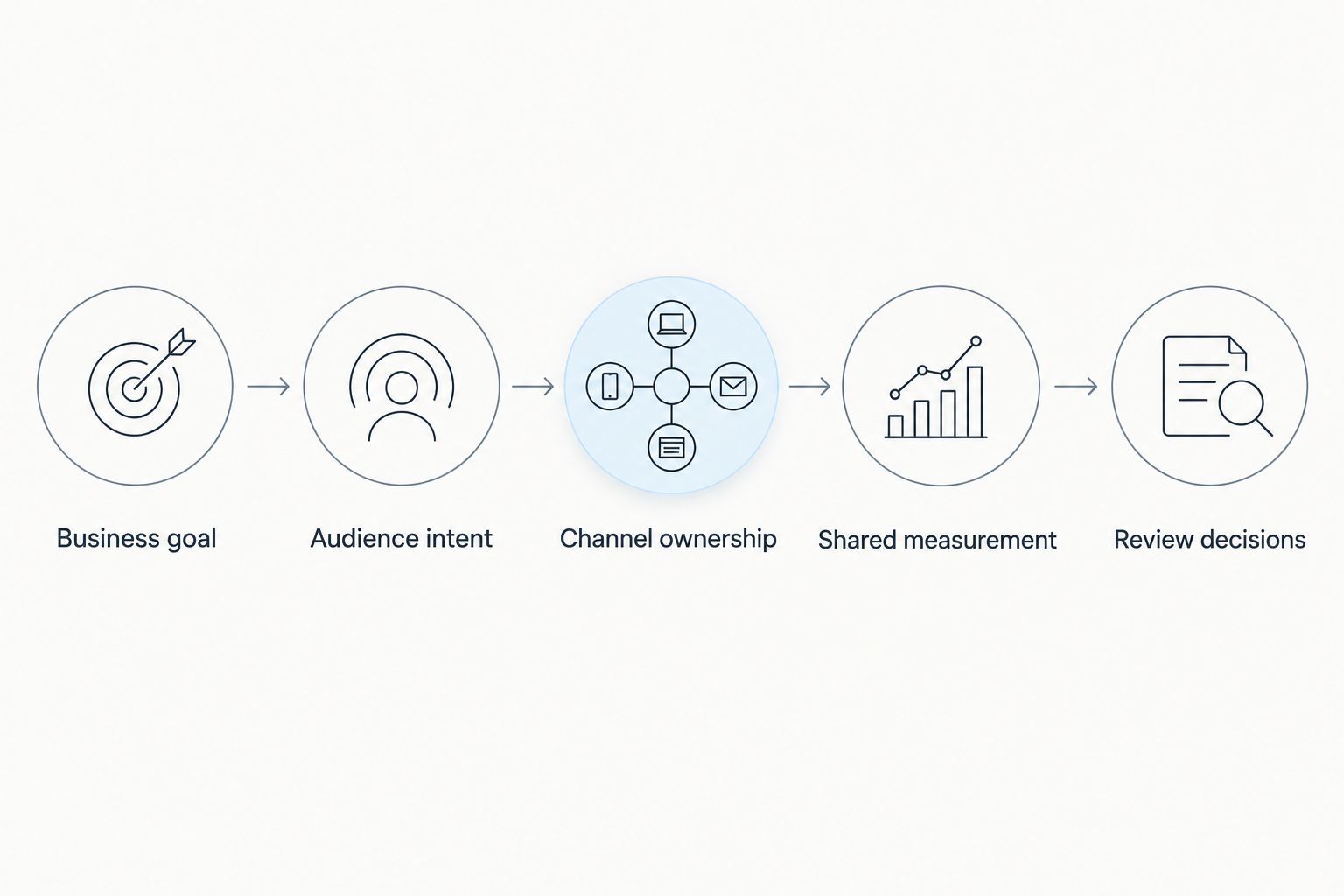
Ask for a workflow you can inspect. For a 2026 engagement, the following sequence turns “integrated marketing” into specific responsibilities rather than a positioning statement.
- Business goal: Define the outcome, such as qualified opportunities, purchases, or repeat orders. Explain what counts and what does not.
- Audience intent: Map buyer questions and objections to the relevant campaigns, content, and website pages. Keep the message consistent without making every asset identical.
- Channel ownership: Name the person responsible for each discipline and the person accountable for resolving conflicting priorities.
- Shared measurement: Agree on conversion definitions, reporting sources, and how sales or purchase outcomes return to the marketing team.
- Review decisions: Use the combined evidence to decide what to improve, stop, or expand. Record the decision and its business reason.
The sequence matters because channel choices should follow the business goal. Starting with a list of platforms leaves you deciding later what those platforms were supposed to accomplish.
Ask for a practical example of information moving between teams. Search questions can inform content briefs; objections found in sales conversations can inform ad copy; landing-page findings can inform broader website changes.
For a specific search handoff, review the Search Console to paid search gaps workflow. The useful question is not whether teams share access, but whether shared information changes their next decision.
Why the right channel mix varies
There is no universal paid-to-organic allocation for a 2026 plan. Set the mix around the work your business needs, then ask the agency to explain the trade-offs.
- Business model: B2B and B2C companies need different definitions of a useful response. Specify whether success means an opportunity, an order, or another commercial action.
- Brand strategy: Unclear positioning creates a messaging problem across channels. Resolve the offer and audience before expanding execution.
- Website requirements: A site build, redesign, or commerce integration changes the work needed around acquisition. Separate those dependencies from ongoing campaign management.
- Creative requirements: Paid social, website pages, and content need different assets. Confirm production responsibilities rather than assuming existing materials cover everything.
- Scope of execution: An engagement combining SEO, advertising, and web work has more moving parts than a single-channel assignment. Match the scope to named owners and deliverables.
Ask for the reason behind the mix, not a standard package. An agency should explain why each proposed channel belongs in your plan and what evidence would justify changing that decision.
What evidence shows an agency can connect the work?
Look for projects that name both the work performed and the reported outcome. A service list establishes breadth; a project summary gives you something more specific to question.
Hey Prospekt’s project summaries include examples of combined website, creative, and acquisition work:
- Window Guard: Paid social, website and catalog redesign, and local SEO were associated with 426 new leads and a 10x revenue increase in five months.
- SwamiG: Magento 2 website work, ERP synchronization, SEO, and advertising were associated with a 310% increase in organic traffic and 4× return on ad spend.
- Russell Westbrook Enterprises: A mobile-first Webflow build with division-specific architecture was associated with a 380% increase in mobile engagement and 2.3x B2B inquiries.
These examples describe different combinations of work. Window Guard and SwamiG are directly relevant to evaluating connected acquisition services; Russell Westbrook Enterprises illustrates the website component rather than proving paid-and-organic management by itself.
For your 2026 shortlist, use those distinctions. Ask for evidence that matches the services you plan to buy. A website engagement is not evidence of advertising execution, and an organic traffic increase does not establish revenue attribution.
Project outcomes also do not isolate each channel’s contribution. Ask how the agency defined the metrics, what changed during the engagement, and which results were attributable to the combined program rather than a single tactic.
What should you ask before signing?
Ask the agency to walk through the proposal as an operating agreement. You should be able to identify the work, the owner, the dependency, and the evidence used to judge progress.
Start with these questions:
- Who owns paid media, SEO, content, creative, and website implementation?
- Which deliverables are included, and which require a separate agreement?
- Who decides when paid and organic teams want different priorities?
- How will sales quality or purchase outcomes reach the delivery team?
- What access will your company retain to accounts, assets, and reporting?
- What happens when an experiment fails or a required website change is delayed?
Strong answers are specific without pretending outcomes are guaranteed. Weak answers substitute campaign volume, publishing volume, or dashboard access for a clear decision process.
A proposal should also state your obligations. Product information, approvals, technical access, and sales feedback need owners on your side; an agency cannot resolve every dependency without your participation.
Define your paid and organic scope
Discuss your business goals and the brand, web, and growth marketing work they require.
Should you hire separate agencies instead?
Separate agencies fit businesses with internal leadership ready to coordinate specialists. Choose that model when you can own the shared brief, resolve priorities, and connect reporting across partners.
The advantage is focused expertise. The drawback is that coordination stays with you, including disagreements about attribution, website changes, and which team gets the next creative resource.
Does organic growth mean you can stop paid campaigns?
Organic growth does not automatically justify stopping paid campaigns. Review whether advertising contributes useful demand beyond what your organic presence already captures.
Likewise, paid performance does not remove the need for useful content or a clear website. Judge each channel by its role and evidence, not by a rule that one must replace the other.
What should the combined report show?
A combined report should show business outcomes alongside channel diagnostics. For lead generation, connect inquiries with qualification and sales outcomes; for commerce, connect acquisition activity with orders and revenue.
Keep attribution limitations visible. Adding together every platform’s claimed conversions is not the same as counting distinct customers or purchases.
FAQ
Can a growth marketing agency manage paid and organic for a B2B company?
Yes, a growth marketing agency can manage both for a B2B company when the scope includes the relevant specialists and deliverables. Define qualified opportunities and sales feedback alongside channel metrics.
Is one agency better than separate SEO and PPC agencies?
One agency is better when you need shared ownership across channels and website work. Separate specialists fit teams with internal leadership available to coordinate strategy, priorities, and measurement.
Does full-service marketing automatically include SEO and advertising?
No, a full-service label does not establish which services your agreement includes. Require explicit deliverables for SEO, advertising, content, creative, and website implementation.
Can Hey Prospekt support brand, website, and growth marketing together?
Hey Prospekt offers brand, web, and growth marketing services for B2B and B2C companies. Confirm the specific paid and organic responsibilities in the proposed engagement.
What should I measure across paid and organic marketing?
Measure business outcomes across paid and organic marketing, then use channel metrics to diagnose performance. Define qualified leads, opportunities, purchases, or other relevant outcomes before reporting begins.
Can an agency guarantee rankings and profitable advertising?
Do not treat an agency promise as proof of future rankings or profitable advertising. Evaluate documented work, relevant project evidence, measurement definitions, and accountability instead.
Do I still need an internal marketing owner with one agency?
Yes, assign an internal owner for goals, approvals, access, and business feedback. One agency consolidates delivery relationships but does not replace your commercial decision-making.
One last thing
Ask the proposed team to explain a decision that would benefit the business but reduce one channel’s reported success. For example, what evidence would make the team reduce an advertising campaign rather than defend its conversion total?
An integrated agency should be accountable for the business outcome, not for making every channel look successful. Put that principle into your brief before discussing the channel list.
Related guides
- Can SEO and PPC work together for faster growth?
- How long does it take to see growth marketing results?
- Can one agency handle both branding and web design?


