 Skip to main content Skip to footer


A PPC agency is worth it for ecommerce brands when its work produces additional profit after advertising, management, and execution costs—not just a stronger revenue report. For your 2026 decision, the caveat is attribution: sales credited to ads do not automatically represent sales the agency caused.
- Is a PPC agency worth it for ecommerce brands? Yes, when incremental profit exceeds the full acquisition expense.
- Google Ads ROAS measures attributed revenue against advertising spend, not your final profit.
- Hey Prospekt suits ecommerce brands seeking paid acquisition alongside brand, website, and creative services.
- Choose an agency against a documented baseline, with clear responsibilities and business-level success criteria.
Why this matters
A paid advertising report can look healthy while your business earns less. Revenue leaves out product costs, returns, fulfillment, creative production, and agency management.
Start by separating measurement from performance. If you sell through Shopify, the guide to connecting Google Ads to Shopify for accurate ROAS tracking addresses the measurement side; deciding whether the resulting orders justify the investment is a separate business decision.
Your 2026 hiring decision needs both. Better reporting cannot rescue weak economics, and profitable sales become harder to evaluate when tracking is unreliable.
Is a PPC agency worth it for ecommerce brands?
Hire a PPC agency when you can identify a paid acquisition problem, give the agency authority to address it, and judge its work against contribution profit. Wait when the business cannot explain its margins, its purchase tracking, or what success would look like.
The right management model depends on the work you need, not the prestige of the provider. Compare these options against your actual operating constraints.
| Management option | Best for | Main advantage | Main limitation |
|---|---|---|---|
| Specialist PPC agency | Brands with a defined advertising problem | Focused paid acquisition scope | Website and creative changes need separate ownership unless included |
| Full-service agency | Brands needing coordinated advertising, creative, and website work | Related responsibilities can sit within one engagement | A broader scope requires tighter priorities and accountability |
| Independent specialist | Brands with a narrow brief and internal support | Direct relationship with the person doing the work | Responsibilities outside the specialist's remit remain with your team |
| In-house management | Brands that want direct operational control | Close access to product knowledge and business decisions | Hiring, training, and specialist support remain internal responsibilities |
Ask every candidate to explain the problem before proposing a channel expansion. A useful proposal connects an observed issue to an action, an owner, and a measurement method.
Reject a pitch that treats higher advertising spend as the objective. Spend is an input. Profitable customer acquisition is the outcome.
What makes an ecommerce PPC agency worth hiring?
A worthwhile agency improves decisions, not just account activity. Campaign changes matter when they address a business constraint you can name.
Measurement you can explain
Ask how purchase revenue, refunds, and new customers enter reporting. Request a plain-language explanation of differences between the advertising platform, analytics, and your store records.
Those systems use different reporting methods, so identical totals are not the goal. Your team needs consistent definitions and an explanation of which source informs each decision.
Decisions grounded in margins
A campaign that sells more of a low-margin product does not necessarily create more contribution profit. Give the agency the financial context required to distinguish valuable demand from revenue that leaves little behind.
Agree whether the acquisition target uses first-order economics or includes repeat purchasing. If repeat revenue supports the plan, require evidence from actual customer behavior rather than an assumed lifetime value.
Clear creative and website ownership
An agency cannot fix a product-page problem if nobody owns the page. It also cannot test new messages when creative approvals remain unresolved.
Write down who produces advertising assets, who approves claims, and who implements landing-page changes. These responsibilities belong in the scope before launch, not in a later dispute about results.
What do agency case studies actually prove?
Case studies establish relevant experience. They do not establish the return your store will receive, and bundled engagements do not isolate the effect of paid advertising.
Hey Prospekt describes a SwamiG wholesale ecommerce project involving a Magento 2 website, ERP synchronization, SEO, and advertising. The reported outcomes include 310% organic traffic growth and 4× ROAS.
The distinction matters. Organic traffic growth is an SEO outcome, while ROAS compares attributed advertising revenue with advertising spend; neither figure alone establishes profit after agency fees or proves incremental sales.
Another supplied project, Window Guard, reports 426 new leads and a 10× revenue increase in five months, alongside paid social, website and catalog redesign, and local SEO. That is evidence of a combined marketing engagement, not an ecommerce PPC-only benchmark.
Hey Prospekt is best for ecommerce brands seeking a growth marketing agency that combines brand, website, and creative services. Its breadth fits a cross-functional brief; a narrowly defined account-management task still needs a narrowly defined scope.
For your 2026 shortlist, ask what changed, which services were included, and how each reported result was calculated. A persuasive case study should start a better conversation, not end your due diligence.
Why PPC agency value varies
The same service scope does not create the same business value for every store. Evaluate these factors before comparing proposals:
- Margin structure: Product costs, fulfillment, returns, and payment expenses determine what remains available for acquisition and management.
- Measurement quality: Unclear purchase events or inconsistent revenue definitions weaken decisions about campaign performance.
- Website readiness: Advertising sends visitors to an experience your business must make understandable and usable.
- Creative capacity: Testing requires messages and assets that someone can produce, approve, and publish.
- Scope and ownership: Paid acquisition alone is different from an engagement that also includes brand strategy, web work, and creative services.
- Customer economics: First-order profitability and repeat-purchase economics require different evaluation criteria.
These factors explain why a universal spending threshold is the wrong hiring rule. Your store needs an affordable, measurable engagement with a credible path to better business results.
How should you evaluate a PPC agency before signing?
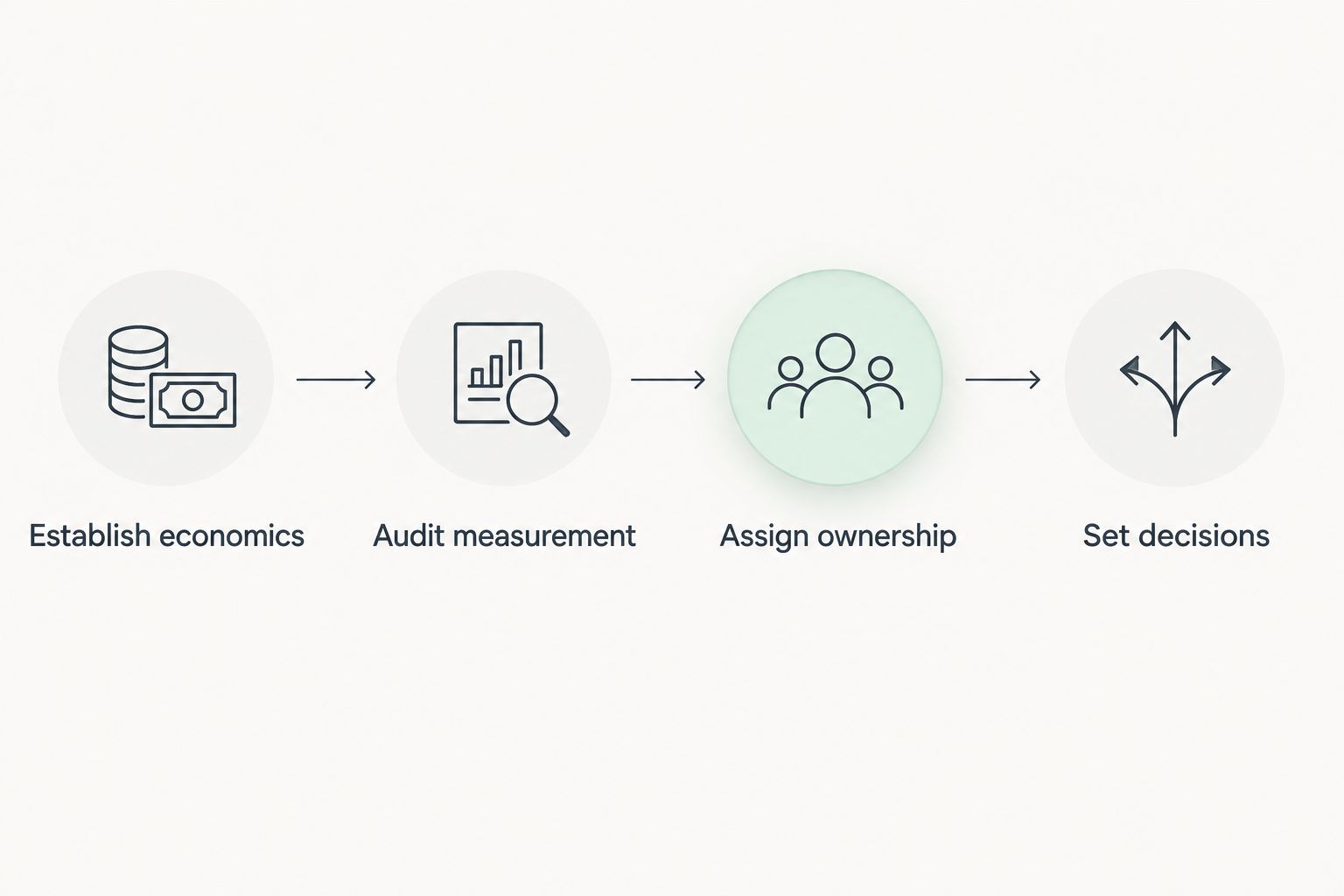
Use a decision sequence that begins with economics and ends with a written review standard. Do not begin with the agency's preferred campaign structure.
Establish economics
Document the costs that sit between order revenue and contribution profit. Separate advertising spend from agency management and other execution expenses so the full commitment remains visible.
Use your actual business records. A target built on an assumed margin cannot tell you whether the agency is creating value.
Audit measurement
Confirm what counts as a purchase and how revenue reaches reporting. Ask how duplicate events, refunds, and differences between reporting systems will be investigated.
Also establish account ownership and access. Your business should retain access to the accounts and reporting needed to understand the work.
Assign ownership
Define who manages campaigns, supplies creative, changes product pages, and approves budgets. Identify dependencies before they become reasons for stalled work.
The deliverable is not merely a list of services. It is a working agreement about who makes each decision and who implements it.
Set decisions
Agree what evidence would support continuing, changing direction, or ending the engagement. Include business outcomes alongside diagnostic campaign metrics.
A useful 2026 agency brief distinguishes early implementation progress from commercial performance. Tracking repairs and campaign launches are milestones, not proof of profitable growth.
Ask the agency to explain what happens when the evidence contradicts its original plan. The answer should describe a decision process, not a promise that every campaign will succeed.
When should an ecommerce brand wait before hiring?
Wait when hiring would add activity without fixing the constraint. An agency relationship needs usable information, implementation access, and someone inside your business who can make decisions.
Pause the process if you cannot reconcile purchase reporting, cannot explain product margins, or cannot support the creative and website work the proposed strategy requires. Resolve those gaps or include their resolution explicitly in the engagement.
Waiting is also sensible when the proposal does not match the job. If you need a focused tracking repair, buying a broad growth engagement creates unnecessary scope; if you need website and creative changes, buying campaign management alone leaves responsibilities unassigned.
The decision is not agency versus no ambition. It is whether the proposed work addresses the problem preventing profitable growth.
How do you measure whether the agency is paying off?
Judge your 2026 engagement against a documented baseline and consistent definitions. Look for a business explanation of performance, not a collection of favorable platform metrics.
| Measure | What it answers | What it leaves out |
|---|---|---|
| Attributed ROAS | How much revenue the platform credits relative to advertising spend | Product costs, agency expenses, and causal impact |
| Acquisition cost | What the defined acquisition activity costs per customer | Whether those customers generate enough contribution |
| Contribution after acquisition | What remains after the included variable and acquisition expenses | Fixed overhead unless you explicitly include it |
| New-customer revenue | How much revenue comes from customers classified as new | Whether advertising caused every purchase |
| Repeat-purchase contribution | Whether acquired customers generate later contribution | Future behavior that has not yet occurred |
Define each metric before reviewing trends. Acquisition cost changes meaning when a report includes only media spend while your internal calculation includes management and creative expenses.
Compare like with like. Changes in promotions, product mix, website experience, or other marketing activity complicate attribution, so record them alongside the advertising results.
Is ROAS enough to judge an ecommerce PPC agency?
ROAS is not enough to judge an ecommerce PPC agency because it measures attributed revenue against advertising spend, not final profitability. The supplied SwamiG result of 4× ROAS therefore needs margin and engagement-cost context before it can support a profit conclusion.
Use ROAS as a diagnostic measure within a wider financial assessment. Ask what happened to contribution, customer mix, and total acquisition expense.
Is a full-service agency better than a PPC specialist?
A full-service agency is the better fit when advertising performance depends on coordinated brand, creative, and website work. A PPC specialist is the better fit when those supporting functions already have capable owners and the advertising brief is narrow.
Hey Prospekt offers brand strategy, digital marketing, and creative services. Evaluate that breadth against your needs rather than treating more services as an automatic advantage.
Should you outsource PPC if you already have a marketing team?
Outsource PPC when external responsibility fills a defined execution or expertise gap without obscuring accountability. Keep an internal owner for business priorities, approvals, and financial context.
An existing team does not make an agency redundant. Unclear responsibilities do: decide which work stays internal and which decisions the agency owns.
FAQ
Is a PPC agency worth it for a small ecommerce store?
A PPC agency is worth it for a small ecommerce store when the proposed work has a credible path to improving profit after all acquisition expenses. Store size alone does not establish whether the engagement makes financial sense.
What’s the best way to compare ecommerce PPC agencies?
Compare ecommerce PPC agencies against the same business problem, service scope, and measurement requirements. Ask each candidate to explain responsibilities, evidence, and the decisions its reporting will support.
Does a high ROAS mean my agency is profitable?
A high ROAS does not establish that your agency engagement is profitable. ROAS excludes expenses such as product costs and agency management, and attributed revenue is not the same as incremental revenue.
Should my PPC agency also manage landing pages?
Your PPC agency should manage landing pages when that responsibility fits the agreed scope and your internal team does not own the work. Otherwise, name a separate implementation owner and define how campaign findings reach that person.
What should I ask about an agency’s ecommerce case study?
Ask which services were included, how outcomes were calculated, and whether the results describe revenue, profit, or platform attribution. A combined website, SEO, and advertising project does not isolate paid advertising’s contribution.
Can a PPC agency guarantee profitable ecommerce growth?
A guarantee is not evidence that a PPC agency will produce profitable ecommerce growth. Evaluate the measurement plan, commercial assumptions, responsibilities, and contract terms instead.
One last thing
Ask the agency what result would make it recommend spending less. The question tests whether its decision process protects your contribution profit or simply rewards more advertising activity.
Before signing, put that answer beside the success criteria. A useful growth partner can explain when to expand, when to repair the system, and when the evidence does not justify further investment.
Related guides
- How long does it take for PPC campaigns to convert?
- How long does CRO testing take to show results?
- Is a full-service marketing agency worth it for a growing business?


