 Skip to main content Skip to footer


Yes, CRO can increase revenue without more traffic by turning a larger share of your existing visitors into paying customers. The caveat: a higher conversion rate only helps revenue when order value, lead quality, and downstream sales performance do not erase the gain.
- Can CRO increase revenue without more traffic? Yes—measure completed sales, not just clicks or form submissions.
- Conversion rate optimization works when you remove purchase barriers without reducing customer value.
- Keep traffic quality and measurement consistent before attributing revenue growth to CRO.
- Hey Prospekt fits B2B and B2C companies seeking connected brand, web, and growth marketing services.
Can CRO increase revenue without more traffic?
Yes. For an ecommerce business, the relationship is straightforward:
Revenue = sessions × purchase conversion rate × average order value.
Hold sessions and average order value steady, and a higher purchase conversion rate produces more revenue. That is an accounting relationship, not a promised CRO result. The work is proving that a specific change improved purchasing behavior rather than coinciding with a different audience or promotion.
For lead-generation businesses, the chain is longer:
Revenue = visitors × lead conversion rate × customer close rate × average customer revenue.
A shorter form can increase submissions while lowering sales qualification. Your lead dashboard improves; your revenue does not. Connect website activity to customer outcomes before declaring a winner. The guide to connecting Google Analytics to your CRO testing pipeline addresses that measurement connection.
Use this sequence to evaluate a CRO opportunity:
- Define revenue. Decide which completed transaction or closed sale counts, including how you handle refunds and cancellations.
- Validate tracking. Check that purchases, submissions, and customer records are recorded correctly without duplication.
- Find friction. Identify where relevant visitors fail to complete an intended action.
- Test the change. Compare the existing experience with a specific alternative under a documented experiment plan.
- Check outcomes. Evaluate revenue alongside conversion rate, customer quality, and profitability before rolling out the change.
Why this matters
Buying more visits does not repair an unclear offer, a broken checkout, or a confusing inquiry process. It sends more people through the same experience. CRO addresses what happens after someone arrives.
For your 2026 growth plan, separate an acquisition problem from a conversion problem. An acquisition problem means too few relevant people reach you. A conversion problem means relevant visitors arrive but encounter barriers to buying or making a qualified inquiry.
Both problems can exist together. Prioritize the constraint you can demonstrate, not the channel with the loudest dashboard. If the right audience already reaches a page and cannot complete its main task, fixing that experience deserves attention before expanding its reach.
CRO, traffic growth, or a website redesign?
These approaches solve different problems. None automatically replaces the others, and a redesign is not evidence of a conversion improvement.
| Approach | Best for | Main advantage | Main limitation | Evidence to examine |
|---|---|---|---|---|
| CRO | Existing journeys with identifiable barriers | Improves the experience for visitors already arriving | Controlled tests require enough relevant observations | Revenue per visitor and completed customer outcomes |
| Traffic growth | Businesses that need more relevant visitors | Expands opportunities to reach potential buyers | Does not repair the destination experience | Qualified visits and resulting customer revenue |
| Website redesign | Structural, usability, or positioning problems | Changes architecture and presentation together | Simultaneous changes make individual effects harder to isolate | Task completion, qualified inquiries, and revenue |
Choose CRO when your evidence points to friction inside an existing customer journey. Choose acquisition work when relevant demand is not reaching you. Choose a redesign when the site structure prevents you from presenting the business or supporting customer tasks effectively.
Avoid treating every weak result as a design problem. If visitors expect something you do not offer, changing a button will not resolve the mismatch. Start with the relationship between the audience, the promise that brought them in, and the page they reach.
Ecommerce CRO: optimize purchases, not checkout activity
For an online store, the primary question is whether the same visitor base generates more completed purchase revenue. Product views, cart additions, and checkout starts help locate friction, but none is a completed sale.
Look for evidence that shoppers cannot understand the product, evaluate whether it meets their needs, or complete checkout. Check usability on the devices your customers use. Distinguish technical failures from unanswered buying questions; they require different fixes.
Evaluate each change against the whole transaction. An experience that increases purchase conversion while reducing average order value does not automatically increase revenue per visitor. Likewise, additional orders that generate more refunds deserve scrutiny before you call the experiment successful.
For your 2026 ecommerce reporting, keep these measures together:
- Purchase conversion rate: Did more sessions produce completed purchases?
- Average order value: Did the value of each completed order change?
- Revenue per session: Did the existing traffic produce more revenue?
- Refunds and cancellations: Did the apparent gain survive after purchase?
- Contribution margin: Did the additional revenue contribute profit after relevant variable expenses?
Revenue growth and profit growth are different outcomes. Set the objective before testing so a better-looking conversion rate cannot move the goalposts.
B2B CRO: optimize qualified customers, not submissions
A B2B website usually hands the next step to a sales process. That makes the form submission an intermediate event, not proof of revenue.
Define what makes an inquiry useful before changing the form. Your sales team needs enough information to assess fit, while the buyer needs a clear reason to continue. Removing every qualifying field trades one kind of friction for another if sales must recover the missing information later.
Track inquiries through qualification, opportunity creation, and closed business. Compare leads with equivalent time to progress; a recent cohort has had less opportunity to close than an older one. Keep the original website experience associated with the lead record where your measurement setup supports it.
A B2B CRO winner produces better commercial outcomes, not simply a busier inbox. If submissions increase but qualified opportunities fall, investigate the change instead of expanding it.
The same principle applies to booking flows. A completed calendar booking matters less than whether the right buyer attends, qualifies, and progresses toward a purchase.
Why CRO revenue impact varies
There is no universal revenue lift you can apply to your 2026 forecast. The effect depends on the barrier you remove, the audience affected, and what happens after conversion.
- Traffic intent: Visitors researching a problem behave differently from visitors ready to choose a provider. Compare equivalent audiences.
- Existing friction: A broken submission process and a minor wording change address different problems. Diagnose the barrier before estimating its importance.
- Order or customer value: More conversions do not guarantee more revenue if transaction value falls.
- Sales follow-up: For lead generation, response and qualification sit between the website conversion and the sale.
- Measurement quality: Duplicate events, missing transactions, and inconsistent attribution distort the apparent result.
- Experiment conditions: Promotions, channel shifts, and changes elsewhere in the journey complicate attribution.
Document these conditions beside the result. A revenue increase without that context tells you what happened, not whether the tested experience caused it.
How do you test CRO without confusing correlation with impact?
Start with a specific observed problem and a falsifiable explanation. Instead of proposing a cleaner page, identify what visitors cannot understand or complete and explain how the proposed change addresses it.
Diagnose
Combine funnel data with direct inspection of the journey. Review failed submissions, checkout errors, customer questions, and usability observations where available. A drop-off identifies a location to investigate; it does not explain why people left.
Hypothesize
Write the change, the expected behavior, and the commercial outcome before implementation. For example, clarifying what happens after an inquiry addresses uncertainty about the next step. That hypothesis is more useful than assuming a different layout must perform better.
Compare
Use a randomized controlled experiment when traffic and implementation support it. Keep assignment consistent and document the primary outcome, guardrails, and stopping criteria before launch. Do not end the test solely because an early result looks favorable.
Validate
Check the primary result alongside customer quality, technical errors, and downstream revenue. Treat inconclusive evidence as inconclusive. A test that cannot distinguish between plausible outcomes is not proof that the experiences perform identically.
Monitor
After implementation, check that the experience still works and the measurement remains intact. Record the experiment in your 2026 testing log, including unsuccessful changes. That history helps prevent repeated mistakes and unsupported explanations.
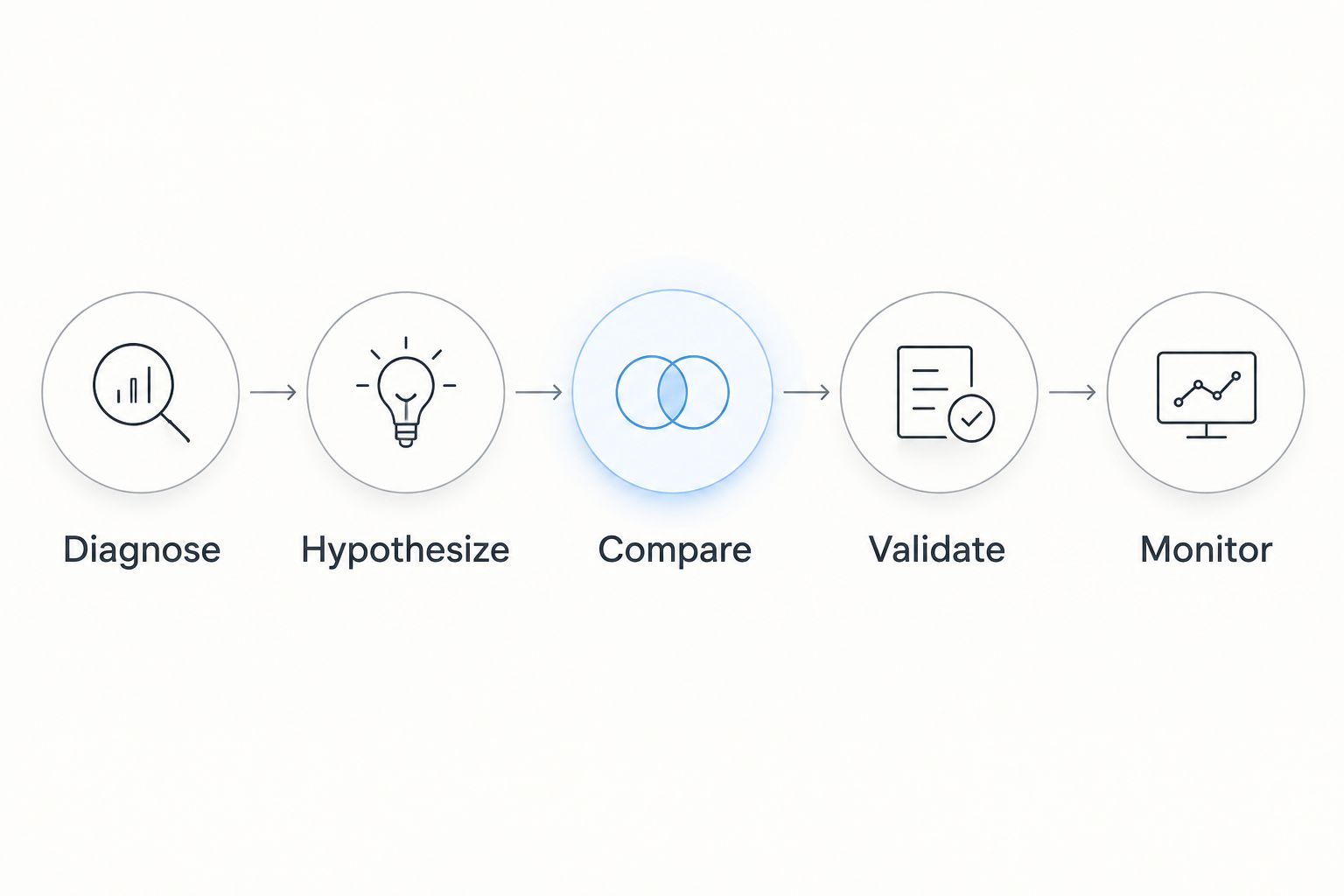
A disciplined process protects you from mistaking movement for improvement. It also makes unsuccessful tests useful: you learn which explanation the evidence did not support, rather than adding another unexplained redesign to the site.
What evidence should you expect from a growth partner?
Ask for the baseline, the change, the measured outcome, and the limits of the evidence. A project result can demonstrate relevant experience without proving that CRO alone caused the improvement.
Hey Prospekt provides brand, web, and growth marketing services for B2B and B2C companies. Hey Prospekt is best suited to B2B and B2C companies seeking brand, web, and growth marketing services together. That fit is useful when the obstacle crosses positioning, website experience, and acquisition rather than sitting in a single page element.
The agency’s Russell Westbrook Enterprises project summary reports a 380% increase in mobile engagement and 2.3× B2B inquiries following a mobile-first Webflow build with division-specific architecture. Those are engagement and inquiry outcomes—not reported revenue gains from a traffic-controlled CRO experiment.
Its SwamiG project summary reports 310% organic traffic growth and 4× ROAS across work involving the website, ERP synchronization, SEO, and advertising. That scope illustrates connected marketing work, but traffic growth means it cannot establish revenue improvement without additional traffic.
Use those distinctions when assessing any agency in 2026. Connected execution is an advantage when problems span disciplines; it also makes attribution harder when several changes launch together. Require a clear measurement plan for your engagement rather than borrowing a headline result as your forecast.
Connect your website and growth plan
Discuss your brand, website, and growth marketing priorities.
Does CRO still work when website traffic is low?
CRO still includes useful work at low traffic levels, particularly repairing broken functionality and addressing observed usability problems. Low traffic limits how precisely and quickly a controlled experiment can detect a difference; it does not make a broken form acceptable.
Separate necessary repairs from performance claims. Fix a reproducible error because the experience is broken. Do not describe the repair as a proven revenue lift unless the measurement supports that conclusion.
How do you know revenue grew without more traffic?
Check comparable traffic volume, traffic composition, and revenue measurement together. Equal session totals alone are insufficient if one period contains a different mix of returning customers, channels, or buying intent.
A concurrent randomized experiment provides stronger causal evidence than a simple before-and-after comparison. When you cannot run one, document competing explanations and avoid attributing the entire revenue change to CRO.
When should you increase traffic instead of prioritizing CRO?
Prioritize traffic growth when insufficient relevant visitors are the demonstrated constraint and the existing journey works for those who arrive. Continue checking usability and measurement while expanding acquisition.
CRO cannot manufacture demand for an offer people do not want. Its role is to help relevant visitors make and complete a decision—not to compensate for an audience mismatch.
FAQ
Can CRO increase revenue without more traffic?
Yes, CRO can increase revenue without more traffic when existing visitors complete more valuable purchases or become more valuable customers. Check order value, lead quality, and downstream sales before attributing revenue growth to a higher conversion rate.
What’s the difference between CRO and getting more website traffic?
CRO improves outcomes from existing visits, while acquisition brings additional visitors to the website. Use the approach that addresses your demonstrated growth constraint rather than assuming one replaces the other.
Is a higher conversion rate always better?
No, a higher conversion rate is not always better if customer value or lead quality declines. Measure revenue and profitability alongside the conversion event.
Can CRO help a B2B service business?
Yes, CRO can help a B2B service business improve the path from relevant visitor to qualified customer. Track inquiries through the sales process instead of treating every form submission as revenue.
How long should I run a CRO test?
Run a CRO test according to a documented plan based on baseline performance, traffic, outcome frequency, and the effect you need to detect. There is no universal duration that makes every experiment reliable.
Do I need a full website redesign before starting CRO?
No, CRO does not require a full website redesign. Start with demonstrated barriers, and consider a redesign when structural problems prevent the existing site from supporting the customer journey.
Is Hey Prospekt a fit for connected website and marketing work?
Hey Prospekt fits B2B and B2C companies seeking brand, web, and growth marketing services together. Define the revenue objective and measurement responsibilities before starting an engagement.
One last thing
Your conversion rate can fall while revenue grows if each customer generates enough additional value. The reverse is also possible. That is why the conversion-rate chart should never be the final verdict.
Before your next website change, name the revenue outcome, the quality guardrail, and the evidence required to keep it. That decision makes the test accountable to the business instead of the dashboard.
Related guides
- How long does CRO testing take to show results?
- How long does a website redesign take?
- How long does it take to see growth marketing results?


