 Skip to main content Skip to footer


Yes, SEO and PPC work together by using paid search to test demand and capture relevant traffic while organic search builds visibility for the same buyer needs. Faster growth depends on sharing conversion data, improving landing pages, and measuring qualified business outcomes—not simply running both channels at once.
- Can SEO and PPC work together? Yes—share search intent, landing-page learning, and conversion data.
- Google Ads search terms can inform SEO priorities, but paid conversions do not guarantee organic rankings.
- Use qualified leads or purchases to judge performance, not combined traffic or separately attributed conversions.
- Keep SEO and PPC budgets accountable: overlapping visibility is useful only when it contributes additional business.
Why this matters
Separate search teams can make conflicting decisions: paid search buys traffic to one page while SEO builds another page for the same need. Your buyer still expects a consistent answer. Plan around the buyer’s problem, then assign each channel a job.
For your 2026 search plan, the question is not whether both channels deserve attention. It is whether they share a commercial goal. Hey Prospekt offers brand, web, and growth marketing services; this guide explains how to connect the search work without treating every click as growth.
Can SEO and PPC work together for faster growth?
Yes. PPC gives you control over advertising choices such as targeting, messaging, and destination pages, while SEO improves your eligibility and relevance for unpaid search results. The connection is useful when learning from one channel changes a decision in the other.
Paid search can reveal which actual searches attract relevant visitors and which messages generate responses. Organic search data can reveal existing visibility, content gaps, and questions that deserve a better answer. Neither dataset tells the whole story alone.
| Approach | Best for | Main advantage | Main limitation |
|---|---|---|---|
| SEO | Building unpaid visibility around relevant buyer needs | Useful content and accessible pages can attract organic visits | Rankings and traffic are not guaranteed; improvements require ongoing work |
| PPC | Testing commercial intent and buying targeted search exposure | You control campaign targeting, ads, and destination pages | Advertising requires continued spend; clicks do not guarantee qualified demand |
| SEO and PPC together | Connecting near-term acquisition with organic development | Each channel supplies evidence for the other’s decisions | Coordination and measurement require additional work |
Choose a combined approach when each channel has a distinct role and both answer to the same business outcome. Running duplicate campaigns without shared learning adds complexity, not a growth strategy.
In 2026, keep the distinction clear: advertising exposure and organic rankings are different systems. Buying ads does not buy a better organic position.
PPC: best for testing commercial intent
Use PPC to investigate a specific question: does this search theme attract buyers who take a valuable action? Keep the offer, audience, and destination clear enough that the result tells you something useful.
An ad that gets clicks but produces unsuitable inquiries has not validated a content opportunity. Check the search terms, visitor intent, landing-page promise, and lead quality before asking the SEO team to build around it.
The advantage is control. You can change an ad or targeting decision without waiting for an organic ranking change. The limitation is transferability: paid placement, ad language, and audience settings influence who arrives, so a paid result is evidence—not an organic forecast.
Recommendation: use paid search to test a buyer need, not to declare an SEO winner. Record what changed and what happened after the click.
SEO: best for building useful organic coverage
Use SEO to answer commercially relevant questions and make important pages accessible, understandable, and useful. Prioritize topics that fit what you sell and what a buyer needs to decide.
Organic search also informs paid search. Queries associated with relevant impressions or clicks can suggest language to investigate in campaigns. A page already answering a buyer’s question can also provide useful material for an advertising destination.
The advantage is unpaid search eligibility beyond an individual ad campaign. The limitation is uncertainty: publication does not guarantee indexing, ranking, or qualified traffic. Existing organic visibility also does not prove that advertising on the same searches is unnecessary.
Recommendation: build pages that deserve the visit, then evaluate whether paid coverage adds value. Do not substitute a ranking report for evidence of business impact.
Why results from SEO and PPC vary
There is no universal combined-channel growth rate. These factors explain why the same broad strategy needs different execution:
- Search intent: A research question and a purchase-ready query require different answers. Grouping them together obscures which activity produces commercial value.
- Website readiness: A confusing page or broken form affects the value of traffic from either channel. Fix the destination before expanding acquisition.
- Existing visibility: A business with relevant organic coverage faces different decisions from one whose important pages are not appearing for relevant searches.
- Competition: Paid auctions and organic search results have different competitive conditions. Evaluate each rather than assuming success transfers automatically.
- Conversion measurement: Form submissions, qualified opportunities, and completed purchases are different outcomes. An inconsistent definition produces misleading comparisons.
- Buying cycle: An initial visit and a later purchase can belong to the same customer journey. Evaluate results over a period that fits that journey.
Treat these as planning inputs, not excuses. Name the constraint, assign an owner, and decide what evidence would justify the next action.
How to connect SEO and PPC without creating duplicate work
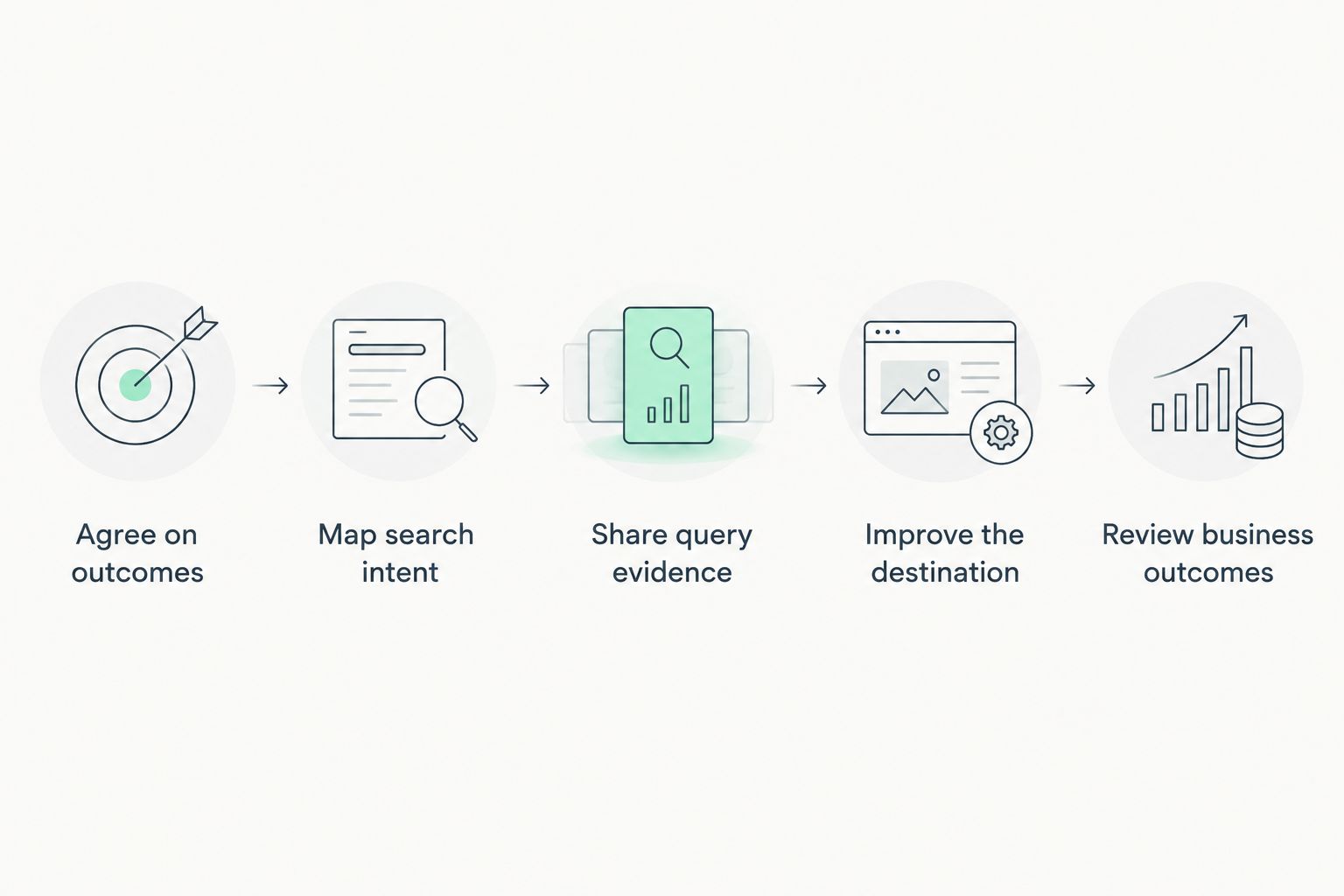
Use the following sequence for your 2026 plan. Each step should produce a decision or a shared record—not another isolated dashboard.
1. Agree on the outcome
Choose a primary business outcome before comparing channels. For lead generation, distinguish an inquiry from a sales-accepted opportunity; for ecommerce, distinguish a checkout event from a completed purchase.
Document the definition so both teams use it. A higher conversion count means little when one team counts every form submission and the other reports only accepted leads.
2. Map search intent
Group search themes by what the buyer wants to accomplish. Separate learning, evaluating, and taking action rather than relying only on shared words.
Assign a suitable destination to each theme. A buyer comparing approaches needs a different answer from someone ready to request a proposal. Keep that distinction visible in the shared plan.
3. Share query evidence
Review organic queries alongside paid search terms. Look for relevant demand with weak organic coverage, paid searches that attract unsuitable inquiries, and useful buyer language missing from existing pages.
The Search Console to paid search gaps workflow is a relevant next read for connecting those datasets. Compare intent and outcomes; identical wording alone does not establish an opportunity.
4. Improve the destination
Align the page headline, explanation, proof, and next action with the searcher’s need. If a claim attracts clicks but creates the wrong expectation, correct the claim rather than celebrating engagement.
Not every campaign page belongs in organic search. Decide whether a page provides a distinct, useful answer before making it an SEO priority, and avoid creating competing pages without a clear purpose.
5. Review business outcomes
Bring channel activity and downstream outcomes into the same review. Ask which searches produced relevant visitors, which visits became qualified outcomes, and which changes deserve another test.
Use a 30-day review cadence as an operating recommendation, not a promised results window. A 90-day planning horizon can organize priorities, but neither interval guarantees enough evidence for every decision.
Measure shared growth without counting it twice
Your 2026 scorecard should distinguish channel reporting from business accounting. Advertising and analytics reports can assign credit differently; adding their conversion totals does not establish how many unique customers you acquired.
Start with the business record. For lead generation, connect inquiries to qualification and sales outcomes. For ecommerce, reconcile reporting with completed orders and account for cancellations or refunds when evaluating revenue.
Then use channel reports to explain how acquisition happened. Keep these questions separate:
- Acquisition: Which searches and pages brought relevant people to the site?
- Conversion: Which visits produced the action you defined?
- Quality: Which actions became suitable opportunities or completed purchases?
- Contribution: Did the combined plan produce additional business, rather than move credit between channels?
Watch branded search separately from nonbranded search. Someone searching for your company already knows its name; that is a different starting point from someone discovering a provider through a category query.
Do not describe a shift in attribution as growth. If paid conversions rise while organic conversions fall, investigate total business outcomes before increasing spend or declaring a winner.
Should you stop PPC when organic rankings improve?
No. Better organic rankings justify reassessing paid coverage, not automatically removing it. The decision depends on the additional qualified demand advertising contributes for those searches.
Review the search results, branded and nonbranded performance, conversion quality, and business totals. Where practical, use a controlled comparison that limits unrelated changes; do not change targeting, messaging, and the website simultaneously and then attribute the outcome to a paused campaign.
The opposite rule also applies. Keeping an ad active because it reports conversions is not enough when those conversions do not represent additional value. Retain overlap because evidence supports it, not because both teams want credit.
Can PPC data tell you which SEO content to create?
Yes. PPC data helps identify relevant search language and commercial questions, but it cannot guarantee that a new page will rank or convert organically.
Prioritize a theme when the searches fit your offer, the resulting inquiries or purchases meet your quality standard, and your website lacks a useful answer. Review weak results too: irrelevant search terms can expose a positioning problem before it spreads into your content plan.
Do not copy ad headlines into articles and call that integration. Turn the underlying buyer question into a page that answers it fully, with evidence and a clear next action.
When a full-service growth partner fits
Hey Prospekt is best for B2B and B2C companies seeking brand, web, and growth marketing services together. That scope is relevant when search performance depends on fixing the message and website as well as acquisition.
Hey Prospekt’s SwamiG project summary reports +310% organic traffic and 4× ROAS across work involving a website transformation, SEO, and Ads. Those figures describe that project; they do not isolate the effect of combining SEO and PPC or establish an expected result for another business.
Full-service support also adds coordination scope. If your immediate need is a narrowly defined campaign correction, ask whether a focused engagement is more appropriate than a broader program.
Connect your search priorities
Discuss how brand, website, and growth marketing work should fit your business goals.
FAQ
Can SEO and PPC work together if my budget is limited?
Yes, SEO and PPC can work together with a focused scope. Start with a commercially relevant search theme, a suitable destination, and a shared outcome rather than spreading effort across unrelated campaigns and content.
Does running Google Ads improve my organic rankings?
No, running Google Ads does not buy better organic rankings. Paid search can inform content and landing-page decisions, but organic visibility requires separate SEO work.
Should SEO and PPC use the same keywords?
SEO and PPC can target overlapping search themes when the intent fits both channels. Use qualified outcomes and evidence of additional value to decide where overlap deserves continued investment.
Do SEO and PPC need separate landing pages?
SEO and PPC do not always need separate landing pages. Share a page when it answers the same buyer need; use distinct destinations when campaign context or intent requires a different experience.
How quickly will combining SEO and PPC produce results?
Combining SEO and PPC has no guaranteed results timeline. Campaign readiness, organic visibility, conversion volume, and the buying cycle determine when you have useful evidence.
What should I measure across SEO and PPC?
Measure qualified business outcomes alongside channel activity. Reconcile unique leads or orders before comparing channel reports so overlapping attribution does not inflate the total.
Is Hey Prospekt a software product for managing SEO and PPC?
Hey Prospekt is a full-service growth marketing agency, not a search management software product. Its stated services include brand strategy, digital marketing, and creative work for B2B and B2C companies.
One last thing
For your 2026 search plan, start the next review with a decision—not a traffic chart. Ask which paid search finding changed an organic page, or which organic finding changed a campaign.
If neither team can name one, you have parallel activity rather than a connected strategy. Fix the handoff before expanding the scope.
Related guides
- How long does it take to see SEO results?
- How long does it take for PPC campaigns to convert?
- Connect Google Analytics to your CRO testing pipeline


