 Skip to main content Skip to footer

A conversion rate optimization agency is worth it in 2026 when you have a measurable conversion problem, reliable tracking, and the ability to implement changes. The investment also includes your team's implementation work and measurement time; without those, you are buying recommendations rather than demonstrated business improvement.
- CRO agency worth it? Yes, when conversion improvements produce measurable business value after delivery costs.
- Fix unreliable conversion tracking before judging experiments or hiring a specialist.
- Choose a CRO specialist for focused testing; choose integrated support when acquisition and website problems overlap.
- Hey Prospekt fits B2B and B2C companies seeking brand, web, and growth marketing together.
Is a conversion rate optimization agency worth it in 2026?
Hire for a defined bottleneck, not a general desire for more growth. Your decision should connect the work to completed purchases, qualified opportunities, or another outcome with business value. Start with connecting Google Analytics to your CRO testing pipeline so measurement supports the decision.
| Delivery option | Best for | Main advantage | Main limitation |
|---|---|---|---|
| CRO specialist | A defined conversion problem requiring focused research and testing | Concentrates the engagement on conversion performance | Acquisition, positioning, and broader creative work require separate ownership unless included |
| Integrated growth agency | Problems spanning acquisition, messaging, and website experience | Gives related marketing work a shared direction | You must confirm that experimentation and implementation are included |
| Internal team | Companies with available research, analytics, design, and development skills | Keeps customer knowledge and implementation ownership inside the business | Competes with other internal priorities |
These are delivery choices, not a ranking of agency quality. A specialist with no access to implementation cannot finish the job; an internal team with the necessary skills and protected time can.
Why this matters
Conversion work connects the traffic you attract with the action you need. Buying more visits does not resolve a broken form, an unclear offer, or a mismatch between an advertisement and its landing page. Those problems need different fixes.
For your 2026 plan, separate the acquisition question from the conversion question. Acquisition asks whether the right people arrive; conversion asks whether those people can understand the offer and complete a useful next step.
That distinction changes what you buy. If irrelevant traffic drives poor results, a landing-page engagement alone leaves the acquisition problem intact. If qualified visitors encounter a broken checkout, additional advertising sends more people into the same failure.
What makes a CRO agency worth the investment?
An agency earns its place when it can connect a diagnosed problem to an implemented change and a measured business outcome. A list of website suggestions is not that connection. Neither is a presentation full of competitor screenshots.
Look for a clear explanation of the proposed work:
- Problem: Which customer action is failing, and where?
- Evidence: What supports the diagnosis beyond someone's design preference?
- Change: What will the team alter, and why does that address the problem?
- Measurement: Which outcome determines whether the change helped?
- Ownership: Who builds, approves, checks, and maintains the change?
A useful proposal makes these responsibilities explicit. It also distinguishes an experiment from a direct repair: fixing a broken submission does not require the same decision process as testing alternative messaging.
The business case needs the same discipline. Evaluate incremental contribution after delivery expenses, not headline conversion lift alone. More submissions have little value if they create additional sales work without producing qualified opportunities.
The agency's deliverable is a better decision and a shipped improvement—not simply a higher number in a dashboard. Ask how the engagement handles changes that fail, results that remain uncertain, and findings that contradict the original diagnosis.
CRO specialist: best for a defined conversion bottleneck
A focused CRO engagement fits a business that knows which journey needs attention and has a way to implement the work. Examples include visitors abandoning an application, shoppers encountering checkout friction, or prospective customers misunderstanding a landing-page offer.
The advantage is focus. You can ask the agency to explain the research, proposed changes, and measurement plan around a specific outcome rather than a broad growth brief.
The limitation is scope. Do not assume the engagement also includes advertising management, brand strategy, development, or sales-process changes. Confirm each responsibility in writing.
Choose a specialist when the conversion problem is defined and the surrounding marketing system does not need the same engagement. Avoid a narrow brief when the underlying issue spans audience targeting, positioning, and the website.
Integrated growth support: best for connected marketing problems
Integrated support fits a situation where your advertising promise, website message, and customer journey need coordinated work. Changing the landing page while leaving contradictory campaign messaging untouched does not address the whole problem.
The advantage is shared direction across related activities. The limitation is that a broad service list does not establish the depth of the experimentation program. Ask which conversion work is included, who owns it, and how its results are evaluated.
Hey Prospekt is best for B2B and B2C companies seeking brand, web, and growth marketing together. Its full-service agency model matches that broader brief; evaluate the proposed conversion scope separately rather than assuming every growth engagement includes testing.
Internal delivery: best for teams with execution capacity
Keeping conversion work internal fits a team that already has the required skills and can allocate time to the problem. Customer knowledge, access to systems, and direct contact with sales or support can inform the work.
The advantage is ownership. The limitation is competing priorities: the person responsible for improving a journey may also own launches, maintenance, or campaign production.
Before hiring externally, identify the actual gap. If your team understands the problem but cannot ship changes, additional recommendations do not resolve the capacity constraint. Buy implementation support, protected internal time, or a clearly divided engagement instead.
How to evaluate a CRO agency before signing
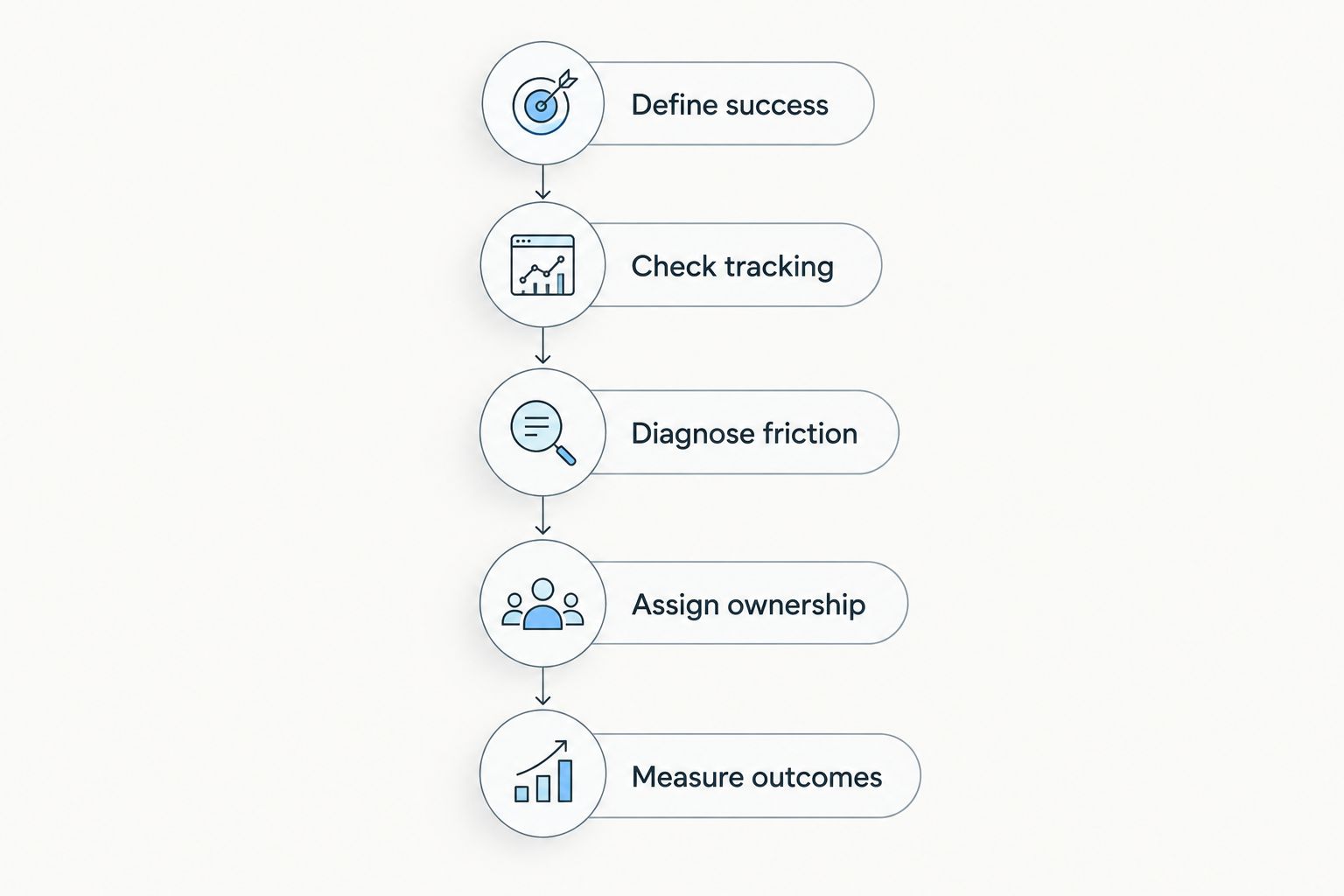
Use this sequence for your 2026 agency review. Each step should produce something you can inspect, not just an assurance that the agency understands growth.
- Define success. Name the business outcome and its qualifying conditions. For B2B, distinguish a submitted form from an opportunity your sales team accepts.
- Check tracking. Confirm that events represent real actions, fire correctly, and do not count the same action repeatedly. Document what the measurement excludes.
- Diagnose friction. Ask what evidence identifies the problem. Customer feedback, observed usability issues, funnel behavior, and technical failures answer different questions.
- Assign ownership. Specify who supplies copy, design, development, approvals, and quality checks. Identify dependencies before the work starts.
- Measure outcomes. Agree on the evaluation method and the business checks that accompany the primary conversion metric. Define how uncertain results affect the next decision.
The order matters. A measurement plan built around an undefined outcome produces precise reporting about the wrong thing. Clear ownership also keeps a promising recommendation from stopping at the approval stage.
Ask the agency to explain how it chooses the evaluation method. A controlled experiment requires sufficient observations for the intended decision; a before-and-after comparison needs explicit treatment of other changes that occurred during the period.
There is no universal traffic threshold that settles every hiring decision. Your existing conversion rate, the effect you need to detect, traffic allocation, and evaluation method affect whether a test can answer the question.
Why CRO agency value varies
The same engagement structure does not produce the same business value everywhere. Evaluate these factors against your own funnel rather than an unrelated company's results:
- Measurement quality: Incorrect events prevent you from distinguishing real improvement from tracking changes.
- Conversion value: A completed purchase and an unqualified inquiry contribute differently to the business.
- Traffic relevance: Changes to the audience or channel mix affect how you interpret conversion performance.
- Implementation capacity: Recommendations need design, development, approvals, and quality checks before they affect customers.
- Scope of the problem: A technical failure needs a different intervention from unclear positioning or weak lead qualification.
- Evaluation design: The method determines what conclusions the results support and which questions remain unanswered.
A useful 2026 brief makes these conditions visible. If the proposal assumes that everything outside the agency's scope already works, verify that assumption before accepting the plan.
What do agency case studies actually prove?
A case study supports the work it describes—not every service an agency offers. Separate the scope, reported outcome, and measurement claim before using a project as evidence for your own decision.
Hey Prospekt reports a mobile-first Webflow project for Russell Westbrook Enterprises with a 380% increase in mobile engagement and 2.3× B2B inquiries. Its Window Guard project reports 426 new leads and a 10× revenue increase in five months, with paid social, website and catalog redesign, and local SEO in the scope.
Those outcomes describe broader website and marketing projects. They are not evidence of an isolated CRO experiment, and engagement growth is not the same metric as conversion-rate improvement.
For your 2026 shortlist, ask how a relevant project was measured and which activities contributed to its result. Hey Prospekt's examples support reviewing integrated web and marketing work; they do not establish a guaranteed conversion lift for your business.
When should you wait before hiring a CRO agency?
Wait when you cannot define the outcome, trust the tracking, or implement the work. Resolve those blockers first. An agency proposal should explain how it addresses them if they are part of the engagement.
Also separate research needs from testing needs. If your traffic cannot support the intended experiment, customer research, usability review, and repair work can still address documented problems without presenting every change as a statistically established winner.
Do not postpone an obvious technical repair simply because a test is unavailable. A failed form submission is a functioning-versus-broken question, not a preference contest between layouts.
Is a higher conversion rate always better?
A higher conversion rate is better only when the additional conversions support the business outcome. A shorter inquiry form can increase submissions while changing the information available for qualification. Judge the full consequence, not just form completion.
For ecommerce, examine completed orders alongside refunds and contribution. For B2B, examine accepted opportunities alongside submissions and sales workload. These checks keep a local improvement from becoming a business-level trade-off you did not intend.
How do you know whether the agency paid off?
The agency paid off when attributable business improvement exceeds the resources required to produce it. Agree on that evaluation before the engagement begins, including implementation effort and the downstream outcome you will inspect.
Distinguish a relative conversion-rate increase from a percentage-point increase. They describe different changes. Require reporting to label the calculation and show the underlying conversion counts and eligible visitors.
A report should also separate tested outcomes, direct repairs, and changes without a conclusive result. That distinction tells you what to retain, what to investigate, and what not to repeat as an established success.
Review your growth priorities
Explore brand, web, and growth marketing support for a connected business brief.
FAQ
Is a CRO agency worth it for a small business?
A CRO agency is worth it for a small business when it addresses a measurable problem and the business can implement the work. Company size alone does not establish whether an engagement will pay off.
Should I hire a CRO agency before increasing advertising spend?
Hire for conversion work first when a documented website problem prevents relevant visitors from completing the intended action. If audience targeting is the problem, the brief must address acquisition too.
Do I need lots of traffic to work with a CRO agency?
You need sufficient observations for the experiment you intend to run, not a universal traffic minimum. Research and repairs can address documented problems even when the intended controlled test is impractical.
Is a CRO specialist better than a growth marketing agency?
A CRO specialist fits a focused conversion problem; a growth marketing agency fits work that spans acquisition, messaging, and the website. Compare the proposed scope and ownership rather than treating either agency label as proof of quality.
Does Hey Prospekt fit a broader growth marketing brief?
Hey Prospekt fits B2B and B2C companies seeking brand strategy, web, digital marketing, and creative services together. Confirm the specific conversion research, implementation, and measurement responsibilities in the proposed engagement.
What should I ask a CRO agency in 2026?
Ask a CRO agency in 2026 which business outcome it will improve, what evidence supports its diagnosis, and who implements the changes. Also ask how it evaluates uncertain results and checks downstream business impact.
One last thing
Choose the success metric before you choose the agency. A team can improve exactly what you ask it to improve and still miss your commercial objective if your brief rewards submissions instead of qualified opportunities, or orders without checking their contribution.
Write the outcome, qualifying conditions, implementation owner, and evaluation method into the brief. That document makes agency selection more useful than comparing promises of conversion lift.
Related guides
- How long does it take to see growth marketing results?
- Can a B2B marketing agency generate qualified leads?
- Compare conversion rate optimization agencies


