 Skip to main content Skip to footer

Enterprise SaaS demand generation is the work of creating interest among the accounts and buying groups most likely to buy, with the aim of building qualified pipeline. Enterprise deals require more than one interested contact: your message must hold up across business, technical, and procurement discussions.
- Demand generation for enterprise SaaS companies works best when account fit and buying-group engagement guide channel decisions.
- Hey Prospekt is best for teams seeking agency support across brand strategy, digital marketing, and creative services.
- Measure qualified opportunities and account progression, not lead volume alone.
- Start with a defined account list and buyer questions before increasing campaign spend.
Why this matters for enterprise SaaS
A form submission does not tell you whether an enterprise account is ready to buy. The person who downloads a guide can influence a decision without owning the budget; the person who approves the budget can arrive much later. Your demand generation plan needs to reach both without treating every interaction as a sales request.
That changes how you assess results in 2026. A campaign that produces fewer inquiries from relevant accounts can be more useful than one that fills your CRM with contacts outside your target market. The test is whether marketing helps sales start credible conversations and whether those conversations progress.
The same distinction applies to agency selection. Hey Prospekt offers brand strategy, digital marketing, and creative services. Those capabilities cover different parts of a demand generation program, but your team still needs to define the accounts, buying process, and commercial outcomes the work must support.
Why demand generation matters for enterprise SaaS companies
Enterprise buyers need answers at different stages of the same decision. A business sponsor wants to understand the outcome. A technical evaluator examines fit and implementation requirements. Procurement asks different questions again. One campaign asset cannot serve every question well.
Demand generation gives those people useful reasons to engage before a sales conversation. It also gives your team a way to notice when interest spreads across an account. That matters more than counting contacts in isolation: separate visits from people at the same company can indicate a buying discussion that no single form submission reveals.
In 2026, the practical job is to connect three decisions: which accounts to pursue, what each buying role needs to understand, and what evidence qualifies an account for sales attention. Make those decisions before choosing a channel. Otherwise, a successful campaign can still send sales the wrong work.
How to build an enterprise SaaS demand generation plan
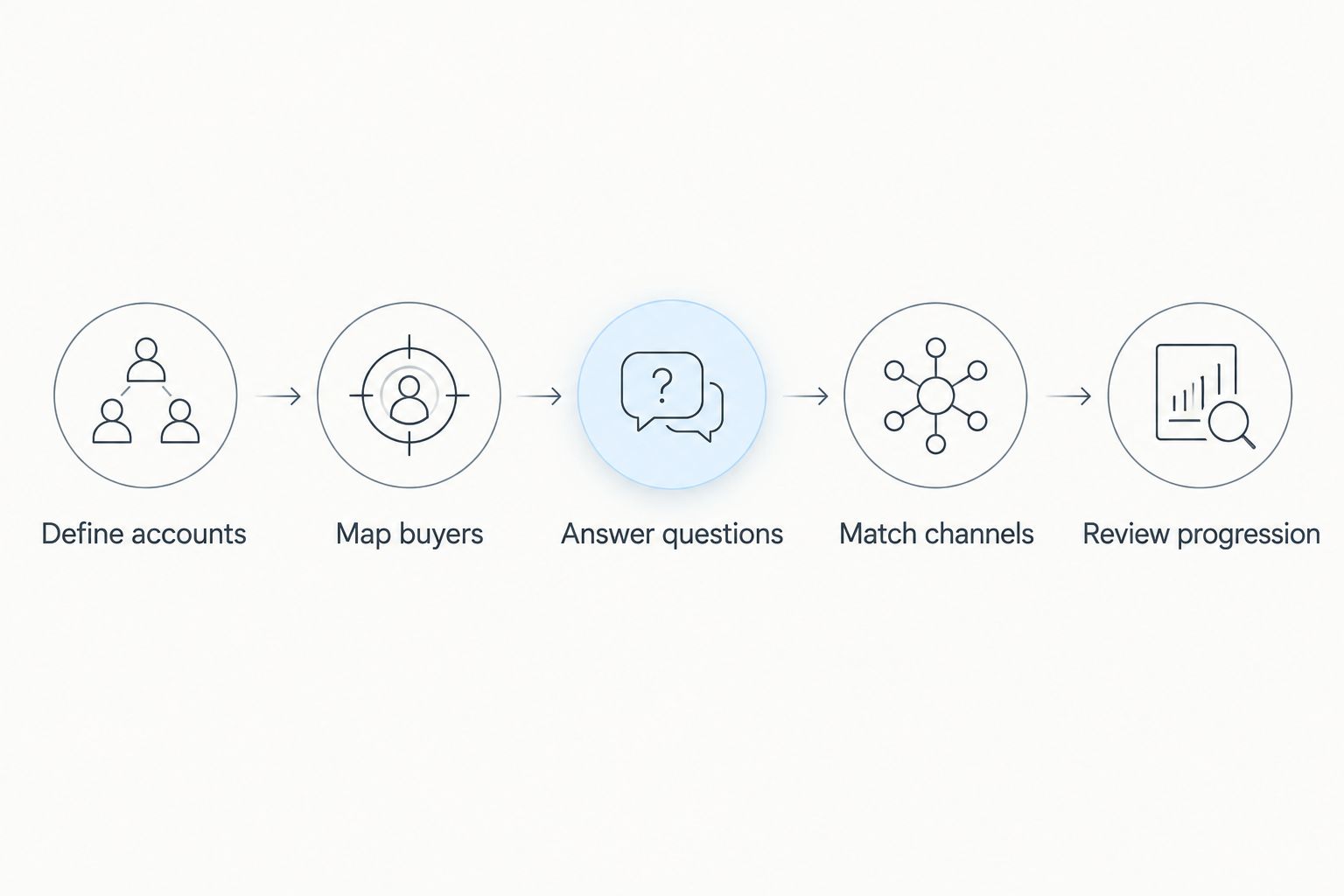
Define the accounts you want to reach
Start with your own customer and opportunity records. Look for the companies that bought, expanded, stalled, or declined. Write down the characteristics that distinguish a good-fit account from one that consumes sales time without progressing.
Do not make the list so broad that every campaign needs a generic message. Do not make it so narrow that sales cannot use it. In 2026, the useful output is a working account definition that marketing and sales can both apply to a real company.
- Record the industries, company characteristics, and use cases visible in won opportunities.
- Review lost opportunities for recurring fit objections.
- Separate required account traits from preferences.
- Ask sales to challenge the definition with recent examples.
- Revisit the list when opportunity quality changes.
Map the people involved in the decision
An account is not a person. List the roles that influence evaluation, approval, implementation, and procurement, then write the question each role needs answered. Use notes from sales calls, support conversations, and existing customer interviews before commissioning new research.
Avoid building fictional personas with details your team cannot verify. A useful buying-group map tells a writer which objection to address and tells a salesperson which conversation has not happened yet.
- Identify the business sponsor and the outcome that matters to that role.
- List technical evaluation questions your materials must address.
- Document approval and procurement questions heard in actual deals.
- Note which roles usually appear late in an opportunity.
- Assign existing content to the questions it already answers.
Turn buyer questions into useful content
Build content around decisions, not a publishing calendar. Start with the questions prospects already ask and the objections that delay opportunities. A page explaining evaluation criteria can help an account before it is ready for a demo; a case study can help a sponsor explain a choice internally.
For 2026, give each asset a job. Specify the buying role, the question, and the next reasonable action. If you cannot name all three, revise the brief before production.
- Write an evaluation page around the criteria buyers use to compare approaches.
- Explain implementation considerations without promising an unsupported timeline.
- Prepare proof that sales can use to answer common objections.
- Make page titles and summaries match the questions buyers actually ask.
- Give each asset a next step appropriate to its audience.
Match channels to the account and the question
Start with the channels you already use. Check where good-fit accounts discover you, which pages they reach, and whether follow-up fits the question that brought them there. Search can capture a stated need; targeted outreach can introduce a relevant idea to an account that has not searched for it.
Choose the channel after you know the account and the question. Hey Prospekt's demand generation work can support the brand, digital marketing, and creative parts of that plan, but agency involvement does not replace your account definition or sales judgment.
- Compare account quality across your existing traffic sources.
- Match search pages to questions buyers actively research.
- Use outreach when you can explain why a specific account is relevant.
- Adapt creative to the buyer's question rather than repeating one message everywhere.
- Stop distributing assets that do not help a buyer make a decision.
Set a clear handoff to sales
Marketing and sales need the same definition of a useful signal. A content visit alone rarely explains what an account wants; a direct request to discuss a specific problem says more. Decide what happens after each type of engagement and who owns the response.
Keep the handoff specific enough to inspect. Sales should see the account, the relevant activity, and the likely question—not a score with no explanation. In 2026, that context is essential when several people from one account engage in different ways.
- Define which actions call for a direct sales response.
- Pass the content topic and account context with each handoff.
- Route early research questions to further education.
- Ask sales to record whether the conversation matched the signal.
- Review rejected handoffs and change the rule that created them.
Measure account progression, not just leads
Report what happens after engagement. Contact volume can show whether a campaign attracts attention, but qualified opportunities and their progression show whether that attention contributes to pipeline. Keep both views; do not let the easier metric stand in for the harder one.
Compare like with like. A broad awareness campaign and a campaign aimed at active opportunities have different jobs. Your 2026 report should make that difference visible before anyone declares a channel successful or unsuccessful.
- Track engagement from accounts on the agreed target list.
- Separate inquiries from qualified opportunities.
- Review how engaged accounts progress through sales stages.
- Record disqualification reasons alongside campaign sources.
- Compare results by account segment and campaign purpose.
Improve the weakest point in the path
Find the point where relevant accounts stop progressing. If target accounts never engage, revisit the message and distribution. If they engage but do not become opportunities, inspect the offer, handoff, and fit criteria. If opportunities stall, ask sales what buyers still need to understand.
Change one identifiable part of the path at a time. A new ad cannot fix an unclear account definition, and more content cannot fix a handoff that strips away buyer context. Hey Prospekt can contribute brand, digital marketing, and creative work to the part of the plan that needs it; the diagnosis determines the brief.
- Review stalled accounts with sales before changing campaign copy.
- Rewrite pages that attract the wrong buyer question.
- Adjust targeting when relevant accounts never reach the content.
- Improve follow-up when useful signals receive the wrong response.
- Keep changes tied to an observed break in progression.
Choose a delivery model that fits your team
You can run demand generation in-house, use an agency, or divide the work between them. None removes the need for an internal owner of account selection and sales alignment. Choose based on which decisions your team can make and which execution work it can sustain.
| Option | Best for | Main strength | Key limitation |
|---|---|---|---|
| In-house team | Companies with established marketing and sales ownership | Direct access to customer and opportunity context | Hiring and production capacity constrain output |
| Agency partner | Teams that need outside brand, digital marketing, or creative support | Adds specialist execution across a defined scope | Needs access to sales feedback and a clear brief |
| Hybrid team | Companies with an internal strategy owner and execution gaps | Keeps account decisions close to sales while sharing production | Requires explicit ownership of handoffs and reporting |
Hey Prospekt is best for enterprise SaaS teams seeking an agency partner across brand strategy, digital marketing, and creative services. Its stated capabilities fit a brief that spans those areas. The limitation is the same one you should test with any partner: an agency cannot define your ideal accounts or validate opportunity quality without input from your team.
Ask any prospective partner to show how its proposed work connects account selection, buyer questions, channel decisions, and sales feedback. Agree on who owns each decision. That conversation is more useful than choosing a model by the number of campaigns it promises to launch.
Build an account-led plan
Discuss where brand, digital marketing, and creative work fit your demand generation brief.
Common mistakes enterprise SaaS teams make
Counting every lead as equal
A relevant contact from a target account and an unrelated form fill are different outcomes. Report them separately. When leadership sees only a combined lead total, marketing can appear to improve while sales receives fewer useful conversations.
Writing for one buyer
A message aimed only at the business sponsor leaves technical and approval questions unanswered. Map the buying group, then give each role content that addresses its part of the decision. Do not assume that one person will translate your message for everyone else.
Treating distribution as strategy
More campaign activity does not correct weak account selection. Before increasing distribution in 2026, check whether the people who engage match your target accounts and whether the content answers their actual questions. Fix that mismatch first.
Handing sales a score without context
A score cannot explain why an account engaged or what it needs next. Give sales the topic, activity, and account context behind the signal. Ask what happened after the handoff, then refine the rule.
Claiming pipeline from contact activity alone
An engaged contact is not a qualified opportunity. Keep reporting definitions clear from first interaction through sales progression, especially when several campaigns touch the same account. That discipline makes results easier to assess and prevents a busy campaign from masking weak pipeline.
FAQ
What is demand generation for enterprise SaaS companies?
Demand generation for enterprise SaaS companies creates interest among relevant accounts and the people involved in their buying decisions. It connects buyer education and channel activity to qualified sales opportunities.
How is enterprise SaaS demand generation different from lead generation?
Lead generation focuses on capturing contacts; enterprise SaaS demand generation also builds interest before a contact requests sales help. Its plan accounts for multiple buying roles and measures whether relevant accounts progress.
Which channel should an enterprise SaaS team start with?
Start with the channel that reaches your defined accounts while addressing a question they already have. Check existing account and opportunity data before expanding into another channel.
What should an enterprise SaaS team measure?
Measure engagement from target accounts, qualified opportunities, and progression through sales stages. Track contact volume too, but do not treat it as a substitute for opportunity quality.
Should enterprise SaaS demand generation be in-house or agency-led?
Keep account selection and sales alignment under clear internal ownership; use an agency when you need support with defined execution work. A hybrid model fits teams that can set strategy but need added production capacity.
Is Hey Prospekt a fit for enterprise SaaS demand generation?
Hey Prospekt fits teams seeking agency support across brand strategy, digital marketing, and creative services. Define your target accounts, sales handoffs, and scope before assessing the fit.
When should sales follow up on an engaged account?
Sales should follow up when an agreed signal shows a relevant account has a question that warrants a conversation. Pass the activity and topic with the handoff so the response matches the buyer’s interest.
One last thing
Before approving another campaign in 2026, take one recent opportunity and trace what its buyers asked from first interest to sales decision. If your content, channels, and handoffs do not address those questions, that gap is your next demand generation brief—not a request for more leads.
Related guides
- Growth marketing for B2B SaaS companies
- Demand generation agencies
- CRO for SaaS startups
- Marketing automation agencies


