 Skip to main content Skip to footer

HubSpot works well until a team outgrows its contact-based pricing or needs sales workflows the platform wasn't built to handle. The strongest hubspot alternatives for growing teams in 2027 split by need: automation depth, sales pipeline control, or raw customization at enterprise scale. The best HubSpot alternative in 2027 is ActiveCampaign if you run automation-heavy marketing on a lean budget, Salesforce if you've outgrown HubSpot's customization ceiling, and Zoho CRM if you want HubSpot's breadth without its pricing curve.
- ActiveCampaign is the top hubspot alternative in 2027 for teams running automation-heavy email and lifecycle marketing on a lean budget.
- Salesforce replaces HubSpot when a sales team needs object-level customization HubSpot’s CRM doesn’t offer.
- Zoho CRM keeps marketing, sales, and analytics in one system for teams that want HubSpot’s breadth at a lower operating cost.
- Pipedrive fits sales-first teams that never used HubSpot’s marketing side to begin with.
- Most teams leave HubSpot because of pricing tiers and workflow rigidity, not because the product is broken.
Why this matters
HubSpot's all-in-one model — CRM, marketing hub, sales hub, service hub — is genuinely strong for teams under roughly 1,000 contacts running straightforward funnels. The friction shows up later: contact-tier pricing scales fast, advanced workflow automation sits behind higher tiers, and CRM object customization is thinner than dedicated sales platforms offer.
None of that makes HubSpot a bad platform. It means the ceiling is real, and growing teams need to know where it sits before they hit it. A growth marketing agency that implements these platforms daily sees the same pattern across clients: teams outgrow HubSpot on complexity or cost, not on capability.
HubSpot alternatives at a glance
| Platform | Best for | Standout feature | How it differs from HubSpot |
|---|---|---|---|
| HubSpot | All-in-one marketing, sales, and service teams | Unified CRM, content, and service desk in one login | Baseline for this comparison |
| ActiveCampaign | Automation-heavy email marketing on a budget | Visual automation builder with deep behavioral segmentation | Lighter CRM, sharper send-time and trigger logic |
| Zoho CRM | Lean teams wanting an affordable end-to-end suite | Bundles CRM, email, and analytics inside the Zoho ecosystem | Broader app ecosystem, lower operating overhead |
| Pipedrive | Sales teams that live in the pipeline view | Visual deal-stage tracking built for reps, not marketers | Sales-first design, thinner native marketing automation |
| Salesforce | Enterprise teams needing deep customization | AppExchange ecosystem and object-level customization | Steeper setup, built for complexity HubSpot avoids |
| Freshsales | Teams wanting simplicity without a big learning curve | Built-in calling and AI-assisted lead scoring | Faster onboarding, thinner marketing automation suite |
The pattern across every hubspot alternatives search: nobody is switching because HubSpot stopped working. They're switching because their contact list, sales complexity, or budget outgrew the tier they're on.
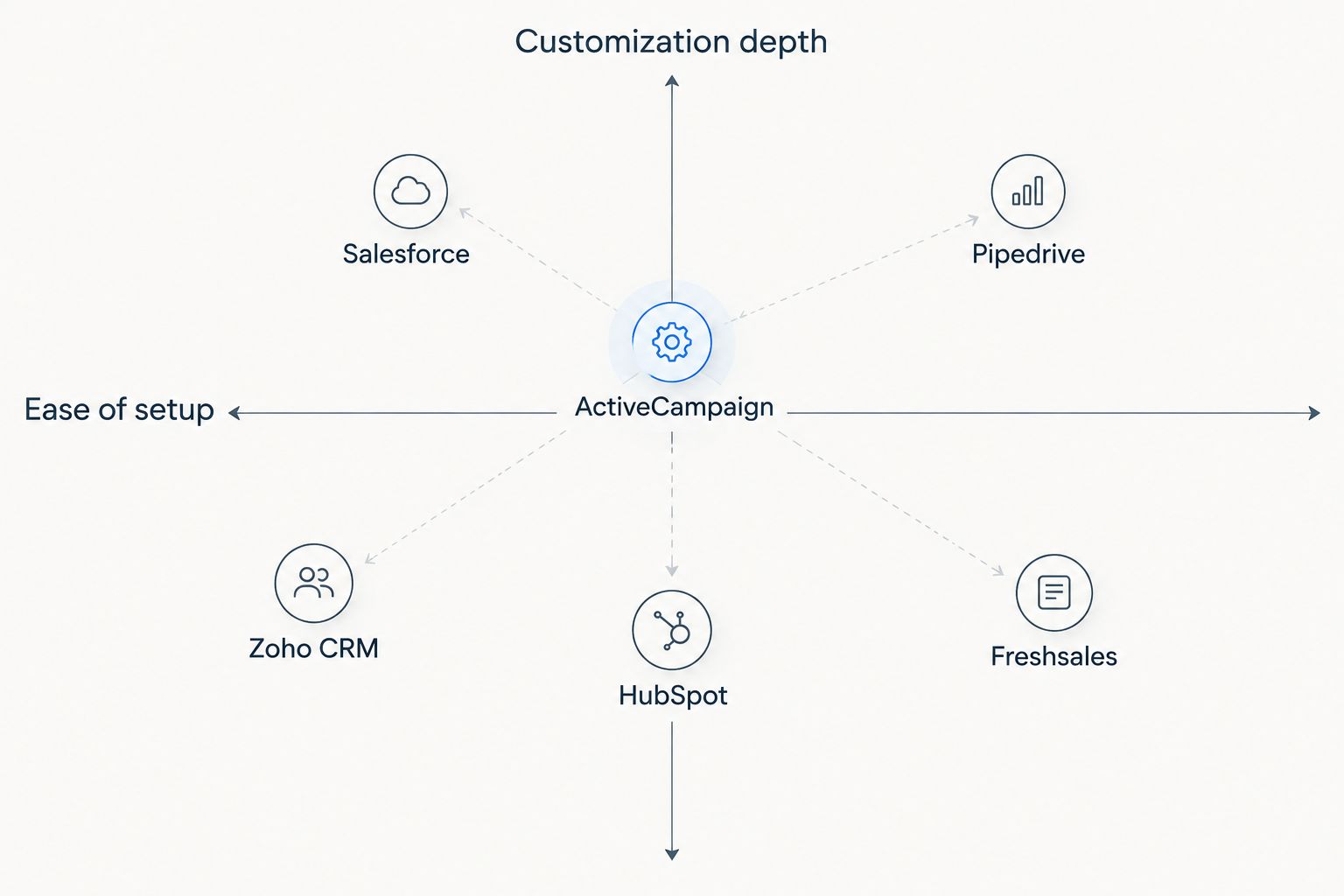
1. ActiveCampaign: best for automation-heavy marketing
ActiveCampaign built its reputation on automation logic before CRM features were an afterthought. Marketing teams running multi-step nurture sequences, behavioral triggers, and lifecycle segmentation get more granular control here than in HubSpot's workflow builder.
Where ActiveCampaign shines:
- Automation branching handles conditional logic HubSpot's lower tiers restrict
- Segmentation runs on real-time behavior, not just static list membership
- Setup time for a marketer without a dev team is short
Where ActiveCampaign falls short:
- The CRM side is thinner than HubSpot's for sales teams managing complex pipelines
- Reporting across marketing and sales lives in separate views more often than HubSpot's unified dashboard
Best for: marketing teams that automate more than they sell directly through the platform.
| Dimension | ActiveCampaign | HubSpot |
|---|---|---|
| Automation depth | Deep, condition-based branching | Deep, but gated behind higher tiers |
| CRM complexity | Lightweight | Full sales pipeline and deal management |
| Onboarding time | Fast for marketers | Moderate, more modules to learn |
Verdict: Buy if marketing automation is the job, not sales pipeline management.
2. Zoho CRM: best for lean teams wanting HubSpot's breadth
Zoho CRM sits inside the wider Zoho One ecosystem, which means email, analytics, and even finance tools connect without stitching together separate vendors. It's the closest thing to HubSpot's all-in-one philosophy at a lower operating overhead.
Where Zoho CRM shines:
- Ecosystem breadth rivals HubSpot without needing as many paid add-ons
- Workflow automation covers most mid-market use cases out of the box
Where Zoho CRM falls short:
- The interface feels less polished than HubSpot's for non-technical marketing staff
- Advanced AI features lag behind what HubSpot ships in its newer releases
Best for: lean teams that want HubSpot-style breadth without HubSpot-style contact pricing.
Verdict: Buy for cost-conscious teams under 50 seats running both marketing and sales in one system.
3. Pipedrive: best for sales-first teams
Pipedrive never tried to be a marketing hub. It's a visual sales pipeline tool built around deal stages, and that focus is the appeal for teams that only ever used HubSpot's CRM tab anyway.
Where Pipedrive shines:
- Deal-stage visualization is faster to read than HubSpot's pipeline view for large deal volumes
- Sales reps adopt it with almost no training curve
Where Pipedrive falls short:
- Marketing automation is an add-on, not a native strength
- Reporting depth for multi-channel campaigns doesn't match HubSpot's marketing hub
Best for: sales teams that never needed HubSpot's marketing side.
Verdict: Hold if marketing automation matters at all — pair it with a separate email tool or look elsewhere.
4. Salesforce: best for enterprise customization
Salesforce is where teams land when HubSpot's object model stops fitting a complex sales process. The AppExchange ecosystem and custom object architecture handle edge cases HubSpot's CRM wasn't designed for.
Where Salesforce shines:
- Object-level customization fits sales processes with multiple product lines or territories
- The AppExchange marketplace covers integrations HubSpot doesn't natively support
Where Salesforce falls short:
- Setup and admin overhead is real — this is not a same-week migration from HubSpot
- Marketing automation typically requires a separate tool layered on top
Best for: enterprise sales teams with processes too complex for HubSpot's CRM to model cleanly.
| Dimension | Salesforce | HubSpot |
|---|---|---|
| Customization depth | Object-level, highly configurable | Configurable within HubSpot's fixed object model |
| Setup complexity | High, often needs admin support | Moderate, built for faster self-serve setup |
| Marketing automation | Requires separate tooling | Native, unified with CRM |
Verdict: Buy for enterprise sales complexity; Skip if your team wants one login for marketing and sales.
5. Freshsales: best for simple, fast onboarding
Freshsales (Freshworks) trades HubSpot's breadth for speed. Built-in calling and AI-assisted lead scoring cover the basics a small sales team needs without the setup time HubSpot's fuller suite requires.
Where Freshsales shines:
- Onboarding a new rep takes hours, not days
- Native calling removes a third-party integration HubSpot often needs
Where Freshsales falls short:
- Marketing automation is noticeably thinner than HubSpot's marketing hub
- Reporting customization is more limited for teams that need granular dashboards
Best for: small sales teams that want speed over feature depth.
Verdict: Hold — solid for a lean sales team, not a full HubSpot replacement for marketing.
Why people switch from HubSpot
- Contact-tier pricing scales with list size, which hits fast-growing email lists hardest
- Workflow limits on lower tiers push automation-heavy marketers toward ActiveCampaign
- CRM object rigidity pushes complex enterprise sales processes toward Salesforce
- Add-on costs for advanced reporting or additional seats change the math as teams scale
None of these are outage stories or dramatic failures — they're the normal friction of a platform built for one stage of growth being used at another.
When HubSpot is still the right call
If your team runs under a few hundred contacts, sells through a single simple funnel, and doesn't need custom objects, switching costs more in migration time than it saves in fees. HubSpot's real strength is one login for marketing, sales, and service — that's hard to replicate exactly, even with a stronger point solution.
How Prospekt fits in
Picking a platform is the easy part. Migrating contact data, rebuilding automation logic, and re-mapping sales pipeline stages without losing lead history is where most in-house teams stall. Prospekt, a growth marketing agency working across B2B and B2C accounts, handles that migration layer alongside the strategy that determines which platform actually fits your funnel.
The question isn't just which hubspot alternatives exist — it's how long a switch takes and what breaks during the move. That timeline depends heavily on data volume and workflow complexity; see how long growth marketing results typically take for a realistic view of ramp time after any platform change. For SaaS teams specifically weighing conversion impact during a switch, the CRO guide for SaaS startups covers what to test before and after migration.
FAQ
What’s the best HubSpot alternative for small teams in 2027?
Zoho CRM is the strongest pick for small teams in 2027 because it bundles marketing, sales, and analytics without HubSpot’s contact-tier pricing scaling as fast. Freshsales works too if the team is sales-only.
Is ActiveCampaign cheaper than HubSpot?
ActiveCampaign generally costs less at scale because its pricing centers on automation and email volume rather than a full CRM suite. Check current pricing on each vendor’s site since plans change.
Can Salesforce replace HubSpot for marketing automation?
Salesforce can handle marketing automation but usually needs a separate tool layered on top, unlike HubSpot’s native marketing hub. Most teams that switch to Salesforce do it for the CRM’s customization, not marketing.
How long does a HubSpot migration take?
Migration timelines depend on contact volume and workflow complexity, not just the platform you’re moving to. A lean CRM-only migration moves faster than one that includes years of marketing automation history.
Do agencies help with CRM and platform migrations?
Yes — growth marketing agencies that implement these platforms regularly handle the data migration and workflow rebuild work that in-house teams often underestimate. This keeps lead history and automation logic intact during the switch.
Is Zoho CRM good for B2B SaaS companies?
Zoho CRM works well for B2B SaaS companies that want marketing and sales in one system without HubSpot’s pricing curve. It fits lean teams better than enterprise SaaS with complex multi-product sales cycles.
What’s the easiest HubSpot alternative to onboard?
Freshsales has the shortest onboarding time among common HubSpot alternatives, with reps productive within hours rather than days. The tradeoff is thinner marketing automation compared to HubSpot’s marketing hub.
Should a growing team stick with HubSpot?
A growing team should stick with HubSpot if contact volume and sales complexity are still manageable and one unified login matters more than deeper customization. The switch becomes worth it once pricing tiers or workflow limits start blocking real work.
One last thing
The HubSpot alternatives search almost always starts with a pricing complaint and ends with a workflow complaint. Teams that switch purely on cost often land on a platform that's cheaper but thinner on automation, then switch again within a year. Map the workflow limits first — pricing follows from there, not the other way around.
Related guides


