Skip to main content Skip to footer

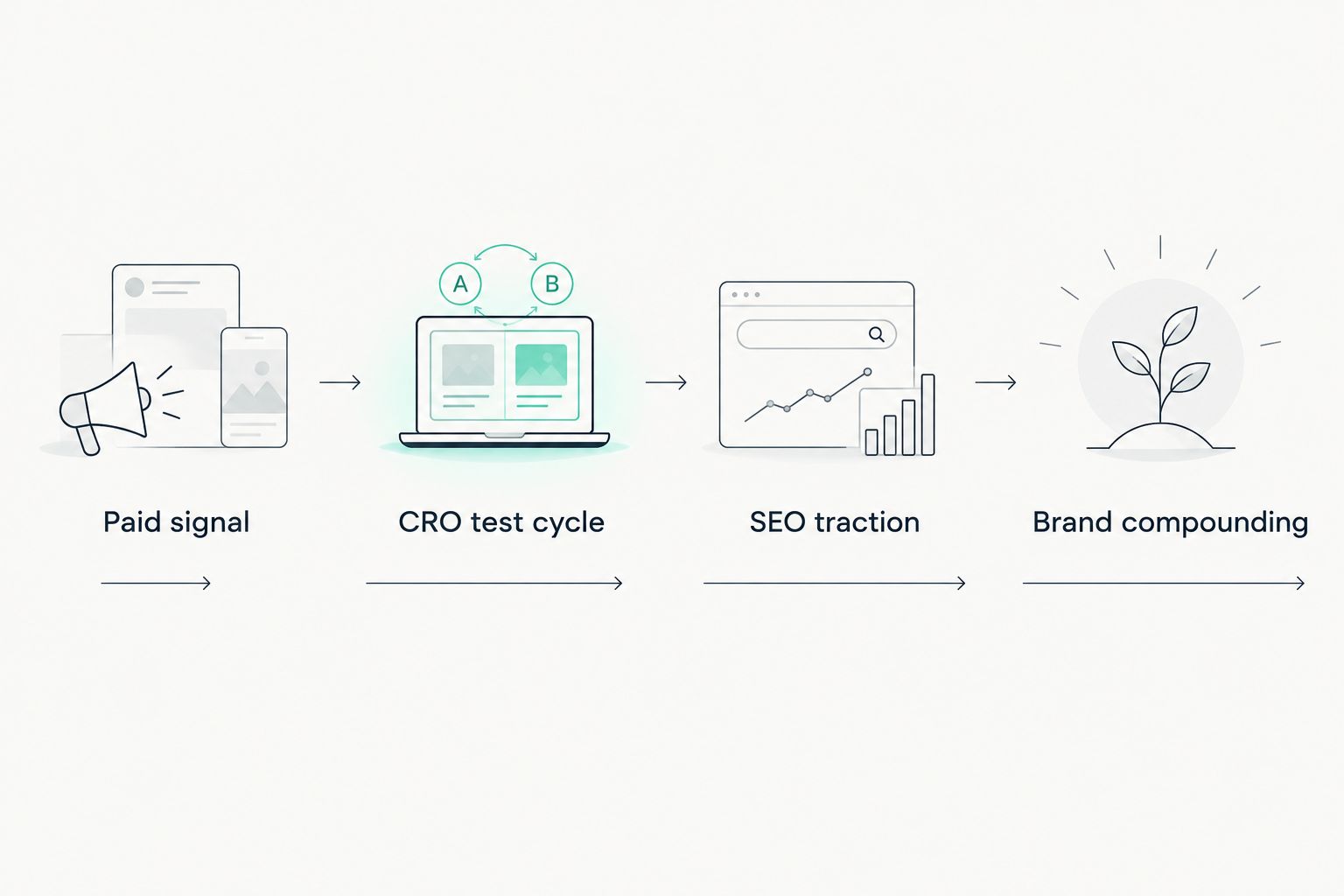
Growth marketing shows its first measurable signal in about 4 weeks and starts delivering real ROI somewhere between 3 and 6 months, depending on the channel mix. Paid social and PPC move fastest; SEO and brand work take the longest to compound, and that gap is the one thing most timelines skip.
The hidden cost nobody quotes upfront: most of that early data is directional, not decisive. A campaign can look profitable in week 3 and flip once seasonality, ad fatigue, or attribution lag catches up in month 2.
- Paid search and paid social produce readable data in 2-4 weeks, but stable ROI needs a full budget cycle.
- SEO needs 4-6 months for early traction and 6-12 months to compound.
- CRO runs in test cycles of roughly 2-4 weeks each until a change hits statistical significance.
- Brand and creative work rarely shows revenue impact before month 3.
- The growth marketing results timeline depends more on baseline data quality than on budget size.
Why this matters
Founders ask this question because most growth marketing agencies quote a 90-day retainer without telling you what "results" means inside that window. A 90-day paid social sprint and a 90-day SEO campaign are not the same product, even if they're sold at the same price point.
Knowing which channel produces which kind of signal, and when, is what separates a client who fires an agency at month 2 from one who scales spend at month 4 because the data finally supports it. Prospekt treats this timeline as the baseline expectation set before any contract starts, not a surprise delivered in a quarterly review.
How long does it take to see growth marketing results?
The honest answer changes by channel. Here's the breakdown founders actually need before they sign anything in 2026:
| Channel | First measurable signal | Meaningful ROI | What "results" looks like |
|---|---|---|---|
| Paid search / PPC | 2-4 weeks | 8-12 weeks | Cost per lead stabilizes, wasted spend gets cut |
| Paid social | 2-4 weeks | 8-12 weeks | CTR and CPA trends become reliable, not noisy |
| CRO / testing | 2-4 weeks per test | 3-4 test cycles | Statistically significant lift on a specific page or flow |
| SEO | 4-6 months | 6-12 months | Organic traffic and ranking positions compound |
| Brand / creative | 6-8 weeks for assets | 3-6 months | Consistent messaging shows up in engagement and recall |
| Email / lifecycle | 2-4 weeks | 30-60 days | List engagement and revenue per send stabilize |
The pattern: anything paid moves fast because the market gives instant feedback. Anything organic or compounding — SEO, brand equity, retention — needs the algorithm or the audience to catch up with the work.
Paid Search & Social: Results in 2-4 Weeks
Paid channels are the fastest because you're buying data, not earning it. Within the first 2 to 4 weeks, click-through rates, cost per acquisition, and audience response start forming a real pattern instead of a guess.
The catch: early wins in paid social often don't survive the first budget increase. Scaling spend changes the auction, and a campaign that looked profitable at $2,000/month can behave differently at $10,000/month. Full ROI confidence usually needs 8 to 12 weeks, not 4.
SEO: Results in 4-6 Months
SEO is the slowest channel in growth marketing, and it's the one most founders underestimate. Google needs to crawl, index, and trust new or updated content before rankings move, and that process alone eats the first 4 to 6 months.
Traffic and rankings genuinely compound after month 6 — a page ranking on page 2 in month 4 can jump to a featured position by month 8 with no additional work, purely from accumulated authority. Agencies that promise SEO results inside 60 days are either running paid placements dressed up as "SEO" or setting a client up for disappointment.
CRO: Results Every 2-4 Weeks (Test Cycles)
Conversion rate optimization runs on test cycles, not calendar months. Each test — a headline change, a checkout flow tweak, a pricing page redesign — needs enough traffic to reach statistical significance, which typically takes 2 to 4 weeks depending on site volume.
A single CRO win rarely moves the business alone; it's the third or fourth test that compounds into a real conversion lift. Low-traffic sites take longer per cycle simply because they need more time to gather enough sessions.
Brand & Creative: Results in 3-6 Months
Brand strategy and creative work don't show up in a dashboard the same way paid ads do. New messaging, a rebuilt site, or a repositioned brand voice needs 3 to 6 months before its effect on conversion, retention, or recall becomes visible in the numbers.
This is the channel most likely to get cut early because it's the hardest to attribute directly to revenue. The mistake is judging brand work by paid-channel timelines — they're not built to answer the same question in the same window.
Why growth marketing timelines vary
No two accounts move at the same speed. The gap between a 60-day win and a 6-month wait usually comes down to a handful of factors:
- Starting data quality — accounts with clean tracking and historical conversion data move faster than accounts starting from zero.
- Budget size — paid channels need enough spend to generate statistically usable data; underfunded campaigns take longer to show a clear signal.
- Competitive density — SEO and paid search both move slower in crowded categories where competitors already own the top positions.
- Existing brand equity — a known brand sees faster conversion lift from new creative than an unknown one starting cold.
- Team bandwidth on the client side — approvals, content sign-off, and technical implementation delays add weeks that have nothing to do with the strategy itself.
- Channel mix — a plan running paid, SEO, and CRO together produces early paid wins that mask how far behind SEO still is.
Get a channel-by-channel timeline
See what results to expect by month, before you commit budget.
Is growth marketing faster than traditional marketing?
Growth marketing is faster to test but not necessarily faster to scale. Its advantage is speed of iteration — a paid campaign or landing page test produces usable data in 2 to 4 weeks — while traditional brand campaigns are built for longer, less measurable arcs. The tradeoff is that growth marketing's fast wins are often smaller in scale until they're validated and scaled up over months.
How long before you see ROI from a growth marketing agency?
Most growth marketing agency engagements show partial ROI signal within 8 to 12 weeks, driven by paid channels and CRO tests that report early. Full-portfolio ROI, once SEO and brand contributions are included, typically takes 4 to 6 months to become clear in the numbers.
Can growth marketing show results in 30 days?
Yes, but only on paid channels — SEO and brand work don't move that fast. A 30-day window is enough to see early click-through rate and cost-per-lead trends on paid search or paid social, but not enough for organic traffic, rankings, or brand recall to shift meaningfully.
FAQ
How long does it take to see growth marketing results in 2026?
Paid channels show first signal in 2-4 weeks and full ROI in 8-12 weeks. SEO and brand work take 4-6 months for early traction and up to 12 months to fully compound.
What’s the fastest growth marketing channel?
Paid search and paid social are fastest, producing readable performance data in 2-4 weeks because they buy market feedback instead of earning it over time.
Is SEO slower than paid ads for growth marketing?
Yes. SEO typically needs 4-6 months for measurable traction versus 2-4 weeks for paid channels, because it depends on search engines crawling and trusting new content.
How long does a CRO test take to show results?
A single CRO test cycle usually takes 2-4 weeks to reach statistical significance, and meaningful conversion lift often needs 3-4 completed test cycles.
When do growth marketing agencies typically report first results?
Most growth marketing agencies report initial paid-channel signal at the 30-day mark, with a fuller ROI picture across all channels by month 3 to 4.
Does brand work show up in growth marketing metrics?
Brand and creative work usually takes 3-6 months to show measurable impact on conversion or recall, slower than paid channels but longer-lasting once it does.
Why do growth marketing timelines vary so much between businesses?
Timelines vary based on starting data quality, budget size, competitive density, and how much of the channel mix leans on slow-compounding work like SEO versus fast-reporting paid channels.
Should I judge a growth marketing agency at 30 days?
No. Thirty days is enough to judge paid-channel signal but not SEO, brand, or full-funnel ROI, which need 3-6 months minimum to read accurately.
One last thing
The biggest timeline mistake isn't picking the wrong channel — it's running every channel on the same clock. A client who expects SEO to behave like paid social by month 2 will cut the one channel that was about to compound. The fix is setting separate benchmarks per channel from day one, so a slow-moving SEO line item doesn't get judged against a fast-moving paid campaign sitting next to it.
Related guides
- Growth marketing agencies compared
- Organic SEO agencies compared
- PPC agencies compared
- CRO for SaaS startups guide